
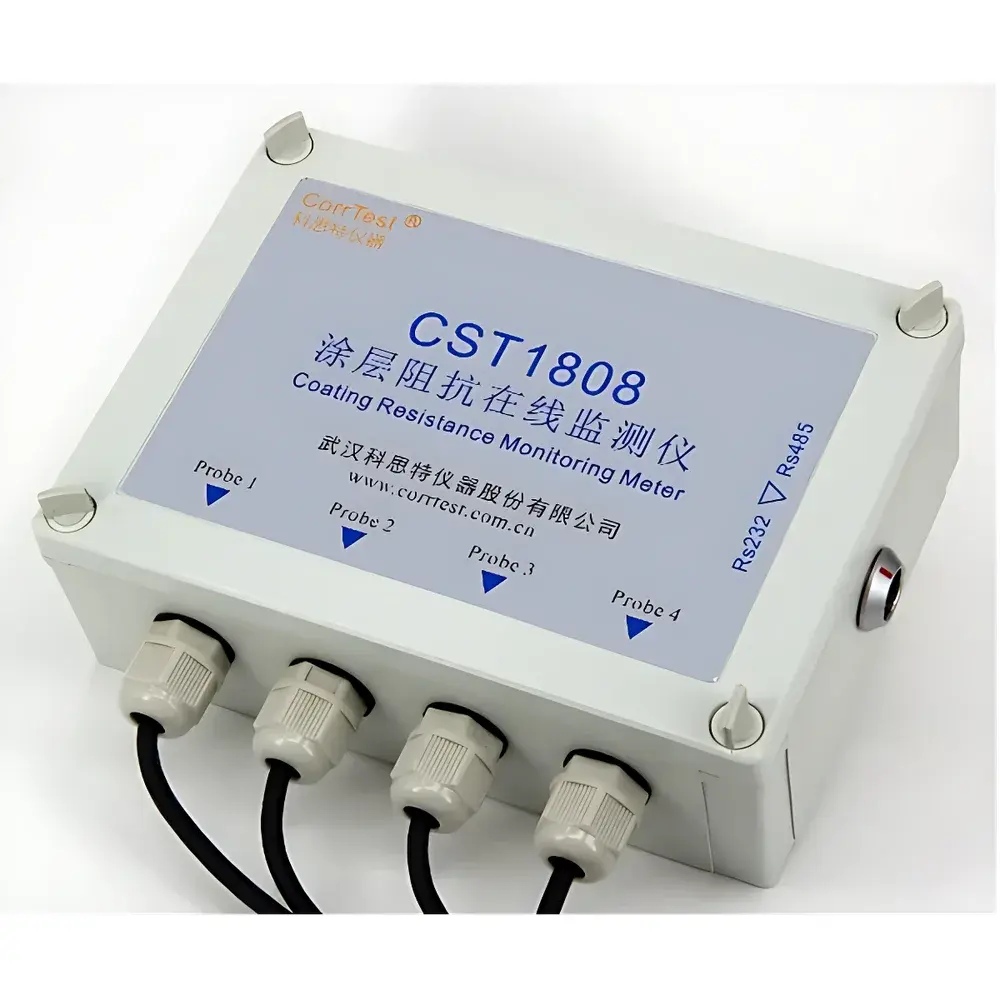
CorrTest CST1808 In-Line Coating Impedance Monitor
| Brand | CorrTest |
|---|---|
| Model | CST1808 |
| Measurement Channels | 4 |
| Impedance Range | 10³ Ω to 10¹⁰ Ω |
| Input Impedance | ≥10¹² Ω |
| Frequency Range | 10 Hz to 100 kHz |
| AC Signal Amplitude | 10 mV to 1000 mV |
| Data Storage | 8 MB (up to 100,000 records) |
| Communication | RS485 with standard Modbus RTU protocol |
| Power Supply | DC 12 V |
| Dimensions | 180 mm × 130 mm × 60 mm |
| Weight | 1.0 kg |
| Operating Temperature | −20 °C to +60 °C |
| Operating Humidity | ≤95% RH (non-condensing) |
| Enclosure Material | Engineering-grade weather-resistant polymer |
| Ingress Protection | IP67 |
| Probe Interface | Dual-electrode (ring-disk or substrate-coupled configuration) |
Overview
The CorrTest CST1808 In-Line Coating Impedance Monitor is an engineered electrochemical instrumentation platform designed for long-term, non-invasive assessment of organic coating integrity on metallic substrates under atmospheric, aqueous, or accelerated exposure conditions. It operates on the principle of electrochemical impedance spectroscopy (EIS), applying a small-amplitude sinusoidal voltage perturbation across a defined frequency range (10 Hz–100 kHz) and measuring the resulting current response to compute complex impedance (Z = Z′ + jZ″), phase angle, and associated dielectric parameters. Unlike conventional spot-check methods, the CST1808 enables continuous, real-time monitoring of interfacial phenomena—such as water uptake, electrolyte penetration, and delamination onset—at the coating/metal interface. Its high-input-impedance analog front-end (>10¹² Ω) ensures minimal signal loading during high-resistance measurements (up to 10¹⁰ Ω), critical for evaluating intact, low-permeability coatings in early-stage aging.
Key Features
- Four independent measurement channels for parallel monitoring of multiple coated assets or exposure zones
- Wide dynamic impedance range (10³ Ω to 10¹⁰ Ω) supporting evaluation of both degraded and highly insulating coatings
- Programmable AC excitation amplitude (10–1000 mV) to optimize signal-to-noise ratio across varying coating resistivity
- IP67-rated rugged enclosure with UV-stabilized engineering polymer housing, validated for outdoor deployment in industrial and marine environments
- Embedded data logging with 8 MB flash memory—capable of storing >100,000 timestamped EIS spectra with environmental metadata (temperature, humidity, pressure)
- RS485 interface compliant with Modbus RTU protocol for seamless integration into SCADA, PLC, or centralized corrosion management systems
- Low-power DC12V operation enabling battery-backed or solar-powered field installations
Sample Compatibility & Compliance
The CST1808 supports two probe configurations optimized for distinct use cases: (1) laboratory-grade ring-disk dual-electrode probes (e.g., CP-181), where coating is applied directly onto the probe surface for controlled performance benchmarking; and (2) substrate-coupled field probes, which utilize the host structure as the working electrode—eliminating the need for embedded reference electrodes and preserving structural continuity. This design conforms to ASTM D1654 (evaluating painted panels after exposure), ISO 12944-6 (corrosion protection of steel structures), and aligns with NACE SP0108 guidelines for field-deployable electrochemical monitoring. All hardware and firmware comply with IEC 61326-1 (EMC requirements for measurement equipment) and meet CE marking essential requirements for industrial instrumentation.
Software & Data Management
CSkit corrosion monitoring software provides full control over measurement scheduling, spectral acquisition, and derived parameter calculation—including coating capacitance (Cc), water uptake (Wu), ionic conductivity (σs), and a normalized aging index (AI) based on time-dependent shifts in low-frequency impedance modulus and phase dispersion. Raw and processed datasets are exportable in native CSV and Excel-compatible formats (.xlsx), with metadata tagging per EN 14683-compliant traceability. The software implements audit-trail functionality per FDA 21 CFR Part 11 requirements when configured with user authentication and electronic signature modules—supporting GLP/GMP-aligned corrosion validation studies in pharmaceutical, aerospace, and infrastructure sectors.
Applications
- Real-time tracking of coating degradation kinetics on offshore platforms, wind turbine towers, and buried pipelines
- Accelerated aging validation of new coating formulations in QUV, salt spray, or cyclic corrosion test chambers
- Condition-based maintenance planning for naval vessels, bridges, and chemical processing equipment
- Correlation of EIS-derived parameters (e.g., Cc, |Z|0.01Hz) with adhesion loss measured via pull-off or scratch testing
- Multi-site comparative analysis of coating performance across geographic exposure zones (e.g., marine vs. industrial atmospheres)
FAQ
Can the CST1808 operate unattended for extended periods in remote locations?
Yes—the instrument supports scheduled autonomous measurements, local data buffering, and low-duty-cycle communication protocols ideal for solar-powered or battery-operated deployments lasting months without intervention.
Is calibration required before each measurement series?
No routine recalibration is needed; the system employs factory-traceable internal references and auto-zeroing circuitry. Optional periodic verification using certified impedance standards (e.g., IET Labs 1001A) is recommended per ISO/IEC 17025 quality assurance programs.
How does the substrate-coupled probe configuration ensure measurement accuracy without a reference electrode?
By leveraging the inherent galvanic stability of the coated substrate and employing differential measurement techniques across the dual-electrode geometry, the CST1808 minimizes drift and compensates for background potential fluctuations—validated against three-electrode EIS benchmarks in ASTM G106-compliant setups.
Does CSkit support automated alerting when coating degradation thresholds are exceeded?
Yes—users can define configurable limits for key indicators (e.g., Cc > 150 nF/cm² or |Z|0.01Hz < 10⁷ Ω·cm²) and trigger email/SMS notifications or Modbus register flags for integration with predictive maintenance workflows.





