
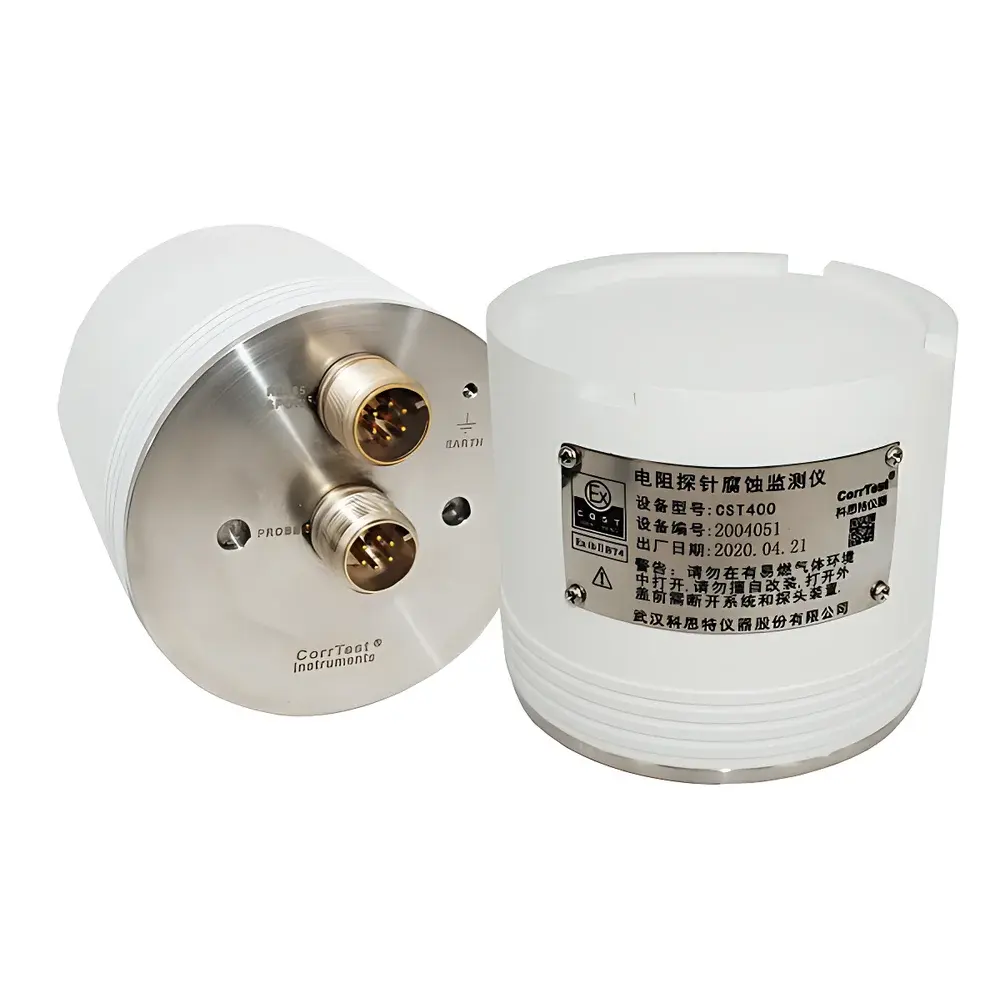
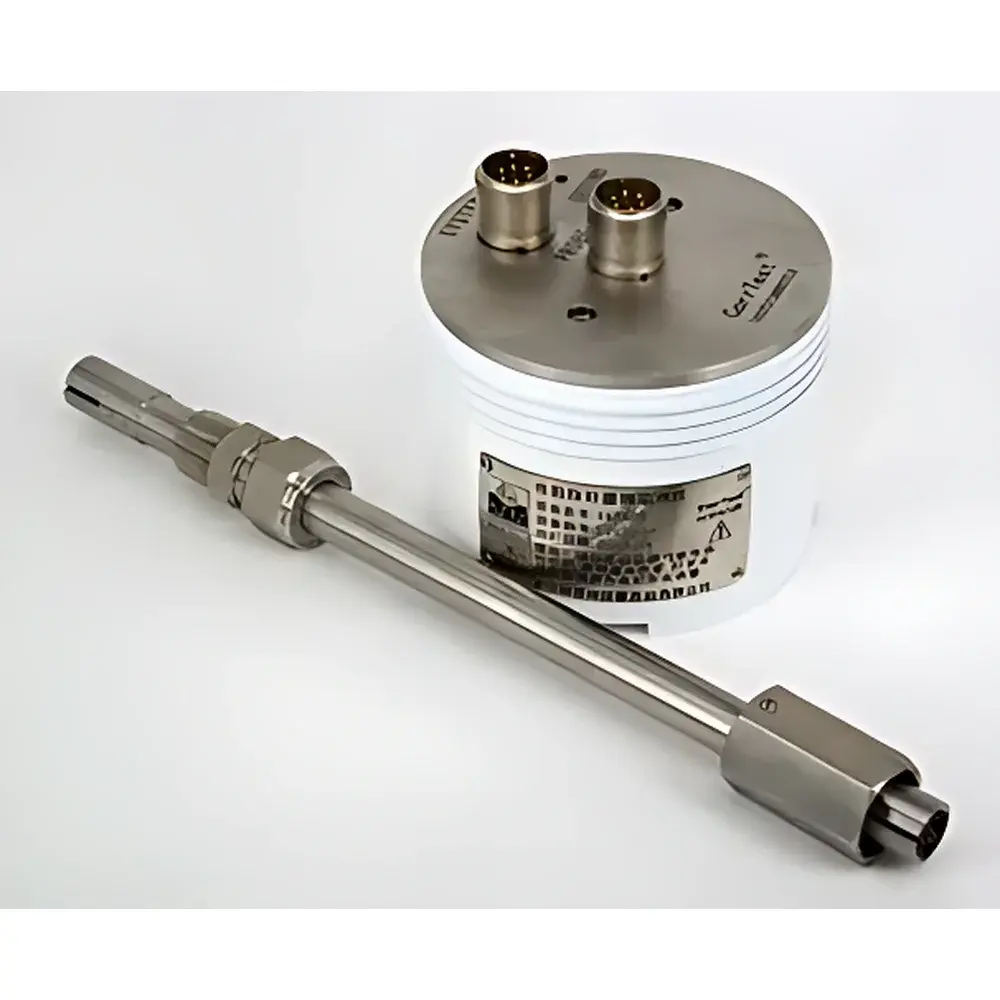
CorrTest CST400C Resistivity Probe Corrosion Monitor
| Brand | CorrTest |
|---|---|
| Origin | Hubei, China |
| Manufacturer Type | Authorized Distributor |
| Product Category | Domestic Instrument |
| Model | CST400C |
| Pricing | Available Upon Request |
| AD Resolution | 24-bit (0.06 ppm) |
| Corrosion Resolution | 0.01% of Sensing Element Thickness |
| RTC Accuracy | <1 min/month |
| Measurement Interval | 1–24 hours |
| Data Storage | 8 MB (up to 100,000 records) |
| Communication | RS485, Modbus RTU compliant |
| Power Supply | DC 12 V |
| Dimensions | Ø114 × 120 mm |
| Weight | 1.3 kg |
| Operating Temperature | −30 °C to +60 °C |
| Relative Humidity | ≤80% RH |
| Enclosure Material | Anodized Aluminum |
| Ingress Protection | IP67 |
| Explosion Protection | Ex ib II C T4 Gb (conforms to GB3836.1–2011 & GB3836.4–2011) |
| Software | CST Corrosion Analysis Suite (Windows XP or later) |
Overview
The CorrTest CST400C Resistivity Probe Corrosion Monitor is an intrinsically safe, field-deployable instrument engineered for continuous, quantitative corrosion monitoring in aggressive and hazardous process environments. It operates on the principle of electrical resistance (ER) measurement—tracking the progressive thinning of a conductive sensing element (typically stainless steel or carbon steel) immersed in or exposed to corrosive media. As metal loss occurs, the cross-sectional area of the sensing element decreases, resulting in a measurable increase in electrical resistance. By applying Ohm’s law and compensating for temperature-induced resistivity changes via integrated thermal sensing and real-time correction algorithms, the CST400C delivers high-fidelity, long-term corrosion rate data with sub-0.01% thickness resolution. Its design targets critical infrastructure applications—including oil & gas production systems, chemical processing units, water injection lines, and offshore platforms—where real-time wall-loss assessment is essential for integrity management and risk-based inspection (RBI) planning.
Key Features
- Intrinsically safe architecture certified to Ex ib II C T4 Gb per GB3836.1–2011 and GB3836.4–2011, enabling deployment in Zone 1 and Zone 2 explosive atmospheres.
- 24-bit low-power ADC with 0.06 ppm resolution and AC-excited Wheatstone bridge topology, minimizing polarization effects and enhancing micro-resistance stability.
- Integrated temperature-compensated measurement circuitry, reducing thermal drift to <±0.02% full scale over −30 °C to +60 °C.
- IP67-rated aluminum enclosure with hermetically sealed connectors, rated for extended outdoor and subsea-adjacent installations.
- Configurable measurement intervals (1–24 hours), onboard real-time clock (RTC) with <1 minute/month drift, and 8 MB non-volatile memory supporting up to 100,000 timestamped records.
- Dual communication pathways: RS485 physical layer with standard Modbus RTU protocol; compatible with wired SCADA networks, CST610 wireless transceivers (GPRS/4G LTE), or CST620 handheld downloaders.
Sample Compatibility & Compliance
The CST400C supports ER probes of standardized geometries—including CP-41 dual-element probes—for immersion in liquid hydrocarbons, produced water, amine solutions, sour gas condensates, and multiphase flow regimes (oil/water/gas). It accommodates both atmospheric and pressurized service via optional high-pressure carriers and hot-tap insertion tools. All hardware complies with ISO 9001 manufacturing controls and meets mechanical robustness requirements outlined in NACE SP0104 and ASTM G163 for field corrosion monitoring equipment. The instrument’s intrinsic safety certification enables use in facilities subject to IEC 60079-11 and ATEX 2014/34/EU equivalency assessments. Documentation includes full traceability to national metrological standards and third-party verification by the National Quality Supervision and Inspection Center for Explosion-Proof Electrical Equipment.
Software & Data Management
The CST Corrosion Analysis Suite is a Windows-based desktop application supporting raw data import from CST620 downloaders or Modbus-enabled gateways. It implements linear regression-based differential analysis of resistance change over time, calculating instantaneous and time-averaged corrosion rates (mm/y or mils/year), remaining wall thickness (corrosion margin), cumulative metal loss, and projected service life. All plots support dual-axis visualization (resistance vs. time; corrosion rate vs. date), export to CSV/PDF/PNG, and batch reporting per API RP 571 or ISO 21809-3 formatting conventions. Audit trails, user access logs, and electronic signature fields comply with GLP and FDA 21 CFR Part 11 requirements when deployed in regulated environments. Language switching between English and Chinese is implemented at the resource-file level without runtime dependencies.
Applications
- Real-time corrosion rate trending in upstream oilfield pipelines and separators under varying H₂S/CO₂ partial pressures.
- Integrity validation of downhole tubing strings and wellhead components during enhanced oil recovery (EOR) operations.
- Monitoring of cooling water circuits and heat exchanger tube bundles in petrochemical refineries.
- Baseline corrosion assessment prior to and following chemical inhibitor dosing campaigns.
- Integration into digital twin frameworks via OPC UA or MQTT bridges using custom Modbus-to-JSON translation modules.
FAQ
What probe types are compatible with the CST400C?
The instrument natively supports CorrTest CP-41 ER probes (single/dual element, 316L or CS variants) and accepts third-party ER sensors meeting IEC 60751 Class B tolerance and 100–1000 Ω nominal resistance range.
Can the CST400C operate without external power for extended periods?
It requires continuous DC 12 V supply; however, it may be paired with solar-charged battery banks or uninterruptible power supplies (UPS) rated for industrial ambient conditions.
Is remote firmware update supported?
Firmware upgrades must be performed locally via RS485 using CST-provided configuration utilities; over-the-air updates are not implemented due to functional safety constraints.
How is calibration traceability maintained?
Each unit ships with a factory calibration certificate referencing NIM (National Institute of Metrology, China) standards; field verification uses certified reference resistors traceable to NIST SRM 1705.
Does the system support integration with cloud-based CMMS platforms?
Yes—via Modbus TCP gateways or custom REST API adapters developed under CorrTest’s OEM integration program, enabling bidirectional synchronization with IBM Maximo, SAP PM, or UpKeep.






