
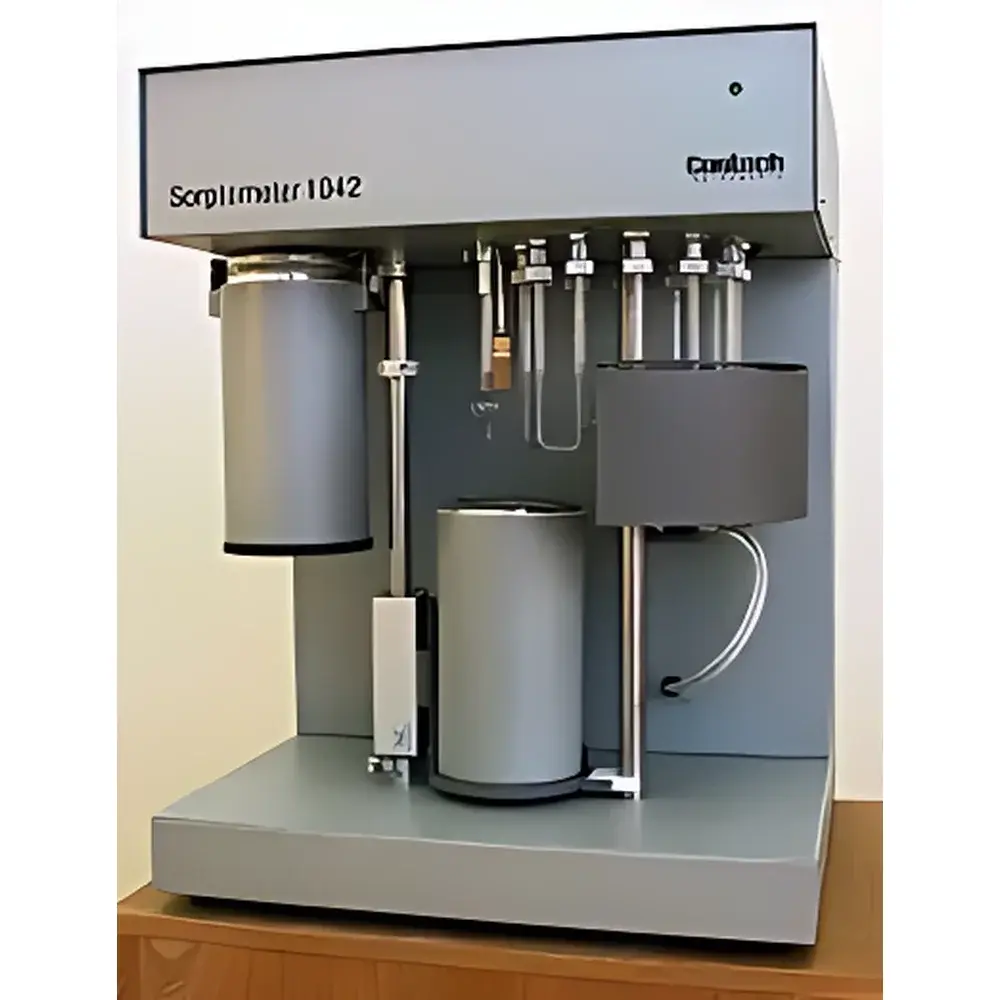
Costech KELVIN Sorptometer 1042 Specific Surface Area and Pore Size Analyzer
| Origin | Italy |
|---|---|
| Manufacturer Type | Authorized Distributor |
| Origin Category | Imported Instrument |
| Model | Costech KELVIN Sorptometer 1042 |
| Quotation | Upon Request |
Overview
The Costech KELVIN Sorptometer 1042 is a fully automated, high-precision specific surface area and pore size analyzer engineered for rigorous physical characterization of porous and powdered solids. It operates on the principle of nitrogen gas adsorption–desorption isotherm analysis at 77 K (liquid nitrogen temperature), adhering to the Brunauer–Emmett–Teller (BET) theory for specific surface area determination and employing density functional theory (DFT), Barrett–Joyner–Halenda (BJH), and other validated models for pore size distribution (PSD) analysis across micropores (0.8 nm) to mesopores (200 nm). Unlike conventional volumetric or gravimetric analyzers, the KELVIN Sorptometer 1042 uniquely captures true kinetic desorption isotherms—enabling microkinetic assessment of surface–gas interaction dynamics. Its integrated degassing station, independent from the analysis manifold, ensures contamination-free transfer and eliminates air exposure post-degassing—a critical requirement for hygroscopic, catalytic, or air-sensitive samples.
Key Features
- True six-sample parallel analysis with fully automated sample handling—from degassing through isotherm acquisition—without manual intervention
- Dedicated, sealed degassing module with independent vacuum circuit; temperature programmable from 35 °C to 350 °C in 1 °C increments
- No external vacuum pump required: utilizes built-in diaphragm pump and high-stability pressure transducers (5 × 10⁻⁴–0.995 P/P0 range)
- Real-time, continuous monitoring of degassing progress via integrated thermal conductivity detector (TCD) prior to analysis initiation
- Fully programmable isotherm acquisition: users may define custom pressure steps, dwell times, and measurement sequences—including single-point, multi-point, full adsorption/desorption, adsorption-only, desorption-only, or rapid screening modes
- On-demand re-measurement capability: any data point on an acquired isotherm can be repeated without re-running the entire isotherm
- Automatic liquid nitrogen replenishment from external dewar (optional configuration); integrated cooling trap and gas filtration available within degassing unit
- Stable equilibrium pressure control achieved via dual-stage pressure regulation and low-drift transducers (measurement accuracy ≤2% for SSA)
Sample Compatibility & Compliance
The KELVIN Sorptometer 1042 is routinely deployed for characterization of heterogeneous catalysts, ceramic precursors, sintered metal powders, construction materials (e.g., cementitious phases), ion-exchange resins, activated carbons, pharmaceutical excipients, metallurgical powders, abrasives, and polymeric nanocomposites. Its design supports GLP-compliant workflows: all instrument parameters, user actions, and raw isotherm data are timestamped and logged with audit-trail capability. Software export functions generate Excel-compatible datasets (CSV/XLSX) compliant with internal QA/QC protocols and externally auditable reporting standards. While not pre-certified to ISO 9277 or ASTM D3663, the system implements measurement methodologies fully aligned with these international standards for BET surface area and IUPAC-recommended pore size analysis practices.
Software & Data Management
Controlled via Windows-based native software, the interface provides intuitive sequence programming, real-time isotherm visualization, and automated data reduction. All calculations—including BET surface area (≥0.01 m²/g), t-plot micropore volume, DFT/BJH PSD, and hysteresis loop analysis—are performed in-line and saved directly to structured database files. The software supports batch processing of multiple samples, comparative overlay of isotherms, and customizable report generation with embedded metadata (sample ID, degas conditions, calibration history). Data export includes raw pressure–volume readings, processed isotherms, and calculation logs—facilitating traceability per FDA 21 CFR Part 11 requirements when deployed in regulated environments (with appropriate IT validation).
Applications
This instrument delivers quantitative structural insight essential for R&D and quality control in advanced materials development. In catalysis, it quantifies active surface area loss after thermal aging or poisoning. In pharmaceutical manufacturing, it verifies consistency of milled API surface area affecting dissolution kinetics. For battery electrode materials, it correlates pore architecture with electrolyte wetting and Li-ion transport resistance. In construction science, it evaluates pozzolanic reactivity of supplementary cementitious materials via specific surface evolution. Its ability to resolve sub-1 nm pores also supports characterization of MOFs, zeolites, and templated silicas where microporosity governs selectivity and capacity.
FAQ
Does the KELVIN Sorptometer 1042 require a separate vacuum pump?
No—it integrates a maintenance-free diaphragm vacuum pump and pressure regulation system; no external roughing pump is needed.
Can I analyze samples that are sensitive to atmospheric moisture or oxygen?
Yes—the degassed sample remains under inert atmosphere or high vacuum until analysis begins, and transfer occurs via sealed, valve-isolated pathways.
Is the software compatible with modern Windows OS versions (e.g., Windows 10/11)?
Yes—the current software release supports Windows 10 (64-bit) and Windows 11, with COM port communication via standard RS-232 or USB-to-serial adapter.
What gases besides nitrogen can be used?
While optimized for N₂ at 77 K, the system can accommodate argon (87 K) or krypton (for ultra-low surface area samples) with appropriate calibration and temperature control.
How is calibration performed and maintained?
Calibration uses certified reference materials (e.g., NIST SRM 1990a silica gel) and is documented per run; drift compensation is applied using internal zero-pressure and span checks before each analysis cycle.



