
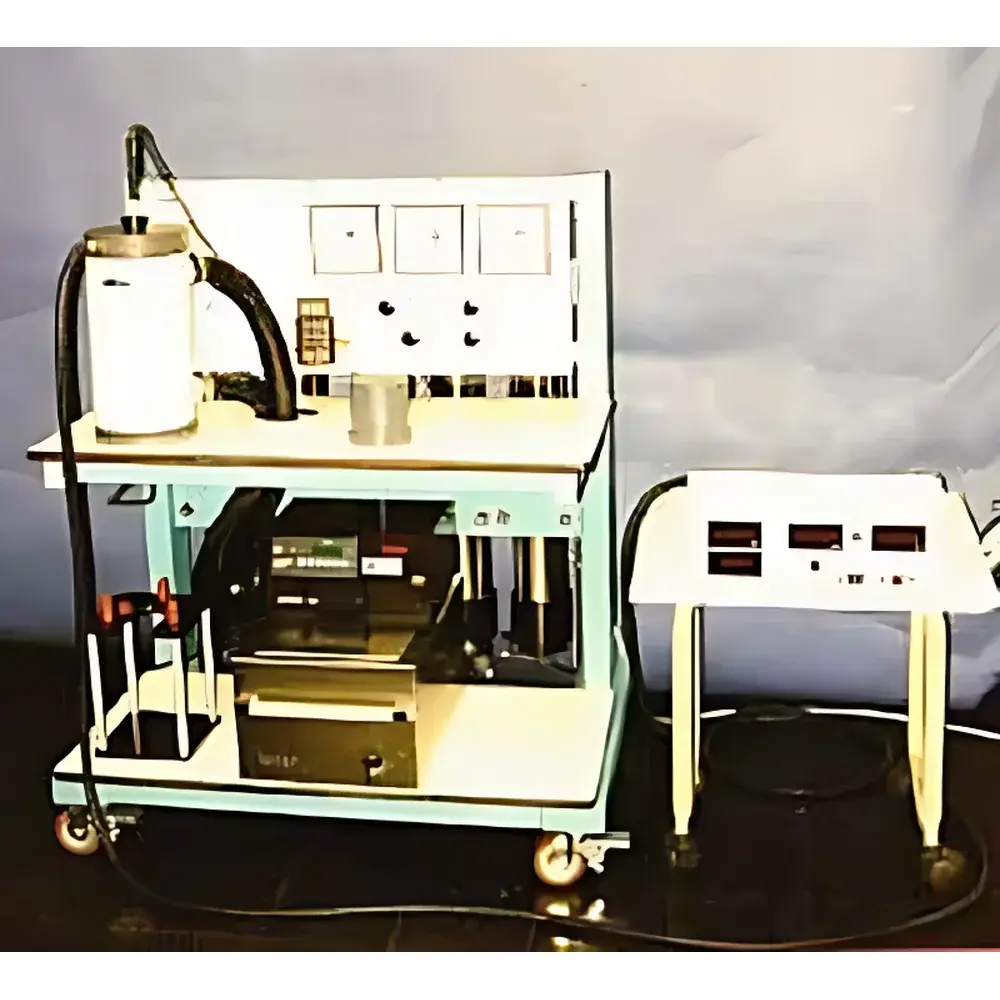
CRAWFORD-Type Propellant Burning Rate Tester
| Origin | Unknown |
|---|---|
| Manufacturer Type | Distributor |
| Origin Category | Imported |
| Model | CRAWFORD-Type |
| Price | Upon Request |
| Compressed Air Reservoir Capacity | 10 L |
| Max Reservoir Pressure | 200 bar |
| High-Pressure Combustion Vessel Operating Temperature Range | –30°C to +70°C |
| Vessel Volume | 700 mL |
| Max Working Pressure (Vessel) | 250 bar |
| Proof Test Pressure | 350 bar |
| Optional Temperature Control System | CC240 |
| Temp Control Range | –40°C to +200°C |
| Thermal Chamber Volume | 5 L |
| Heating Power | 1.5 kW |
| Cooling Capacity | 1.8 kW (at 0–100°C), 0.8 kW (at –20°C) |
| Max Vacuum Flow Rate | 15 L/min at 0.4 bar |
| Max Positive Flow Rate | 18 L/min at 0.5 bar |
| Construction Materials | Stainless Steel, Ceramic, PTFE |
Overview
The CRAWFORD-Type Propellant Burning Rate Tester is a precision-engineered bench-scale combustion test system designed for the quantitative determination of linear burning rate (mm/s or in/s) of solid propellants under controlled pressure and temperature conditions. It operates on the principle of confined combustion in a high-pressure vessel, where propellant samples—typically cast cylindrical grains or strands—are ignited under regulated inert gas (N₂) overpressure, simulating motor internal ballistics environments. The system enables measurement of regression rate as a function of chamber pressure (typically 1–35 MPa), temperature (–30°C to +70°C, extendable to –40°C/+200°C with optional CC240 thermal control), and formulation variables. Its design adheres to foundational methodologies outlined in legacy U.S. military standards (e.g., MIL-STD-202, TM 9-1300-214) and supports compliance-driven test protocols required for qualification of rocket motor propellants in aerospace and defense applications.
Key Features
- Triple N₂-compressed air reservoir system (10 L total volume, rated to 200 bar) with integrated buffer capacity for stable pressurization and repeatable pressure ramping profiles.
- High-integrity stainless steel combustion vessel (700 mL internal volume) rated for continuous operation up to 250 bar and hydrostatically proof-tested to 350 bar—ensuring structural integrity during transient overpressure events.
- Active temperature-controlled vessel jacket enabling precise thermal conditioning from –30°C to +70°C; optionally expandable via CC240 thermal management unit (–40°C to +200°C, 5 L chamber volume, 1.5 kW heating / 1.8 kW cooling capacity).
- Multi-point electronic ignition and real-time burn-front tracking: three synchronized optical or thermocouple-based measurement zones per propellant strand, supporting statistical evaluation of burning uniformity and lateral regression anomalies.
- Integrated control panel with digital pressure transducers (0–400 bar range, ±0.25% FS accuracy), temperature indicators, and safety interlocks compliant with IEC 61508 SIL 2 functional safety requirements.
- Modular mobile trolley platform accommodating all major subsystems—reservoirs, combustion vessel, control console, and vacuum/ventilation interface—facilitating laboratory reconfiguration and ISO 17025-compliant spatial segregation of hazardous operations.
Sample Compatibility & Compliance
The tester accommodates standard propellant geometries including single-perforated cylinders, end-burning slabs, and multi-strand configurations (diameter: 3–25 mm; length: 20–150 mm). Sample holders are fabricated from inert, high-temperature-resistant materials—ceramic insulators and PTFE-sealed stainless steel fixtures—to prevent catalytic interference or thermal runaway. The system supports ASTM E2017 (Standard Test Method for Determining Burning Rate of Solid Propellants Using the Crawford Burner), as well as internally developed procedures aligned with NASA SP-8001, AIAA S-111A, and ECSS-Q-ST-70-02C. All pressure instrumentation is traceably calibrated to NIST standards; data acquisition timestamps and operator actions are logged with audit-trail capability meeting FDA 21 CFR Part 11 and GLP documentation requirements.
Software & Data Management
Data acquisition is managed via embedded real-time controller interfaced with optional PC-based software (Windows 10/11 compatible). The software records synchronized time-series data streams—including chamber pressure, vessel wall temperature, burn surface thermography (when equipped), and ignition event markers—at configurable sampling rates up to 1 kHz. Raw datasets are exported in CSV and HDF5 formats for post-processing in MATLAB, Python (NumPy/Pandas), or proprietary ballistic modeling suites (e.g., PROPEP, CETT). Calibration certificates, test reports, and user-defined SOP templates are stored within a role-based access database, supporting version-controlled revision history and electronic signature workflows compliant with ISO/IEC 17025 clause 7.7.
Applications
- Development and qualification of composite solid propellants (AP/HTPB, AP/CTPB, NEPE formulations).
- Pressure exponent (n) and temperature sensitivity (σp) characterization per Vieille’s law and Arrhenius-derived models.
- Evaluation of ballistic modifiers (e.g., Fe₂O₃, CuO, nanoscale catalysts) and binder crosslinking effects on burning surface morphology.
- Supporting hazard classification per UN Test Series 3 and DOT-E 49 CFR §173.56 for transportation approval.
- Root-cause analysis of anomalous combustion behavior—including oscillatory burning, extinguishment thresholds, and slag accumulation—under sub-ambient and elevated thermal boundary conditions.
FAQ
What pressure ranges can this system accurately measure burning rate across?
The system supports continuous operation from 1 MPa to 25 MPa (10–250 bar), with validated calibration and mechanical integrity confirmed up to the 35 MPa (350 bar) proof test pressure.
Is vacuum capability integrated for pre-test degassing of propellant samples?
Yes—the system includes a dedicated vacuum line with maximum flow of 15 L/min at 0.4 bar absolute, enabling controlled outgassing of moisture or volatiles prior to pressurization.
Can the CC240 thermal control module be retrofitted to existing units?
Yes—CC240 integration is available as a field-upgrade kit, requiring only electrical interface validation and mechanical mounting verification per manufacturer’s installation protocol.
Does the system support automated pressure ramping profiles?
Standard configuration includes manual pressure regulation; programmable ramping (e.g., linear, step-wise) is enabled via optional digital pressure controller add-on with RS-485/Modbus RTU interface.
Are replacement consumables and certified calibration services available globally?
Original equipment manufacturer (OEM)-authorized service partners provide PTFE seals, ceramic liners, pressure transducer recalibration, and full-system performance verification—traceable to national metrology institutes in EU, US, and APAC regions.



