
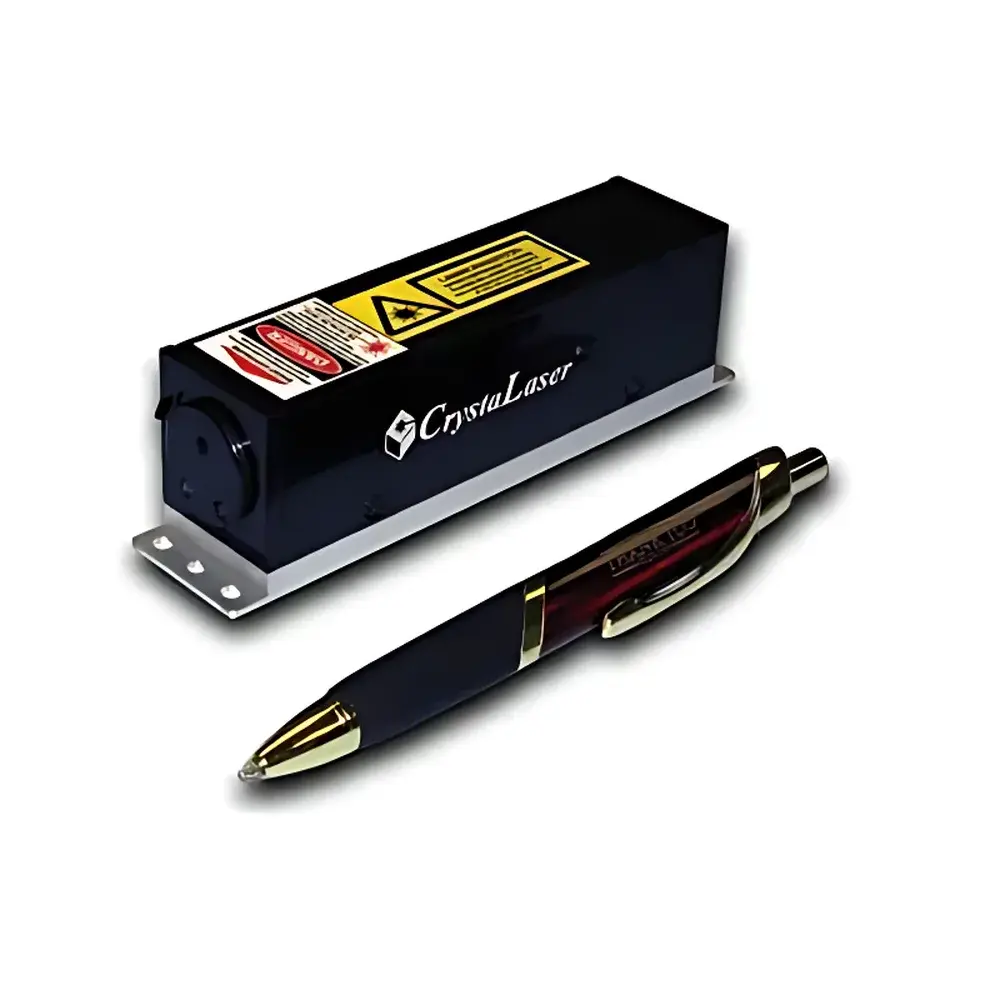
CrystaLaser QL657/QL660/QL671 Q-Switched Red Diode-Pumped Solid-State Lasers
| Brand | CrystaLaser |
|---|---|
| Wavelengths | 657 nm, 660 nm, 671 nm |
| Max. Avg. Power (at optimal rep. rate) | 200 mW, 500 mW, 500 mW |
| Pulse Energy (at 10 kHz) | 20 µJ, 0.50 µJ, 0.50 µJ |
| Avg. Power Options | 100–500 mW |
| Pulse Width | 10–100 ns (typ. 20–40 ns) |
| Repetition Rate | 1–100 kHz (internal), up to 200 kHz (external trigger) |
| Transverse Mode | TEM₀₀, M² < 1.2 (typ. < 1.1) |
| Beam Diameter (1/e²) | 0.3 mm |
| Beam Divergence (full angle) | 3–4 mrad |
| Linewidth & Coherence | Narrow linewidth with optional long-coherence configuration |
| Power Stability (rms) | ≤3% after thermal stabilization |
| Beam Pointing Stability | < 0.02 mrad (constant temperature) |
| Polarization | Linear, >100:1 extinction ratio |
Overview
The CrystaLaser QL657, QL660, and QL671 series are compact, air-cooled, diode-pumped solid-state (DPSS) Q-switched lasers engineered for precision applications requiring stable red-wavelength nanosecond pulses. Unlike gas-based red lasers, these systems utilize Nd:YVO₄ or similar gain media with intracavity frequency-doubling or direct red-emitting crystals, delivering high peak power with excellent beam quality in the visible red spectrum. Each model is optimized for a specific emission wavelength—657 nm, 660 nm, or 671 nm—enabling selective excitation of fluorophores, atomic transitions (e.g., Rb D₂ line at 780 nm via sum-frequency generation), or calibration targets in optical metrology. The Q-switching mechanism employs acousto-optic (AO) or electro-optic (EO) modulation, ensuring precise temporal control and minimal pulse jitter. Designed for integration into OEM instrumentation, confocal microscopy platforms, time-resolved fluorescence lifetime measurement (FLIM) setups, and laser-induced breakdown spectroscopy (LIBS) systems, these lasers operate without water cooling or high-voltage supplies, supporting robust 24/7 laboratory and industrial deployment.
Key Features
- Three discrete wavelength options (657 nm, 660 nm, 671 nm) with spectral purity < 0.1 nm FWHM and optional narrow-linewidth (< 10 MHz) configurations for interferometric applications
- Adjustable repetition rate from 1 kHz to 100 kHz (internally controlled); external TTL-triggered operation supports 0 Hz (single-shot) up to 200 kHz with < 5 ns jitter
- Consistent TEM₀₀ spatial profile with M² < 1.2 (typically < 1.1), enabling efficient coupling into single-mode fibers and high-NA microscope objectives
- Stable output power (≤3% RMS fluctuation after 30-minute warm-up) and sub-0.02 mrad pointing stability under constant ambient conditions—critical for alignment-sensitive optical trapping and holography
- Linear polarization with >100:1 extinction ratio, facilitating polarization-sensitive measurements such as dichroic reflectance or magneto-optical Kerr effect (MOKE) studies
- Compact OEM-ready housing (120 × 80 × 45 mm typical) with standard SMA905 or FC/PC fiber-coupling options and integrated driver electronics
Sample Compatibility & Compliance
These lasers are compatible with standard optical tables, motorized translation stages, and commercial confocal or multiphoton microscope frames (e.g., Zeiss LSM, Nikon A1R, Olympus FV3000). Beam parameters meet ISO 11146-1 requirements for M² measurement and align with ANSI Z136.1 safety standards for Class IV laser operation. All units are CE-marked and comply with RoHS 2011/65/EU directives. For regulated environments—including clinical research labs operating under GLP or GMP frameworks—the lasers support optional analog modulation inputs and TTL synchronization interfaces required for audit-trail-capable data acquisition systems. While not FDA-cleared as medical devices, they are routinely deployed in preclinical imaging and flow cytometry validation per ISO 13485-aligned protocols.
Software & Data Management
No proprietary software is bundled; however, CrystaLaser provides comprehensive SDKs (C/C++, LabVIEW™, Python) for full remote control of repetition rate, pulse energy scaling, and external trigger mode selection. Integration with National Instruments DAQ systems, Thorlabs Kinesis, or MATLAB-based automation suites enables synchronized acquisition across multiple detectors (e.g., PMTs, SPAD arrays, streak cameras). All operational parameters—including internal temperature logs, power monitor readings, and interlock status—are accessible via RS-232 or USB-C serial interface. For 21 CFR Part 11 compliance, users may implement third-party electronic lab notebook (ELN) solutions that log command history, user authentication, and timestamped parameter changes during instrument operation.
Applications
- Fluorescence Lifetime Imaging Microscopy (FLIM): Nanosecond pulses enable time-correlated single-photon counting (TCSPC) with red-emitting dyes (e.g., Alexa Fluor 647, Cy5) and quantum dots
- Laser-Induced Fluorescence (LIF) Spectroscopy: Selective excitation of heme proteins, phytochromes, and rare-earth-doped materials with minimal photobleaching
- Optical Pump-Probe Experiments: Synchronization with ultrafast Ti:sapphire or Yb-fiber lasers for carrier dynamics studies in 2D semiconductors
- Calibration & Metrology: Wavelength reference sources for spectrometer alignment, beam profiler validation, and interferometer phase calibration
- Microfabrication & Marking: Low-thermal-load ablation of polymer films and thin-film solar cell layers where green or UV photons induce unwanted photochemical side reactions
FAQ
Are these lasers gas-based or solid-state?
These are diode-pumped solid-state (DPSS) lasers—not gas lasers. They use crystalline gain media (e.g., Nd:YVO₄, Pr:YLF) with nonlinear frequency conversion or direct red lasing crystals.
What is the typical warm-up time to achieve rated power stability?
Full thermal equilibrium is reached within 25–30 minutes; power stability improves to ≤3% RMS thereafter and remains consistent over 8-hour continuous operation.
Can the pulse width be customized beyond the standard 20–40 ns range?
Yes—optional pulse width modules support 10 ns (minimum) to 100 ns (maximum) at fixed repetition rates, subject to average power derating per manufacturer specifications.
Is fiber coupling available as a factory option?
Yes—standard SMA905 or FC/PC connectors are offered with collimated or fiber-coupled output variants; numerical aperture and core diameter are specified per application requirement.
Do these lasers support analog modulation for intensity control?
Analog modulation (0–5 V input) is supported on all models for real-time pulse energy adjustment without altering repetition rate or timing jitter.





