
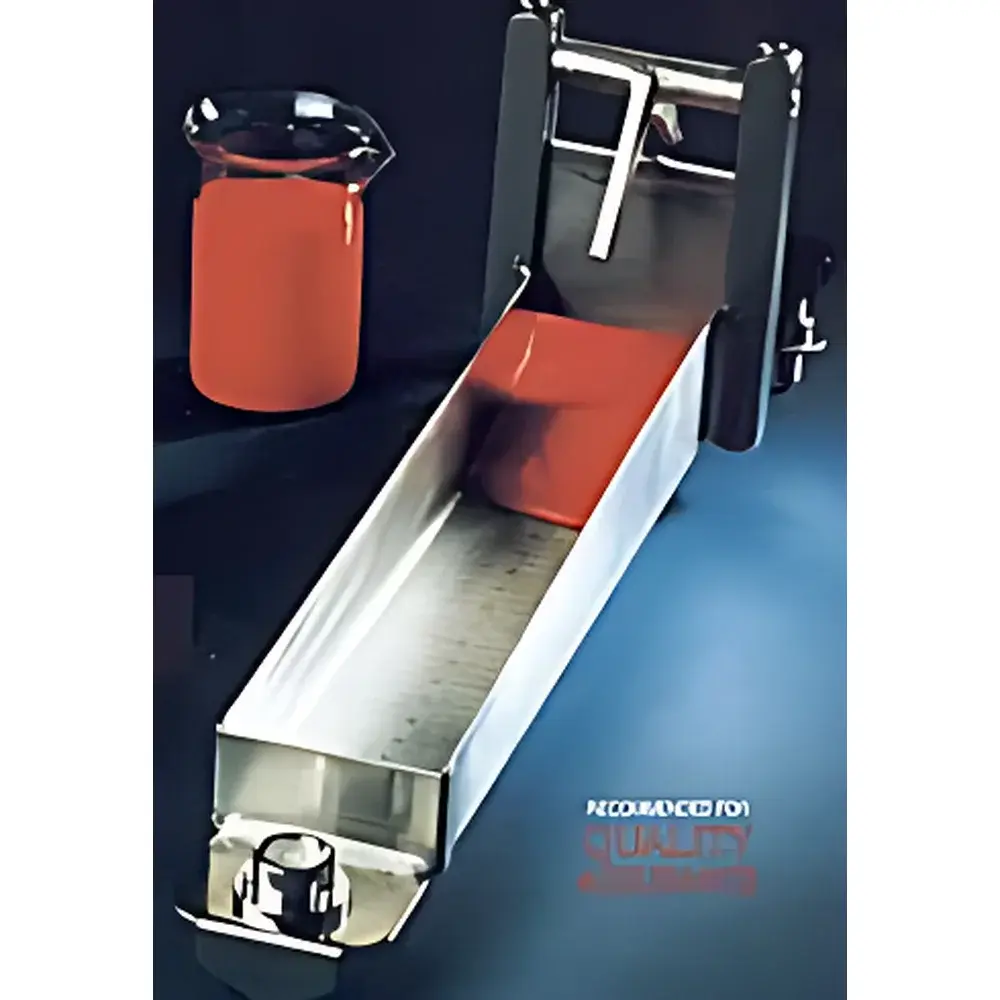
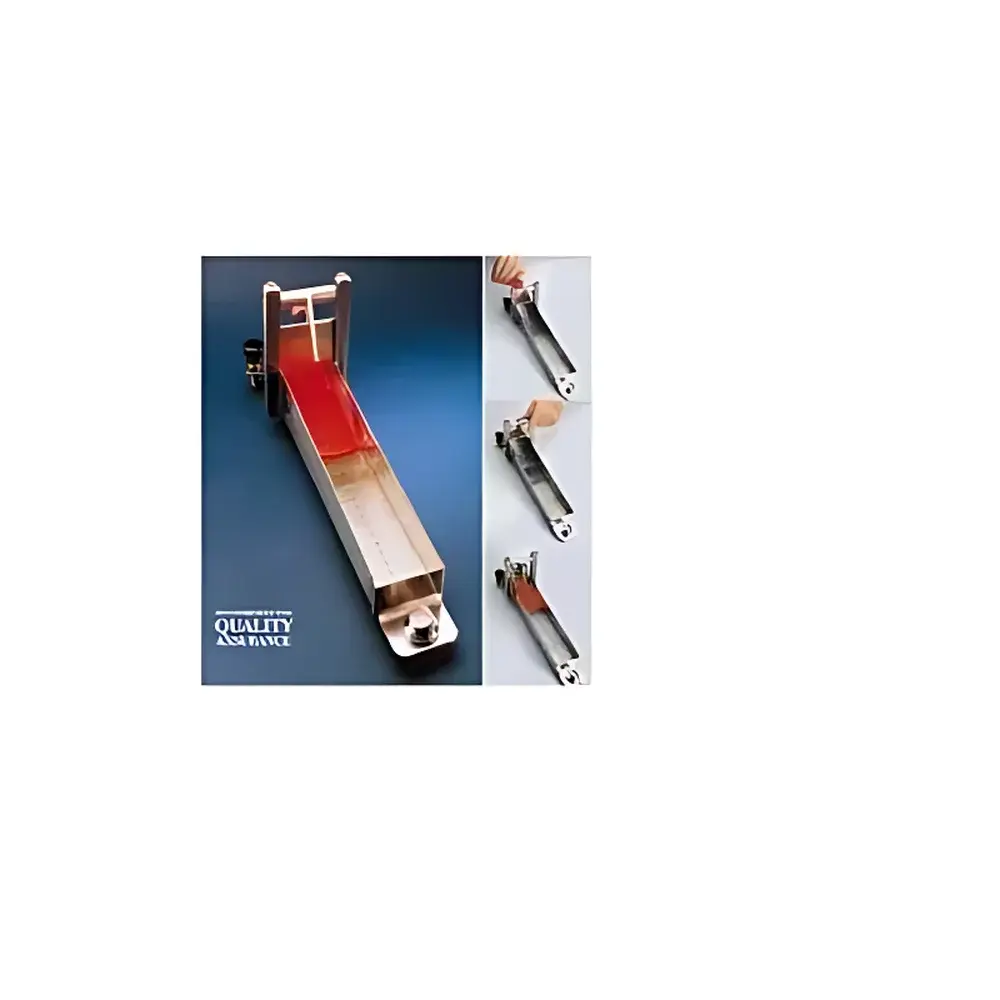
CSC Bostwick Consistometer for Jam, Ketchup, and Dairy Products
| Brand | CSC |
|---|---|
| Origin | USA |
| Model | Bostwick |
| Construction | Stainless Steel |
| Dimensions (L×W×H) | 14 in × 3.5 in × 5.5 in |
| Sample Volume | 75 mL |
| Timing Interval | Standard 30 s |
| Scale Graduation | 0.5 cm |
| Leveling | Dual adjustable leveling screws + bubble level |
| Gate Mechanism | Spring-loaded instantaneous release gate |
| Compliance | ASTM D1682 (for consistency testing), ISO 11393-2 (food texture reference), USDA/FSIS guideline compatible |
| Application Scope | Semi-solid food products with yield stress behavior |
Overview
The CSC Bostwick Consistometer is a gravity-driven, empirical flow measurement instrument engineered for rapid, repeatable assessment of yield-controlled semi-solid food materials. Unlike rotational viscometers or capillary rheometers, the Bostwick operates on the principle of controlled gravitational flow under defined geometry—specifically, the distance (in centimeters) a sample flows along an inclined stainless-steel trough within a fixed time interval (typically 30 seconds). This method quantifies structural integrity, yield stress approximation, and flow onset behavior—critical parameters for quality control of high-viscosity, non-Newtonian food systems such as fruit jams, tomato ketchup, yogurt, sour cream, and condensed dairy products. Its design adheres to standardized test protocols referenced in ASTM D1682 (Standard Test Method for Consistency of Tomato Products) and serves as a functional proxy for yield stress in routine production environments where full rheological characterization is impractical.
Key Features
- Robust all-stainless-steel construction ensures long-term corrosion resistance against acidic, sugary, and protein-rich food matrices.
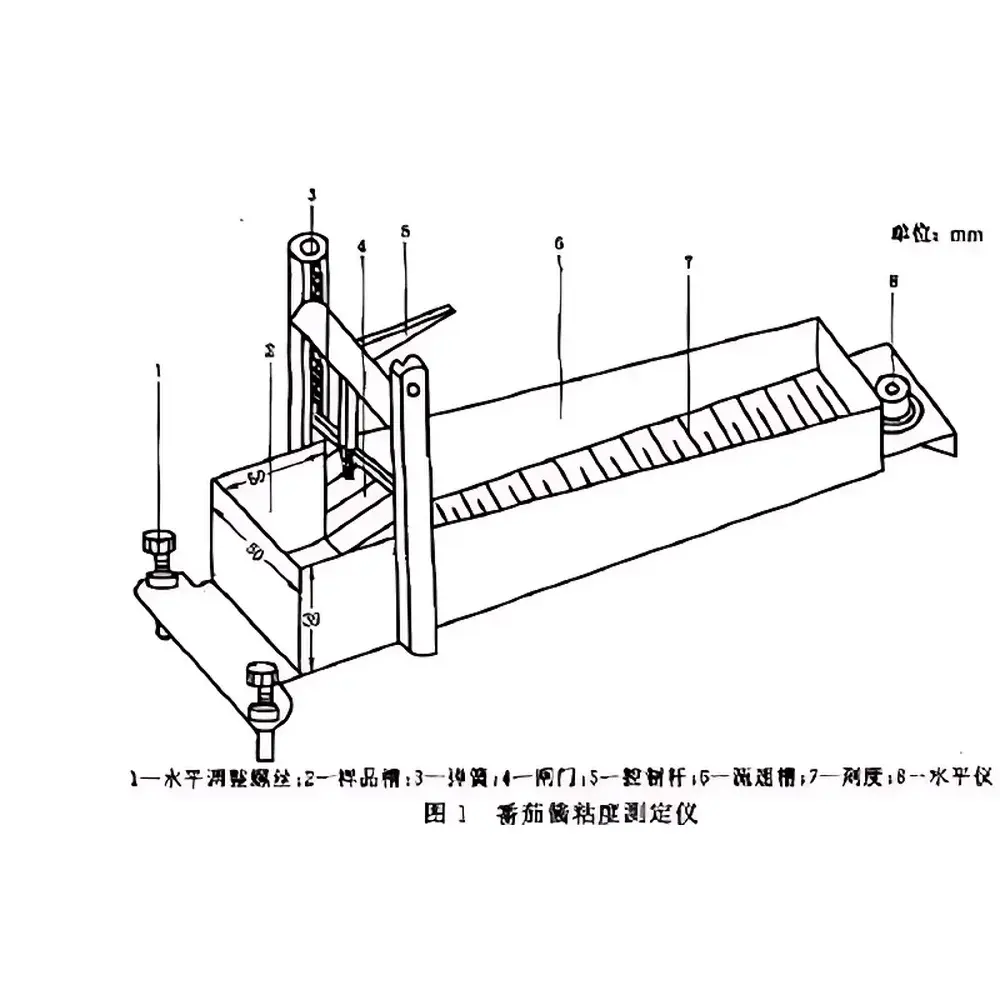
- Precision-machined 2 mm-thick electrolytically treated steel trough with laser-etched 0.5 cm scale divisions for ±0.1 cm reading resolution.
- Integrated bubble level and dual micrometer-adjustable leveling screws guarantee consistent 0° inclination across repeated measurements—eliminating angular variance as a source of error.
- Spring-actuated gate mechanism delivers instantaneous, reproducible sample release without manual delay or operator-induced shear pre-conditioning.
- Compact footprint (14″ × 3.5″ × 5.5″) enables deployment on crowded QC benches or near production lines without dedicated infrastructure.
- Low sample requirement (75 mL) minimizes material waste and supports high-throughput screening in both R&D labs and manufacturing QA settings.
Sample Compatibility & Compliance
The Bostwick Consistometer is validated for use with structured, yield-stress-dominant food suspensions and gels exhibiting minimal thixotropy over short timeframes (65° Brix), fermented dairy products (pH 4.0–4.6), and plant-based spreads. While not a primary rheometer per ISO 14407 or ASTM D2196, its results correlate strongly with yield stress (τy) and apparent viscosity at low shear rates—making it suitable for in-process release criteria under FDA-regulated GMP environments. Instrument calibration verification follows internal CSC traceable procedures aligned with NIST-traceable dimensional standards; no external certification is required for routine QC use per 21 CFR Part 11 Annex 11 guidance for non-automated analytical equipment.
Software & Data Management
The Bostwick Consistometer is a manually operated mechanical instrument with no embedded electronics, firmware, or data logging capability. All measurements are recorded directly onto paper-based lab notebooks or LIMS-integrated electronic worksheets. This analog architecture eliminates validation overhead associated with software-driven instruments—fully compliant with GLP/GMP documentation requirements for manual analytical methods. Users may integrate readings into statistical process control (SPC) platforms via simple CSV upload, supporting Cp/Cpk analysis, trend charting, and specification limit alerts for real-time batch release decisions.
Applications
- Batch-to-batch consistency verification of tomato ketchup prior to canning or aseptic filling.
- Monitoring pectin gel strength development during jam cooking and cooling cycles.
- Evaluating post-fermentation thickening in Greek-style yogurt and skyr formulations.
- Assessing stabilizer efficacy (e.g., carrageenan, xanthan) in dairy-free cream alternatives.
- Supporting shelf-life studies by tracking structural breakdown under accelerated storage conditions.
- Training new QC technicians due to intuitive operation and immediate visual feedback.
FAQ
What does a Bostwick value represent numerically?
A Bostwick value is the distance (in centimeters) traveled by the sample front along the trough after exactly 30 seconds. Higher values indicate lower yield stress and greater fluidity; values below 5 cm suggest highly structured, spoonable products.
Can the Bostwick Consistometer measure viscosity in centipoise (cP)?
No—it does not provide absolute viscosity units. It delivers an empirical consistency index correlated to yield behavior, not dynamic viscosity. For cP quantification, a rotational rheometer (e.g., Brookfield DVNext) is required.
Is temperature control built into the instrument?
No. Ambient temperature must be stabilized at 20 ± 2°C per ASTM D1682; users should equilibrate samples prior to loading.
How often should the instrument be cleaned between tests?
Thorough cleaning with warm water and food-grade detergent is mandatory after each sample to prevent cross-contamination and residue buildup affecting gate function.
Does CSC provide calibration certificates or traceability documentation?
CSC supplies a Certificate of Conformance with each unit, confirming dimensional compliance to original Bostwick specifications. NIST-traceable calibration is not applicable, as the device relies on geometric and temporal standards—not force or torque transduction.



