
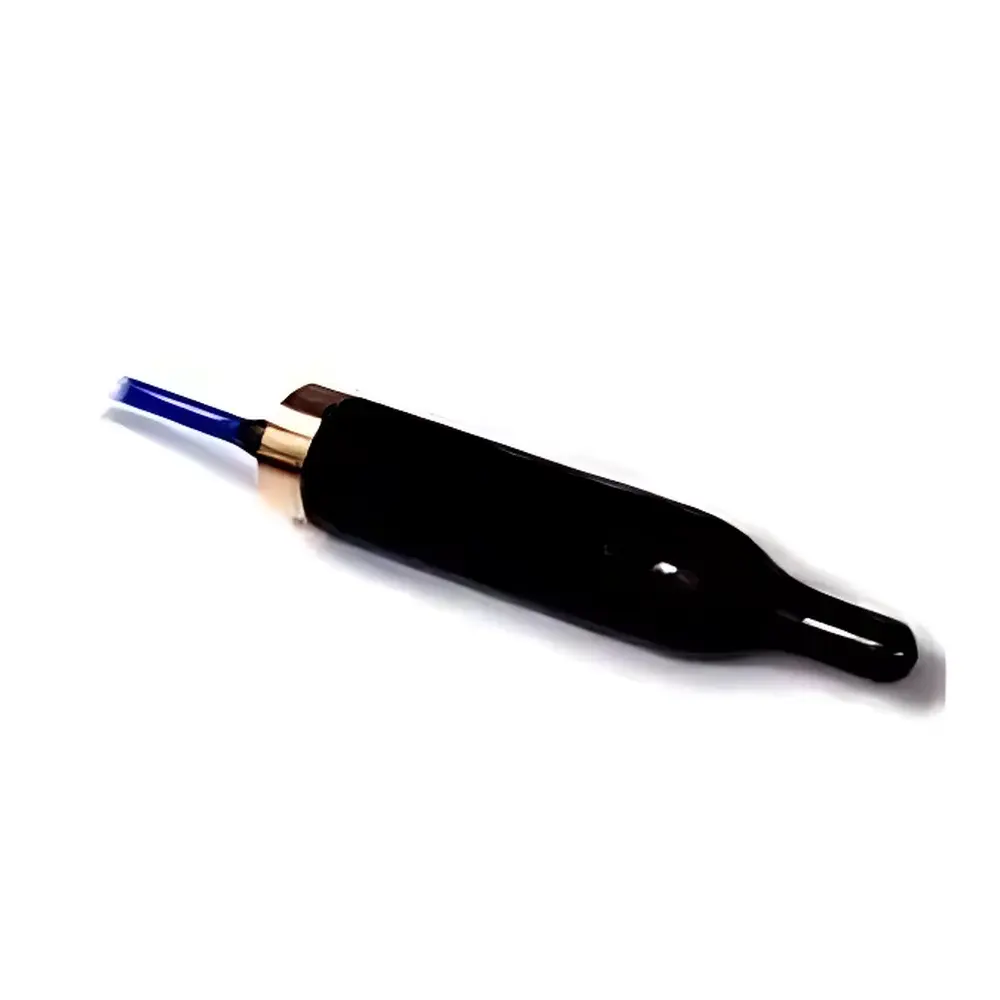
CTG Hydrosense Pre-Amplified Hydrophone
| Brand | CTG |
|---|---|
| Origin | United Kingdom |
| Model | Hydrosense |
| Type | Pre-amplified underwater acoustic transducer |
| Frequency Range | Wideband (typical coverage: 10 Hz – 200 kHz, dependent on configuration) |
| Directivity | Omnidirectional in horizontal plane |
| Sensitivity | High receive sensitivity (typical −165 dB re 1 V/µPa, integrated preamplifier) |
| Signal-to-Noise Ratio | Optimized for low-noise environmental monitoring |
| Operating Depth | Up to 1000 m (standard version) |
| Compliance | Designed per ISO 18405, IEC 60565, and ASTM E1002 for hydrophone calibration and field deployment |
| Output Interface | Low-impedance voltage output, BNC or LEMO connector |
| Environmental Rating | IP68, corrosion-resistant titanium or stainless-steel housing |
Overview
The CTG Hydrosense is a high-performance, pre-amplified hydrophone engineered for precision underwater acoustic measurement in demanding environmental and marine research applications. Based on piezoelectric ceramic sensing technology, it operates on the principle of pressure-to-voltage transduction, where incident acoustic pressure waves induce mechanical strain in the active element, generating a proportional electrical signal. Its integrated low-noise preamplifier ensures minimal signal degradation during transmission over extended cable lengths—critical for remote, long-term deployments in coastal zones, estuaries, offshore platforms, and deep-ocean observatories. Unlike passive hydrophones requiring external amplification, the Hydrosense delivers stable, calibrated voltage output directly compatible with standard data acquisition systems, SCADA interfaces, and real-time telemetry platforms. It is designed not as a general-purpose sensor but as a metrologically traceable instrument—calibrated in accordance with IEC 60565 and traceable to UK’s National Physical Laboratory (NPL) standards.
Key Features
- Integrated ultra-low-noise JFET preamplifier housed within the transducer body, eliminating external amplifier drift and grounding complications
- Omnidirectional response in the horizontal plane (±1° tolerance up to 50 kHz), enabling accurate sound field mapping without rotational alignment
- Wide operational bandwidth (10 Hz–200 kHz, configurable), supporting both low-frequency ambient noise characterization and high-frequency bioacoustic event detection
- Titanium or 316 stainless-steel pressure housing rated to 1000 m depth, with epoxy-filled internal cavities for long-term seawater immersion stability
- Factory-calibrated sensitivity with NIST-traceable certificate; optional in-situ recalibration support via CTG’s accredited hydroacoustic calibration service
- Low-power consumption (< 5 mA at ±12 V DC), suitable for solar- or battery-powered autonomous monitoring stations
Sample Compatibility & Compliance
The Hydrosense is validated for continuous operation in natural aquatic environments—including brackish water, full-strength seawater (35 ppt), and freshwater—with no performance drift attributable to salinity or temperature gradients (compensated over −2 °C to +30 °C). It complies with ISO 18405:2017 (Underwater acoustics — Terms and definitions), IEC 60565:2017 (Hydrophones — Calibration methods), and ASTM E1002-21 (Standard Practice for Calibration of Hydrophones). For regulated environmental monitoring programs, its data output supports audit-ready logging under GLP-compliant workflows, including time-stamped metadata embedding and digital signature-capable firmware (optional). The device meets RoHS 2011/65/EU and REACH Annex XVII requirements, with no restricted substances in housing, encapsulant, or cabling.
Software & Data Management
CTG provides the HydroView™ desktop application (Windows/macOS) for real-time spectral analysis, event-triggered recording, and FFT-based noise floor profiling. Raw output is delivered in IEEE 754-compliant 24-bit PCM format, fully compatible with MATLAB, Python (SciPy/obspy), and industry-standard platforms such as National Instruments LabVIEW and Brüel & Kjær PULSE. Firmware updates and configuration are performed via USB-C or RS-485 interface using secure signed binaries. All acquired datasets include embedded calibration coefficients, temperature/pressure telemetry (when paired with optional CTG EnviroLog™ environmental module), and UTC-synchronized timestamps compliant with IEC 61508 SIL2 for safety-critical deployments. Audit trails—including parameter changes, calibration history, and user login events—are retained onboard and exportable in CSV or XML for regulatory submission.
Applications
- Long-term passive acoustic monitoring (PAM) of marine mammal vocalizations (e.g., cetacean echolocation clicks, baleen whale songs) under IMO MSC.1/Circ.1257 guidelines
- Regulatory compliance monitoring of anthropogenic noise near offshore wind farms, dredging sites, and port infrastructure per EU Marine Strategy Framework Directive (MSFD) Descriptor 11
- Baseline ambient noise surveys for Environmental Impact Assessments (EIAs) in proposed aquaculture or subsea cable corridors
- Calibration reference for multi-hydrophone arrays used in acoustic thermometry or seafloor geophone networks
- Integration into autonomous surface vehicles (ASVs) and gliders for synoptic oceanographic noise mapping
- Validation of numerical acoustic propagation models (e.g., RAM, PE, Kraken) using in-situ broadband transfer function measurements
FAQ
Is the Hydrosense suitable for shallow-water riverine monitoring?
Yes—its low-frequency extension (down to 10 Hz) and high dynamic range (140 dB) enable robust detection of vessel noise, pile driving harmonics, and fish passage signals in turbulent, sediment-laden freshwater environments.
Can it be deployed alongside other CTG sensors (e.g., fluorometers or CTDs)?
Absolutely—the Hydrosense shares common power, communication, and mounting interfaces with CTG’s EnviroNode™ modular sensor platform, allowing synchronized multi-parameter acquisition with sub-millisecond timestamp alignment.
Does CTG provide calibration services outside the UK?
Yes—CTG operates accredited mobile calibration laboratories across Europe, North America, and APAC regions, offering on-site hydrophone sensitivity verification per ISO 17025:2017.
What is the recommended cable length limit for analog transmission?
For optimal SNR, analog output is supported up to 200 m using shielded twisted-pair cable (RG-174/U or equivalent); beyond that, fiber-optic signal conversion (via optional CTG OptoLink™ interface) is advised.
Is firmware update capability available in the field?
Yes—all Hydrosense units ship with field-upgradable firmware; updates are delivered via signed binary packages and verified cryptographically before installation.







