
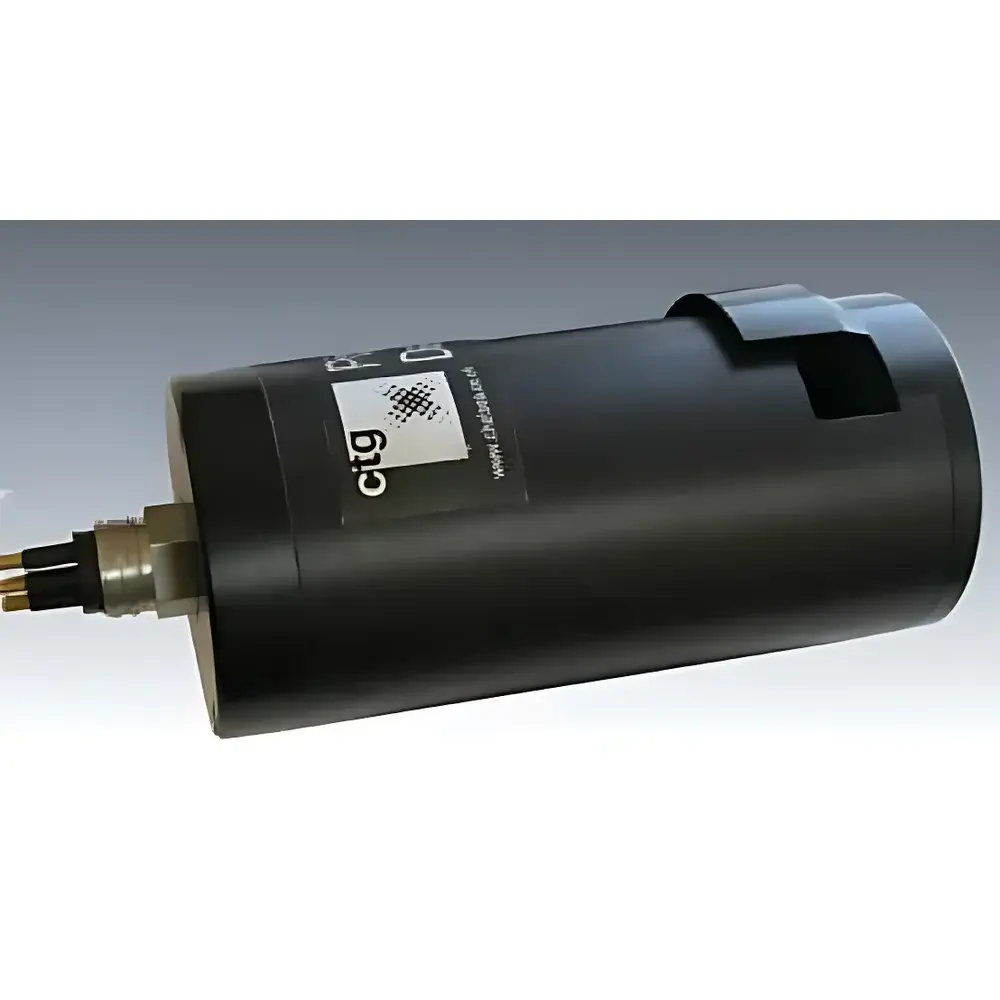
CTG UviLux UV Fluorometer
| Brand | CTG |
|---|---|
| Origin | United Kingdom |
| Manufacturer Type | Authorized Distributor |
| Origin Category | Imported |
| Model | UviLux |
| Instrument Type | Online |
| Measurement Principle | Ultraviolet-Induced Fluorescence Spectrometry |
| Measurement Range | 0.005–200 µg/L (as hydrocarbons or PAHs) |
| Detection Limit | 0.005 µg/L |
| Sampling Frequency | 0.1–3 Hz |
| Dimensions | Ø70 mm × 149 mm |
| Air Weight | 0.8 kg |
| In-Water Buoyant Weight | 0.15 kg |
| Pressure Rating | 600 m |
| Housing Material | Acetal C |
| Electrical Interface | Subcon MCBH6M |
| Supply Voltage | 9–36 V DC |
| Power Consumption | <1 W @ 12 V |
| Operating Temperature | −2 to +40 °C |
| Storage Temperature | −40 to +70 °C |
| Output Options | RS232 (standard), 0–5 V analog (standard), RS422 or SDI-12 (optional) |
| Software | Windows-based GUI included |
Overview
The CTG UviLux UV Fluorometer is a compact, submersible online fluorometer engineered for continuous, real-time detection and quantification of ultraviolet-excitable fluorescent compounds in aquatic environments. Based on the principle of ultraviolet-induced fluorescence spectrometry, the instrument emits UV light (typically centered at 254 nm or 365 nm, depending on configuration) to excite native fluorophores—including polycyclic aromatic hydrocarbons (PAHs), colored dissolved organic matter (CDOM), tryptophan-like substances (a proxy for biological oxygen demand), optical brighteners, and bacterial metabolites—and measures the resulting fluorescence emission intensity at specific wavelengths. Its high-sensitivity photodetector and integrated reference channel enable stable operation under variable ambient light conditions, including direct solar exposure, through active excitation intensity normalization and optical noise suppression. Designed for long-term deployment in challenging marine, estuarine, wastewater, and reclaimed water systems, the UviLux delivers robust performance across dynamic turbidity ranges without requiring reagent addition or sample extraction.
Key Features
- Submersible, pressure-rated housing (600 m depth) constructed from chemically inert acetal C for corrosion resistance and biofouling resilience
- Dual-output interface: RS232 digital communication (ASCII protocol) and 0–5 V analog output (configurable engineering units), with optional RS422 or SDI-12 for integration into SCADA, telemetry, or environmental monitoring networks
- User-selectable sampling frequency from 0.1 Hz to 3 Hz, enabling adaptive temporal resolution for transient event detection (e.g., hydrocarbon spills, stormwater runoff)
- Low-power design (<1 W @ 12 V DC), supporting battery-, solar-, or mains-powered deployments in remote or off-grid locations
- Onboard excitation reference channel compensates for LED aging and temperature drift, ensuring long-term measurement stability and reproducibility
- Optimized optical path geometry minimizes scattering interference, allowing reliable operation in low-to-moderate turbidity waters (up to ~100 NTU, depending on matrix)
- Dynamic range adjustment via software-configurable gain settings supports detection across orders of magnitude—from trace-level contamination (0.005 µg/L) to acute spill events (200 µg/L)
Sample Compatibility & Compliance
The UviLux is validated for use in natural waters (freshwater, seawater, estuaries), treated wastewater effluents, greywater reuse streams, and industrial process water. It complies with the physical and electrical requirements of IEC 60529 (IP68 equivalent for submerged operation) and meets CE marking directives for electromagnetic compatibility (EMC) and low-voltage equipment. While not a certified reference method per se, its response characteristics align with ASTM D5847 (Standard Practice for Continuous Monitoring of Water Quality Parameters) and ISO 10523 (Water Quality — Determination of pH), particularly when used as a screening tool for hydrocarbon contamination. Data integrity is supported by timestamped digital output and linear analog scaling—facilitating alignment with GLP-compliant data logging practices and audit-ready recordkeeping where configured with time-synchronized controllers.
Software & Data Management
The UviLux ships with a Windows-based graphical user interface (GUI) that enables full instrument configuration, real-time data visualization, calibration management, and firmware updates. The software supports batch export of time-series data in CSV format, including raw counts, normalized fluorescence intensity, and derived concentration values (when calibrated against lab-validated standards). All communication follows ASCII-based command-response protocols, permitting seamless integration with third-party platforms such as Campbell Scientific LoggerNet, LabVIEW, or custom Python/Node-RED data acquisition systems. Optional SDI-12 support allows plug-and-play interoperability with widely deployed environmental sensor networks. No proprietary cloud service is required; local storage and edge processing are fully supported.
Applications
- Early-warning detection of crude oil and refined petroleum hydrocarbon leaks near offshore drilling rigs, subsea pipelines, and port infrastructure
- Real-time monitoring of airport de-icing fluid runoff and hydrocarbon accumulation on tarmacs and drainage channels
- Coastal and estuarine pollution tracking—including urban outfall plumes, marina discharges, and dredging-related PAH mobilization
- Wastewater treatment plant influent/effluent surveillance for organic loading surges, nitrification inhibition indicators, or illicit industrial discharge
- Environmental impact assessments (EIA) and baseline studies requiring high-temporal-resolution fluorescence profiling
- ROV-mounted or moored deployments for benthic survey campaigns, sediment porewater characterization, and aquifer interface monitoring
FAQ
Is the UviLux suitable for drinking water applications?
Yes—provided the target analytes (e.g., PAHs, tryptophan-like organics) fall within its calibrated range and matrix interferences (e.g., high chloride, humic acids) are characterized during site-specific validation.
Can it distinguish between different fluorescent compounds?
No—the standard UviLux is a single-excitation/single-emission band fluorometer and does not provide spectral resolution. Compound differentiation requires multi-wavelength or excitation-emission matrix (EEM) instrumentation.
What calibration standards are recommended?
Quinine sulfate dihydrate (in 0.1 M H₂SO₄) is commonly used for system verification; PAH-specific calibrations (e.g., phenanthrene or pyrene in methanol/water dilutions) should be performed using traceable reference materials per ISO Guide 35.
Does it require regular maintenance or consumables?
No—there are no lamps, filters, or reagents to replace. Routine cleaning of the optical window and periodic verification against reference standards are sufficient for sustained accuracy.
How is ambient light rejection achieved?
Through synchronized pulsed UV excitation and gated detection, combined with real-time reference LED intensity monitoring to normalize signal drift caused by temperature or aging effects.
Related Products







