
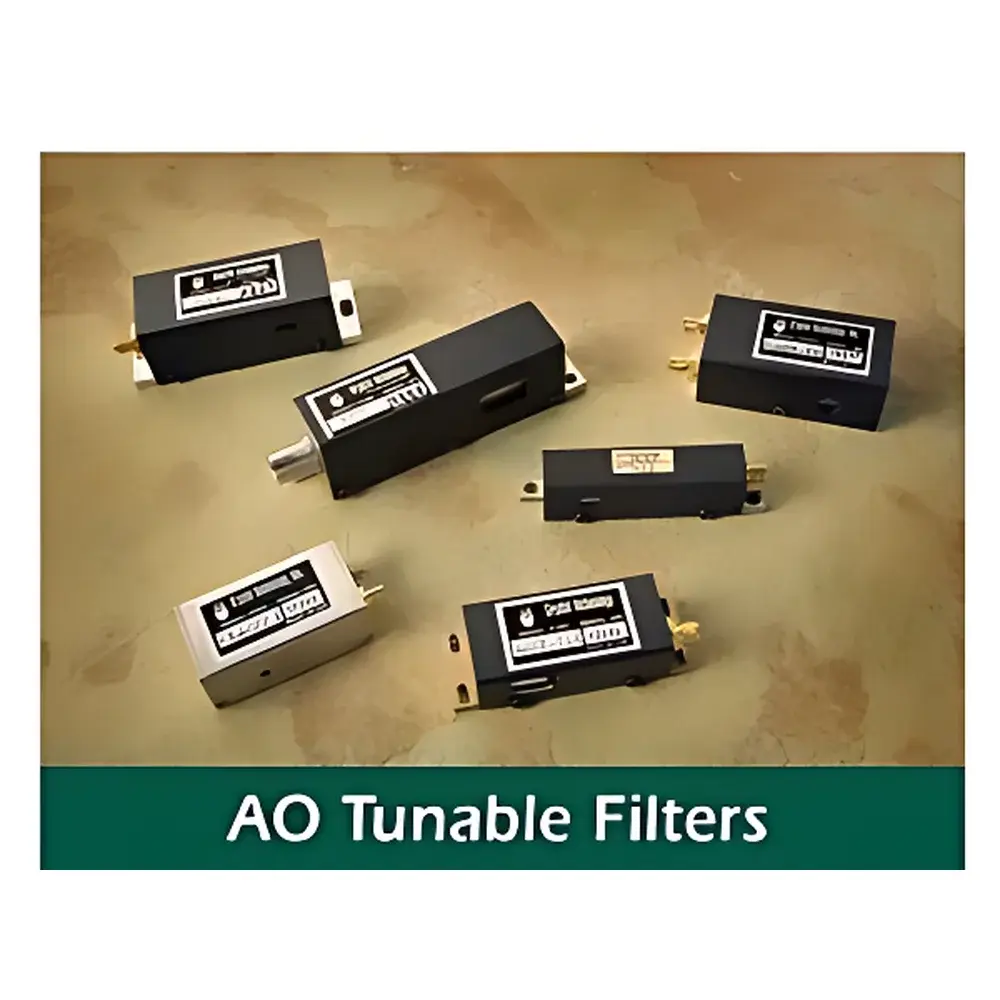
CTI AO Tunable Filter (AOTF) – Acousto-Optic Tunable Filter
| Origin | USA |
|---|---|
| Manufacturer Type | Authorized Distributor |
| Origin Category | Imported |
| Model | AO Tunable Filter |
| Pricing | Upon Request |
Overview
The CTI AO Tunable Filter (AOTF) is a solid-state, electronically addressable bandpass filter engineered for precision wavelength selection in demanding optical systems. Based on the acousto-optic diffraction principle in anisotropic birefringent crystals—typically TeO2 or quartz—the AOTF operates by launching a radio-frequency (RF) acoustic wave into the crystal via a bonded piezoelectric transducer. This acoustic wave generates a periodic refractive index grating that acts as a dynamic Bragg grating. Incident polychromatic or broadband light undergoes first-order diffraction, with the diffracted wavelength satisfying the phase-matching condition governed by the RF drive frequency, crystal orientation, and optical polarization. Unlike mechanically tuned filters or monochromators, the AOTF enables microsecond-scale spectral tuning without moving parts, delivering high optical stability, repeatability, and immunity to mechanical drift or vibration. Its all-solid-state architecture supports continuous, random-access wavelength scanning across UV–NIR spectral bands (350 nm to 2450 nm), making it ideal for applications requiring rapid spectral agility, high extinction ratio (>60 dB typical), and polarization-sensitive filtering.
Key Features
- Microsecond-scale wavelength switching (<5 µs typical settling time)
- High optical extinction ratio (>60 dB for suppressed zero-order beam)
- Wavelength resolution down to <0.45 nm (FWHM) at visible wavelengths, scalable with aperture and crystal design
- Low RF drive power requirements: as low as 15 mW for select CBAOTF configurations
- Collimated or focused-beam compatible designs; acceptance angle optimized per model (±0.1° to ±3.0°)
- Dual-polarization support: linear (horizontal/vertical) or unpolarized input, with polarization-dependent diffraction efficiency
- Hermetically sealed, temperature-stabilized modules available for long-term laboratory or field deployment
- Compliance with RoHS and REACH directives; CE-marked units available upon request
Sample Compatibility & Compliance
The CTI AOTF series is compatible with a broad range of light sources—including CW and pulsed laser diodes, gas lasers (Ar+, He–Ne), supercontinuum sources, xenon arc lamps, and halogen broadband emitters. Input beam diameters range from 1 mm to 15 mm (depending on model), with M² < 1.3 recommended for optimal diffraction efficiency and spectral fidelity. All units are designed to meet ISO 10110 optical surface quality standards and conform to IEC 61000-6-3 (EMC emission) and IEC 61000-6-2 (immunity) specifications. For regulated environments—such as clinical spectroscopy or GLP-compliant analytical labs—CTI AOTFs support traceable calibration documentation and optional integration with FDA 21 CFR Part 11–compliant control software (via external host interface). Device firmware includes built-in self-test routines and real-time RF power monitoring for operational integrity assurance.
Software & Data Management
CTI provides a vendor-agnostic USB 2.0 / RS-232 interface protocol, enabling seamless integration with LabVIEW™, MATLAB®, Python (PySerial), and custom C++/C# applications. The accompanying AOTF Control Suite (Windows/Linux) offers GUI-based wavelength sweep programming, multi-channel synchronization (for dual-AOTF setups), intensity modulation via RF amplitude control, and logging of timestamped spectral acquisition metadata. All configuration parameters—including RF frequency, amplitude, dwell time, and polarization state—are stored in non-volatile memory with versioned firmware updates. Audit trails, user access levels, and electronic signatures can be implemented externally via host-system middleware to satisfy GMP/GLP data integrity requirements. Raw diffraction efficiency curves and spectral calibration certificates are delivered with each unit, traceable to NIST-traceable spectroradiometric reference standards.
Applications
- Life Sciences: Real-time hyperspectral imaging in confocal and multiphoton microscopy; excitation wavelength selection in flow cytometry; fluorescence lifetime imaging (FLIM) gating
- Spectroscopy: Rapid-scan Raman, LIBS, and absorption spectroscopy; tunable source generation for FTIR auxiliary calibration
- Defense & Sensing: Eye-safe LIDAR wavelength agility; chemical vapor detection via differential absorption spectroscopy (DAS)
- Telecom & Photonics: WDM channel selection, reconfigurable optical add-drop multiplexing (ROADM), and coherent receiver pre-filtering
- Industrial Metrology: In-line colorimetric inspection, thin-film thickness monitoring, and LED spectral binning
FAQ
What determines the minimum resolvable bandwidth of an AOTF?
The resolution is governed by the acoustic transit time across the optical beam, crystal birefringence, and RF bandwidth. Narrower apertures and longer interaction lengths yield higher resolution—typically 0.45–7.0 nm FWHM depending on model and wavelength.
Can the AOTF operate with unpolarized input light?
Yes—though diffraction efficiency will vary with polarization state. Most models specify performance for linearly polarized input; unpolarized light yields ~50% average efficiency relative to optimal polarization.
Is thermal drift compensated in standard AOTF modules?
Standard units rely on passive thermal mass stabilization. Actively temperature-controlled variants (±0.05°C) are available for ultra-high-resolution applications requiring sub-picometer wavelength stability over 8+ hours.
How is wavelength calibration maintained over time?
Each unit ships with a factory-measured wavelength-vs-RF-frequency lookup table, updated annually via optional recalibration service using a calibrated wavemeter traceable to NIST SRM 2034.
Do CTI AOTFs support TTL or analog modulation inputs?
Yes—models feature configurable digital trigger inputs (TTL-compatible) for synchronous gating and analog voltage inputs (0–5 V) for direct RF amplitude control, enabling intensity modulation at up to 1 MHz bandwidth.





