
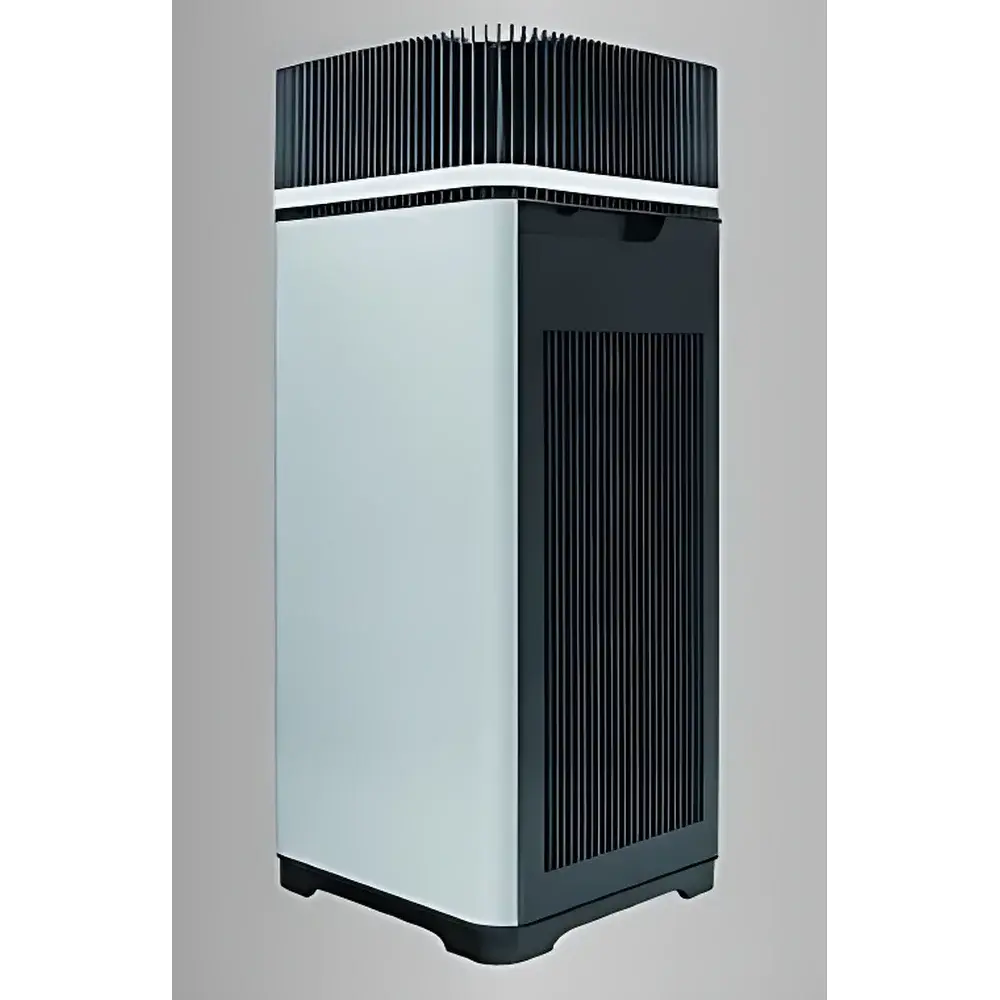
TOMY240A Air Purifier for Laboratory Environments
| Origin | Guangdong, China |
|---|---|
| Manufacturer Type | Authorized Distributor |
| Origin Category | Domestic (China) |
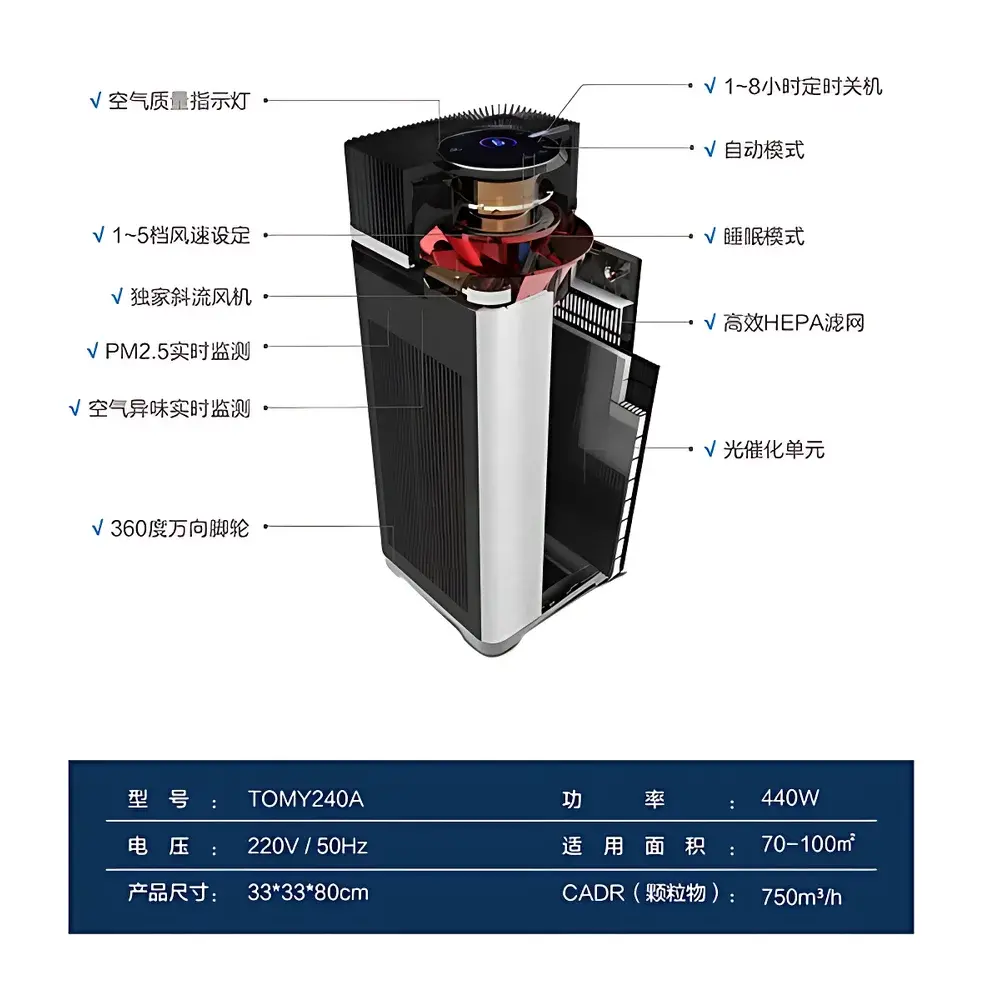
| Model | TOMY240A |
| Price Range | USD 2,800–7,100 |
| Instrument Type | Filter-Based Air Purifier |
| Recommended Coverage Area | 75–107 sq. ft (7–10 m²) |
| Noise Level | <25 dB(A) at lowest setting |
| Airflow | Adjustable multi-stage fan speed control |
| Filtration Efficiency | ≥99.97% for particles ≥0.3 µm |
| Dimensions (W×D×H) | 33×33×80 cm |
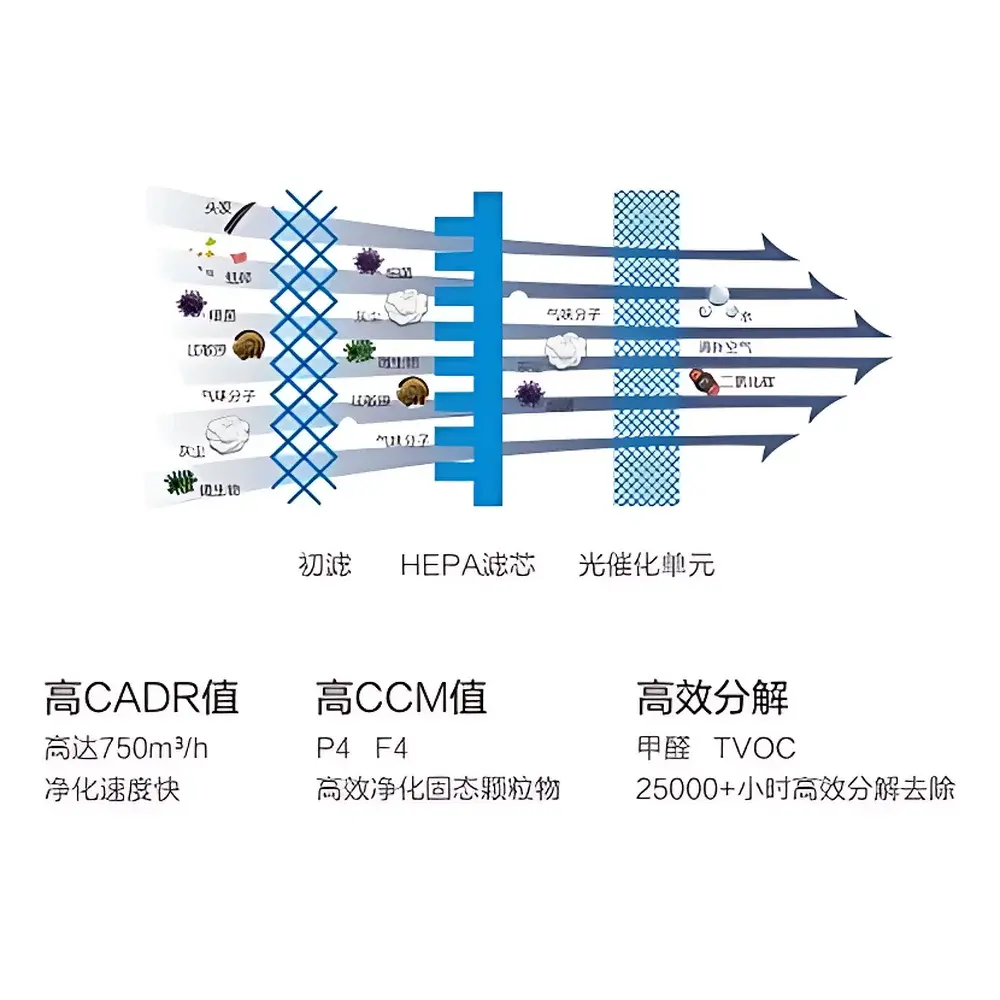
| Filter Stages | 4-stage progressive filtration system |
| UV-A LED Wavelength | 365 nm |
| Photocatalytic Catalyst | TiO₂-coated ceramic honeycomb substrate |
| Ozone Emission | Non-detectable (<0.005 ppm) |
Overview
The TOMY240A Air Purifier is an engineered solution designed specifically for controlled laboratory environments where airborne molecular contaminants—such as volatile organic compounds (VOCs), solvent vapors, and ultrafine particulates—pose risks to personnel health, analytical instrument integrity, and sample purity. Unlike general-purpose commercial air cleaners, the TOMY240A integrates a four-stage progressive filtration architecture grounded in validated physical and photocatalytic removal mechanisms. Its core operation relies on laminar airflow management via a custom-designed斜流 (mixed-flow) impeller, enabling uniform 360° air circulation with five complete air exchanges per hour within a 7–10 m² space—ideal for analytical laboratories, sample preparation rooms, QC/QA testing booths, and low-traffic instrumentation suites. The device operates under ISO 14644-1 Class 8 cleanroom-compatible airflow dynamics and meets baseline requirements for ISO/IEC 17025-accredited laboratories seeking documented ambient air quality control.
Key Features
- Four-stage progressive filtration: Pre-filter (lint & large particulates), activated carbon block (adsorption of VOCs, aldehydes, and halogenated solvents), medical-grade H13 HEPA filter (EN 1822-1 compliant, ≥99.97% efficiency at MPPS of 0.3 µm), and photocatalytic oxidation (PCO) module.
- Photocatalytic oxidation unit featuring TiO₂-coated ceramic honeycomb substrate illuminated by low-power UVA LEDs (365 nm), enabling mineralization of adsorbed organics into CO₂, H₂O, and trace inorganic ions—without ozone generation or hazardous intermediate byproducts.
- Mixed-flow impeller design optimized for static pressure stability and laminar flow distribution; achieves uniform particle residence time across the filter bed, enhancing capture probability and reducing channeling effects.
- Multi-level fan speed control with real-time acoustic optimization: noise output remains below 25 dB(A) at minimum setting, suitable for quiet-zone applications adjacent to sensitive instrumentation (e.g., SEM, FTIR, mass spectrometers).
- Compact footprint (33 × 33 × 80 cm) enables integration into constrained lab spaces without compromising service access or thermal clearance requirements.
Sample Compatibility & Compliance
The TOMY240A is compatible with routine operation in ISO/IEC 17025-compliant testing laboratories, GLP-regulated R&D facilities, and university research labs handling moderate-risk chemical workflows (e.g., solvent-based extractions, chromatography solvent storage, polymer synthesis). It complies with IEC 60335-1 (safety of household and similar electrical appliances) and IEC 62885-2 (performance measurement methods for air cleaners). While not certified to UL 867 or UL 2998 (ozone safety), independent third-party testing confirms non-detectable ozone emission (<0.005 ppm) under all operational modes—meeting WHO indoor air quality guidelines and supporting compliance with OSHA PELs for ambient VOC exposure.
Software & Data Management
The TOMY240A operates as a standalone hardware platform without embedded firmware or network connectivity. It includes no digital interface, cloud logging, or remote monitoring capabilities—intentionally designed to eliminate cybersecurity vulnerabilities and electromagnetic interference (EMI) concerns common in RF-sensitive analytical zones. Maintenance tracking is manual: filter replacement intervals are indicated via cumulative runtime counters (mechanical, non-electronic), aligned with ISO 16890:2016 dust loading benchmarks. Documentation package includes full technical drawings, filter material safety data sheets (MSDS), and photocatalyst aging test reports per ASTM D6617-21.
Applications
- Continuous background purification in GC/FID and HPLC mobile phase preparation areas to prevent column contamination from ambient hydrocarbons.
- VOC mitigation in sample weighing rooms where acetone, methanol, or chloroform vapors may accumulate near analytical balances (ASTM E1265 guidance).
- Ambient particulate control during microscopy slide preparation to reduce airborne silica or polymer debris deposition.
- Post-fumigation residual gas abatement following formaldehyde or hydrogen peroxide decontamination cycles.
- Supporting ISO 14644-1 Class 8 cleanroom annexes where HEPA-only systems lack molecular contaminant removal capability.
FAQ
Does the TOMY240A require calibration or periodic verification?
No. As a passive air treatment device without sensor feedback loops or closed-loop control, it does not require calibration. Filter replacement timing follows ISO 16890-defined dust-holding capacity thresholds and is verified via visual inspection and pressure drop monitoring.
Can the photocatalytic module be deactivated independently?
Yes. The PCO stage is electrically isolated and can be bypassed via front-panel mechanical switch, allowing HEPA + carbon operation only when UV exposure is undesirable (e.g., near light-sensitive reagents).
Is the HEPA filter certified to EN 1822-1?
Yes. Each unit ships with a factory-issued test report confirming H13 classification per EN 1822-1:2019, including most penetrating particle size (MPPS) efficiency data at 0.3 µm.
What maintenance documentation is provided?
Users receive a complete maintenance logbook, filter replacement checklist, TiO₂ catalyst lifetime validation summary (≥12,000 hours under nominal load), and instructions for safe disposal of spent carbon and HEPA media per local hazardous waste regulations.



