
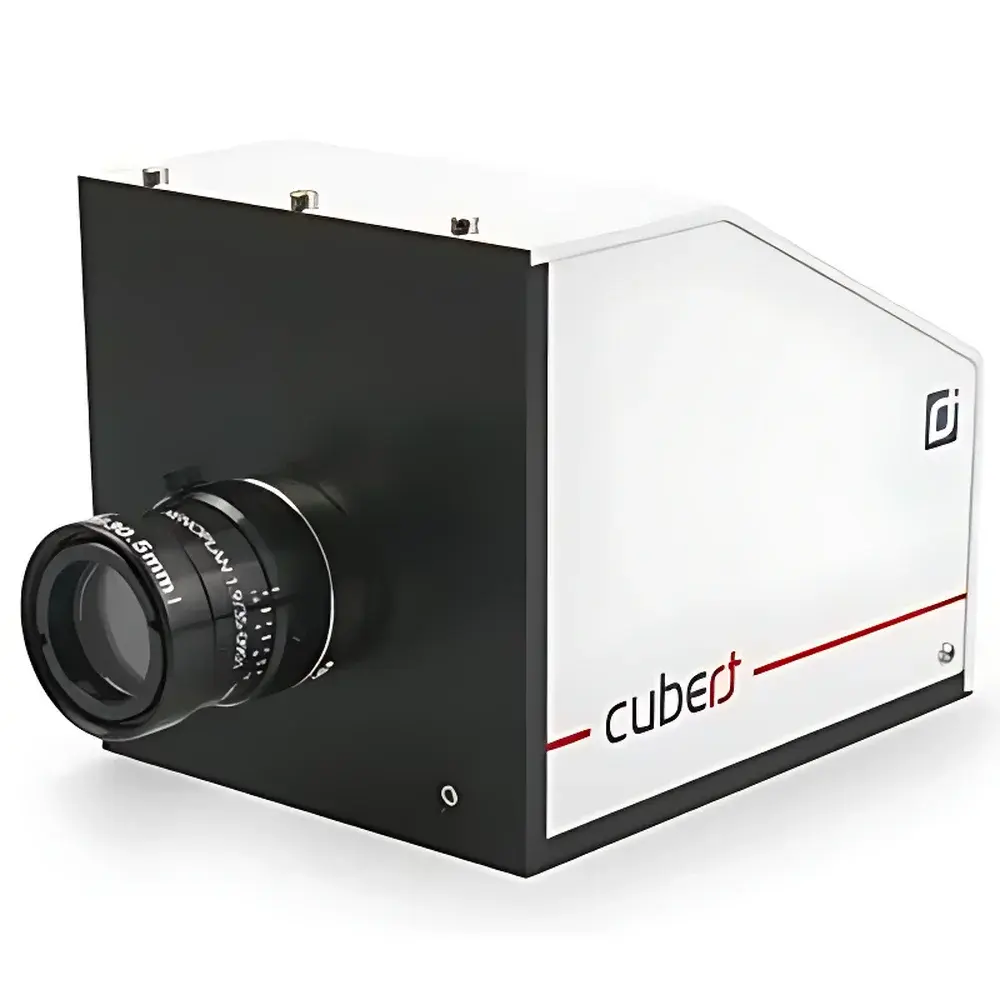
Cubert S258 Dual-Channel Snapshot Hyperspectral Imaging Spectrometer
| Brand | Cubert |
|---|---|
| Origin | Germany |
| Model | S258 |
| Spectral Range | 450–900 nm |
| Spectral Sampling Interval | ~10 nm |
| Spectral Resolution | >10 nm |
| Spatial Resolution | 2 × 2.0 MP (Si CMOS) |
| Frame Rate | 15 Hyperspectral Cubes/s |
| Imaging Modality | Single-lens, snapshot, frame-based pushbroom-free acquisition |
| FOV Options | 10 mm / 23 mm / 35 mm C-mount Schneider lenses |
| IFOV | Configurable (mm–m scale at ground level) |
| Shutter Type | Global shutter |
| Exposure Time | 0.1–1000 ms |
| Data Storage | Internal microSD + PC transfer via USB/GigE |
| Interface | USB 3.0, Gigabit Ethernet, Hardware Trigger |
| Power Supply | DC 9–24 V, 15 W |
| Operating Temperature | 0–40 °C (non-condensing) |
| Weight | 800 g |
| Compliance | CE, RoHS, ISO 9001-manufactured supply chain |
Overview
The Cubert S258 is a dual-channel snapshot hyperspectral imaging spectrometer engineered for high-fidelity, motion-artifact-free spectral data acquisition across the visible to near-infrared (VNIR) range (450–900 nm). Unlike scanning or whiskbroom systems, the S258 employs a proprietary dual-sensor architecture with synchronized, single-lens, frame-based acquisition—enabling simultaneous capture of 41 spectrally resolved bands at full spatial resolution. This snapshot methodology eliminates temporal misregistration and spatial smearing, making it uniquely suited for dynamic measurement scenarios including UAV-mounted remote sensing, real-time process monitoring, and laboratory-scale plant phenotyping. The instrument operates on the principle of spectral filtering via integrated micro-optical filter arrays bonded directly to two high-speed Si CMOS sensors, each delivering 2.0 megapixels at 10-bit or 8-bit digitization. Its ARM-based embedded processing unit supports on-device preview, metadata tagging, and lossless cube compression prior to storage on removable microSD media.
Key Features
- Dual-sensor, single-optics snapshot architecture ensures perfect spatiotemporal registration across all 41 spectral channels—no interpolation, no motion-induced artifacts.
- Real-time acquisition at up to 15 hyperspectral cubes per second (each cube: 2048 × 2048 × 41), with global shutter exposure control from 0.1 ms to 1 s.
- Modular optical interface: C-mount compatibility with interchangeable Schneider lenses (10 mm, 23 mm, 35 mm) enabling field-of-view and ground sampling distance (GSD) optimization for ground, tower, or airborne deployment.
- Embedded ARM processor enables standalone operation—no external computer required for acquisition, preview, or SD-card storage.
- Open API and command-line instruction set (CLI) support custom integration into automated workflows, OEM platforms, or research-grade analysis pipelines.
- Comprehensive connectivity: USB 3.0 for rapid local transfer, Gigabit Ethernet for networked operation, and hardware trigger input for synchronization with external sensors or lighting systems.
Sample Compatibility & Compliance
The S258 is designed for non-contact, reflectance/transmittance-based spectral characterization of heterogeneous surfaces and volumetric samples under ambient or controlled illumination. It supports both static benchtop use and mobile deployment in environmental, agricultural, industrial, and biomedical contexts. While not a regulated medical device, its radiometric stability and spectral repeatability align with ASTM E275, ISO 13406-2, and EN 61000-6-3 electromagnetic compatibility standards. Data provenance—including timestamp, GPS (when externally synced), lens ID, exposure parameters, and sensor temperature—is automatically embedded in each hyperspectral cube (BIL/BIP format) to support GLP-compliant documentation. Firmware and calibration files adhere to version-controlled revision protocols traceable to Cubert’s German manufacturing QA system (ISO 9001 certified).
Software & Data Management
Cubert’s native software suite—available as a Windows/macOS desktop application and Android-compatible touchscreen terminal—provides intuitive spectral cube visualization, region-of-interest (ROI) extraction, band math, PCA decomposition, and supervised/unsupervised classification. All operations retain original radiometric calibration and geometric metadata. Export formats include ENVI-compatible BIL/BIP, TIFF stacks, CSV spectra, and HDF5 for scalable scientific computing. For regulatory environments, optional audit-trail logging and user-access controls can be enabled to meet FDA 21 CFR Part 11 requirements when deployed in GMP-aligned quality assurance workflows. Raw data remains fully accessible without vendor lock-in; spectral response functions and dark/current reference frames are provided with each factory calibration certificate.
Applications
- Remote Sensing & Precision Agriculture: Crop health assessment (NDVI, PRI, MCARI), yield prediction, irrigation stress mapping, and pesticide residue screening via spectral unmixing.
- Plant Science & Phenotyping: High-throughput analysis of chlorophyll content, anthocyanin distribution, stomatal conductance proxies, and senescence progression under controlled growth chambers or field conditions.
- Food Quality Control: Detection of surface contamination, bruising, ripeness staging, and compositional heterogeneity in fruits, grains, and processed meats.
- Environmental Monitoring: In-situ water quality profiling (chlorophyll-a, CDOM, turbidity), soil organic matter estimation, and mineralogical mapping in geotechnical surveys.
- Biomedical Research: Non-invasive tissue oxygenation studies, wound healing progression tracking, and ex vivo histopathology support using label-free spectral contrast.
- Industrial Inspection: Polymer identification, coating uniformity verification, counterfeit detection in pharmaceutical packaging, and recycling stream sorting.
FAQ
Does the S258 require external cooling or temperature stabilization?
No—the instrument operates passively within 0–40 °C and includes internal thermal monitoring to adjust gain and offset in real time. Active cooling is unnecessary for VNIR spectral fidelity.
Can the S258 be integrated into an existing drone platform?
Yes—its 800 g mass, low power draw (15 W), GigE/trigger interfaces, and vibration-resistant aluminum housing make it compatible with Class II and III UAVs. Mounting brackets and UAV synchronization firmware extensions are available upon request.
What calibration standards are included with delivery?
Each unit ships with NIST-traceable white reference panel (Spectralon®), dark current reference, and factory spectral response function (SRF) file. Optional yearly recalibration services are offered through Cubert’s German service center.
Is raw data access supported for MATLAB or Python development?
Yes—binary cube files follow standard BIL layout with ASCII header (.hdr) and include complete metadata. Python libraries (e.g., hsitools, scikit-image) and MATLAB hyperspectral toolboxes integrate natively; CLI commands enable batch scripting for pipeline automation.
How is geometric distortion corrected across the dual-sensor array?
Factory-applied per-pixel radiometric and geometric correction matrices account for lens vignetting, sensor alignment offset, and micro-filter array registration error—delivered as part of the calibration package and applied automatically during acquisition or post-processing.





