
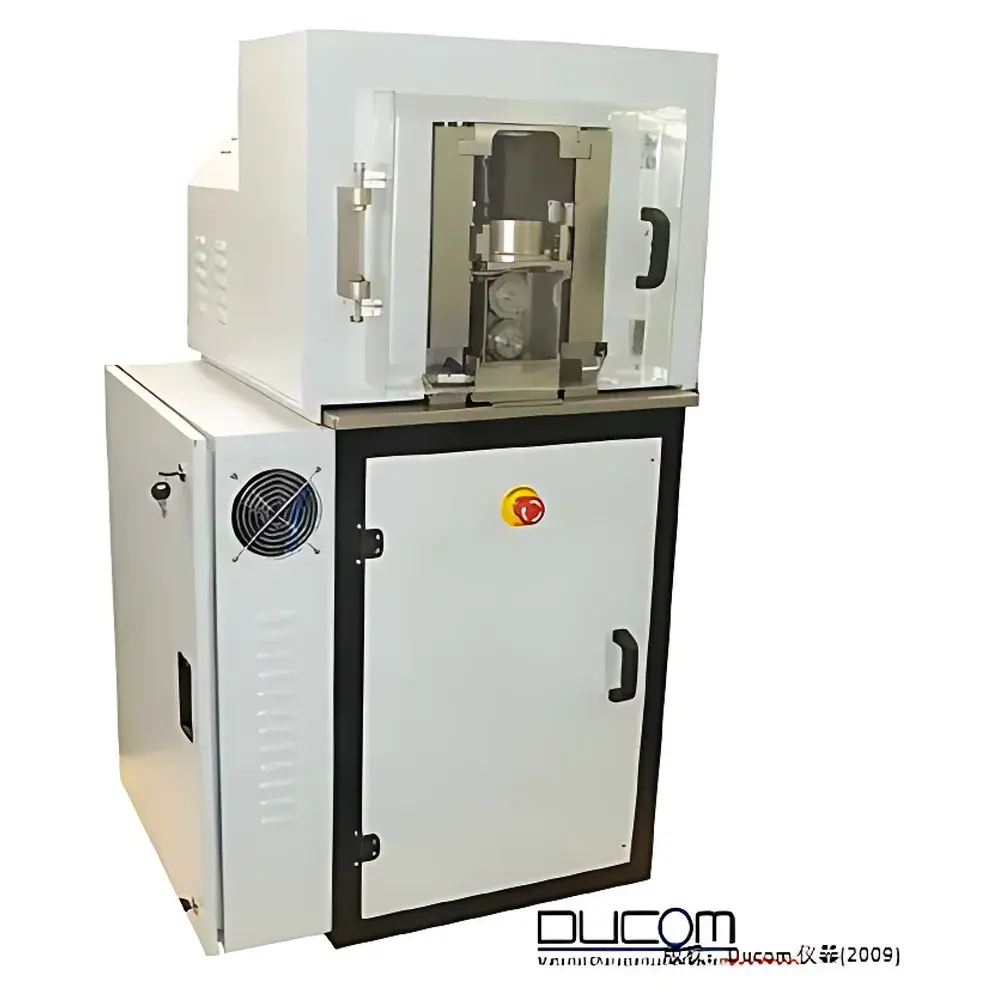
Cylindrical-on-Cylindrical Tribometer
| Origin | Imported |
|---|---|
| Manufacturer Type | Distributor |
| Model | Cylindrical-on-Cylindrical Tribometer |
| Pricing | Upon Request |
Overview
The Cylindrical-on-Cylindrical Tribometer is a precision-engineered benchtop tribological testing system designed to quantify frictional behavior, wear kinetics, and lubricant efficacy under controlled sliding and rolling contact conditions. Based on the fundamental principles of contact mechanics and boundary/mixed/elastohydrodynamic lubrication regimes, this instrument implements a standardized cylindrical counterface geometry—where one rotating cylindrical specimen engages a second cylindrical counterpart under adjustable normal load, rotational speed, and kinematic configuration (pure rolling, pure sliding, or combined roll–slide ratio). Its architecture conforms to ASTM G99, ISO 7148-1, and DIN 50324 standards for pin-on-disk and cylinder-on-cylinder configurations, enabling traceable, repeatable measurement of coefficient of friction (COF), wear volume (via profilometry or mass loss), and real-time thermal response at the interface.
Key Features
- Full-servo motor control for independent, synchronized rotation of both cylindrical specimens—enabling precise regulation of roll-to-slide ratio (0% to 100%) and surface velocity differential.
- Modular adapter system supporting interchangeable test geometries: standard cylindrical pairs (e.g., 10 mm Ø × 20 mm L), optional flat-ended or crowned cylinders, and auxiliary fixtures for cross-cylinder or cylinder-on-flat configurations.
- Integrated high-resolution load cell (±0.1% FS) and torque transducer (±0.2% FS) for simultaneous acquisition of normal force, tangential friction force, and instantaneous COF with sub-millisecond sampling.
- Environmental chamber compatibility (optional) for temperature-controlled testing from −40 °C to +250 °C, supporting evaluation of thermal stability in greases, solid lubricants, and polymer composites.
- Rigid granite base and low-vibration isolation design ensure mechanical stability during long-duration wear tests (up to 100+ hours), minimizing signal drift and enhancing reproducibility across replicate runs.
Sample Compatibility & Compliance
The tribometer accommodates cylindrical specimens fabricated from metals (steel, aluminum, titanium alloys), ceramics (Al2O3, Si3N4), polymers (PEEK, UHMWPE, PTFE), and coated substrates (DLC, CrN, MoS2). Specimen dimensions adhere to ISO 20806 and ASTM D3702 guidelines for cylindrical geometry validation. All hardware and firmware comply with CE Machinery Directive 2006/42/EC and EMC Directive 2014/30/EU. Data acquisition workflows support GLP-compliant audit trails, including user authentication, parameter locking, and timestamped metadata export—fully compatible with FDA 21 CFR Part 11 requirements when paired with validated software modules.
Software & Data Management
The proprietary TriboControl Suite provides real-time visualization of friction coefficient, wear rate, temperature rise, and acoustic emission signatures. Test protocols are programmable via intuitive graphical sequence editors, supporting multi-step load/speed ramps, dwell periods, and conditional triggers (e.g., COF threshold exceedance). Raw data is stored in HDF5 format with embedded calibration certificates and environmental metadata. Export options include CSV, MATLAB (.mat), and ASCII-compatible formats for third-party statistical analysis (e.g., Weibull wear modeling, ANOVA of lubricant performance). Optional IQ/OQ documentation packages are available for regulated laboratory environments requiring formal validation per ISO/IEC 17025.
Applications
- Formulation screening of industrial lubricants (mineral oils, synthetic esters, bio-based fluids) under mixed-film conditions relevant to gear and bearing applications.
- Wear resistance benchmarking of surface-engineered components—such as nitrided crankshafts, roller cam followers, and railway wheel-rail interfaces.
- Fundamental research into tribofilm formation mechanisms, shear-induced phase transitions in ionic liquids, and third-body particle generation in dry sliding contacts.
- Validation of computational tribology models (e.g., finite element contact simulations, Reynolds equation solvers) using experimentally derived pressure–velocity–temperature (PVT) boundary conditions.
- Accelerated aging studies of elastomeric seals and polymer bushings subjected to oscillatory rolling–sliding motion under humid or saline atmospheres.
FAQ
What types of lubricants can be evaluated on this system?
It supports liquid lubricants (oils, greases), solid lubricants (graphite, MoS2 dispersions), and semi-solid pastes—provided viscosity and volatility permit stable film formation under test conditions.
Is calibration certification included with delivery?
Yes—each unit ships with NIST-traceable calibration reports for load, torque, rotational speed, and temperature sensors, along with uncertainty budgets per ISO/IEC 17025 Annex A.
Can the system operate unattended for extended wear tests?
Yes—integrated safety interlocks, thermal cutoffs, and automatic emergency stop logic enable fully autonomous operation up to 120 hours, with email/SNMP alerts triggered upon deviation from set thresholds.
Does it support custom fixture development?
Yes—mechanical drawings and mounting interface specifications are provided under NDA for customer-designed adapters, including non-standard cylinder profiles or integrated electrical contact probes.
Is remote monitoring supported?
TriboControl Suite includes secure HTTPS-based remote access with role-based permissions, allowing lab managers to monitor live data streams and review historical test logs from off-site locations.



