
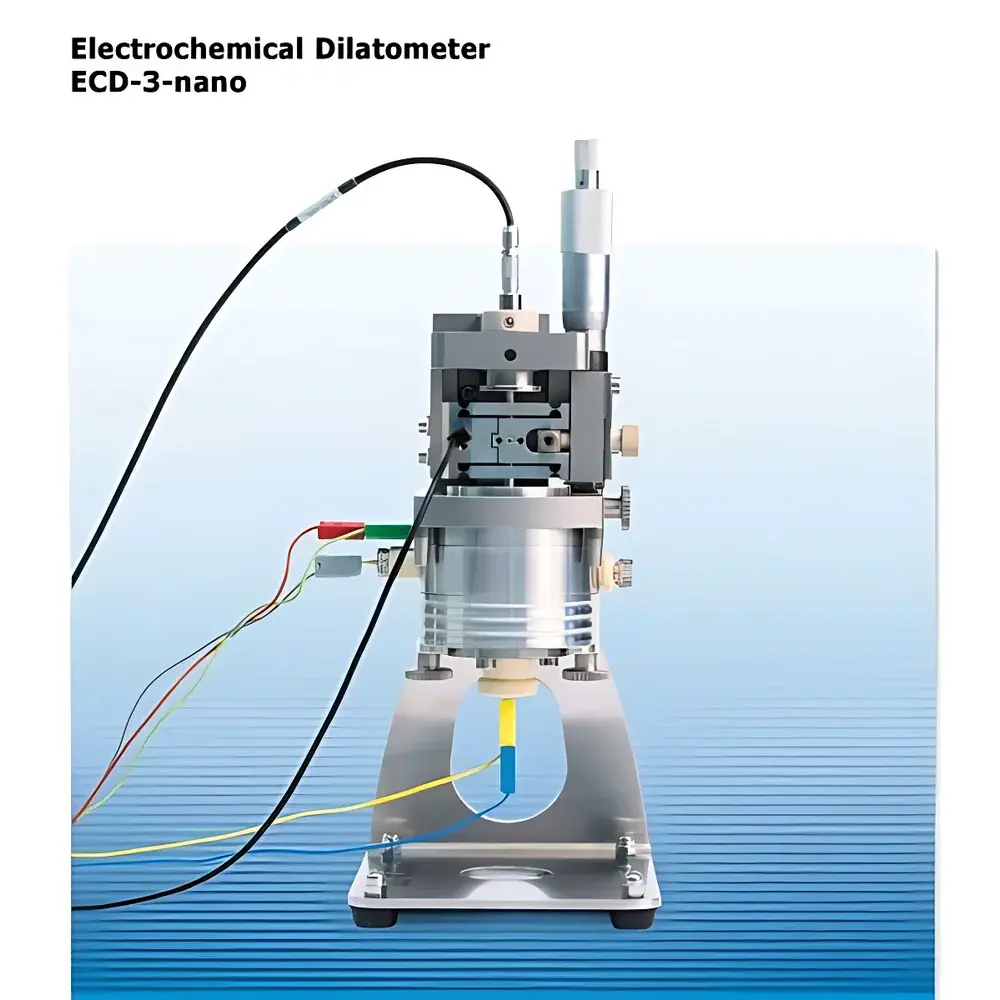
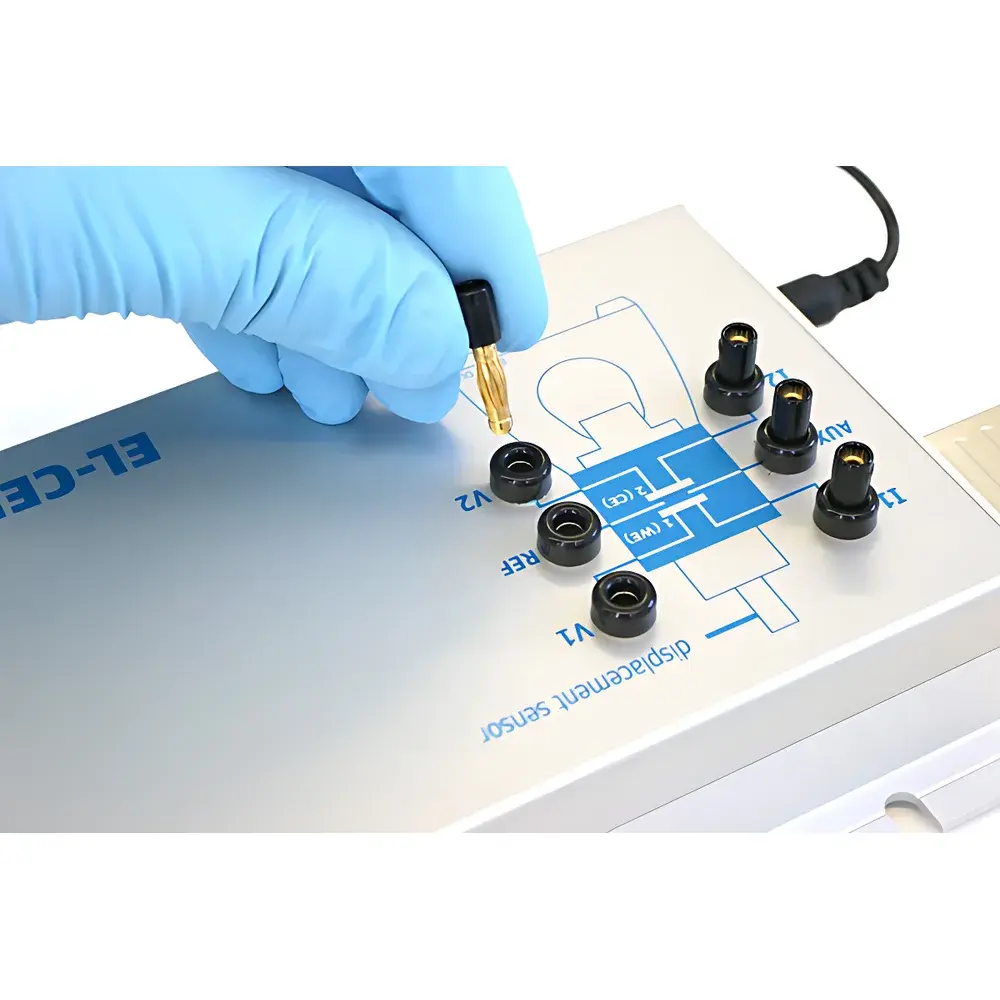
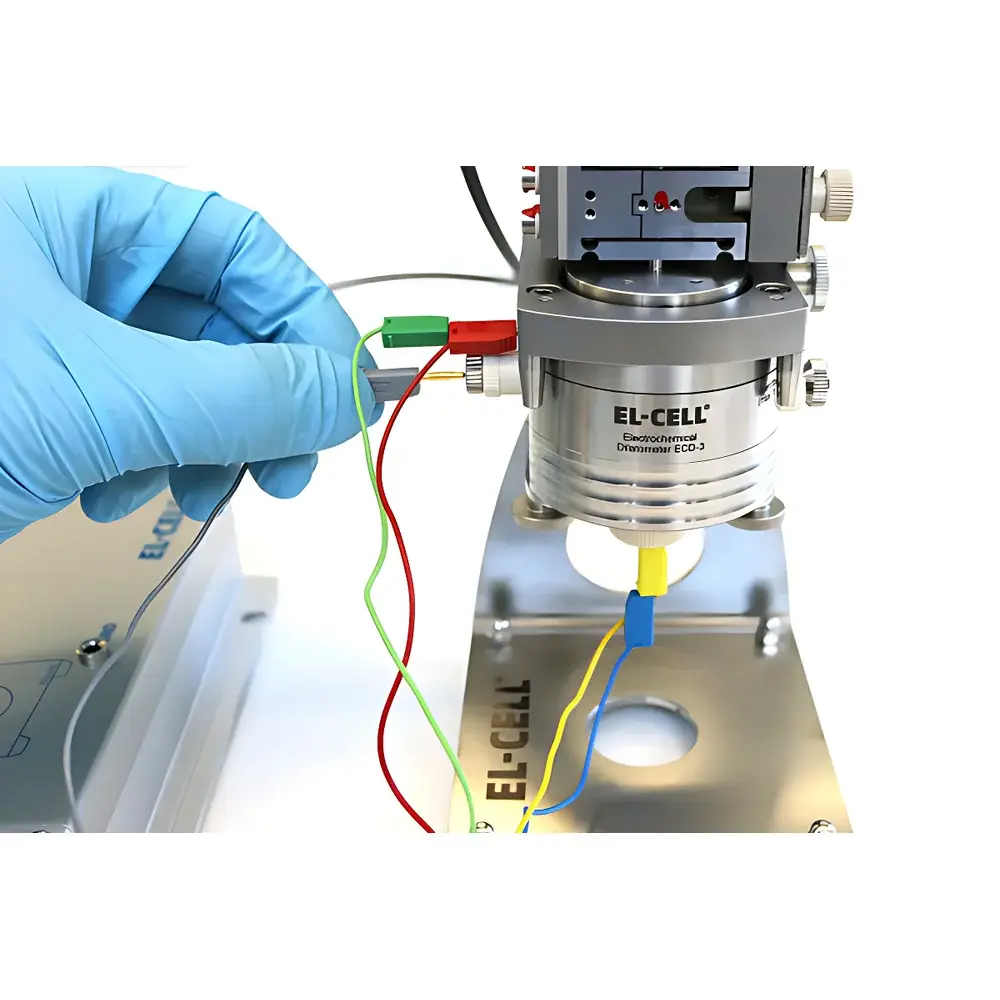
EL-Cell ECD-3 Nano Electrochemical Dilatometer
| Brand | EL-Cell |
|---|---|
| Origin | Germany |
| Model | ECD-3 Nano |
| Displacement Resolution | ≤5 nm |
| Measurement Range | 100 µm / 250 µm (selectable) |
| Linear Accuracy | <0.1% of full scale |
| Output Signal | DC voltage, –10 to +10 V |
| Sensor Type | High-precision capacitive transducer |
| Electrolyte Volume | ~1 mL (minimum), up to 3 mL |
| Electrode Compatibility | Disk electrodes up to Ø10 mm × 1.0 mm thickness |
| Operating Temperature Range | –20 °C to +70 °C (with external temperature control) |
| Dimensions (H×W×D) | 230 mm × 100 mm × 110 mm |
| Weight | 2.5 kg |
| Load on Working Electrode | Fixed 130 g (adjustable via optional load kit) |
| Sealing Materials | PEEK, EPDM, stainless steel 1.4404, or gold-plated components (aqueous-compatible upgrade) |
Overview
The EL-Cell ECD-3 Nano Electrochemical Dilatometer is a high-precision, modular instrument engineered for in situ measurement of nanoscale dimensional changes during electrochemical processes. It operates on the principle of capacitive displacement sensing, where minute electrode surface expansions or contractions—induced by ion intercalation, solid-electrolyte interphase (SEI) formation, passivation layer growth, or hydrogen absorption—are translated into quantitative, real-time thickness variations. With sub-5-nanometer resolution and drift stability of ≤20 nm/h over extended durations, the ECD-3 Nano enables rigorous investigation of quasi-two-electrode phenomena in battery materials, corrosion science, and proton-conducting systems. Its hermetically sealed electrochemical cell—featuring rigid borosilicate glass frit separation between counter and working electrodes—ensures strict environmental isolation, essential for air- and moisture-sensitive experiments such as Li-ion battery anode/cathode studies conducted inside gloveboxes.
Key Features
- Capacitive displacement sensor with ≤5 nm resolution and selectable full-scale ranges of 100 µm or 250 µm
- Modular, glovebox-compatible design (230 × 100 × 110 mm; 2.5 kg) with tool-free assembly and disassembly
- Electrode holder accommodating disk-type electrodes up to Ø10 mm × 1.0 mm—including binder-free powders, single crystals, and grain-oriented specimens
- Configurable cell construction: stainless steel 1.4404 standard for non-aqueous electrolytes; optional gold-plated components for aqueous electrochemistry
- Low-volume electrolyte requirement: as little as 1 mL (up to 3 mL), minimizing material consumption and enabling rapid equilibration
- Fixed mechanical preload of 130 g on the working electrode, with optional variable-load kits for controlled stress application
- Integrated USB data logger and analog DC output (–10 V to +10 V) compatible with standard DAQ systems and third-party acquisition software
- Thermal compatibility from –20 °C to +70 °C when paired with external temperature stages or climate chambers
Sample Compatibility & Compliance
The ECD-3 Nano supports diverse electrochemical configurations across organic, protic, and aqueous media. Standard construction uses chemically resistant PEEK insulators and EPDM elastomer seals, validated for carbonate-based Li-ion electrolytes (e.g., 1 M LiPF6 in EC/DMC). The aqueous upgrade replaces stainless steel components with gold-plated counterparts, eliminating corrosion risks during long-term cycling in acidic or alkaline solutions. All wetted materials comply with ISO 8502-3 for extractable metal ion limits and meet ASTM D1193 Type II water purity requirements when used with deionized electrolytes. The system’s mechanical rigidity and low thermal expansion housing ensure measurement integrity under GLP-compliant laboratory conditions; raw sensor output adheres to IEC 61000-4-3 immunity standards for electromagnetic environments typical of electrochemical labs.
Software & Data Management
Data acquisition is performed via the included USB-based digital recorder, delivering time-stamped displacement traces at user-defined sampling rates (default: 10 Hz, scalable to 100 Hz). Output voltage signals are referenced to a stable internal 2.5 V reference, ensuring traceability per ISO/IEC 17025 calibration protocols. Export formats include CSV and MATLAB-compatible binary (.mat), facilitating integration with Python-based analysis pipelines (e.g., Pandas, SciPy) or commercial electrochemical modeling tools such as COMSOL Multiphysics® and Thermo-Calc™. Audit trails—including timestamped parameter logs, sensor zero-point verification records, and hardware configuration snapshots—are retained locally and support FDA 21 CFR Part 11 compliance when deployed with validated electronic lab notebook (ELN) systems.
Applications
- In situ quantification of SEI growth kinetics on graphite, silicon, or lithium metal anodes during initial lithiation
- Real-time monitoring of lattice expansion/contraction in layered oxide cathodes (e.g., NMC, LCO) under potentiostatic hold or galvanostatic cycling
- Hydrogen-induced swelling in palladium or nickel alloys during cathodic charging—relevant to hydrogen embrittlement and energy storage
- Proton-driven dimensional changes in Nafion® membranes or MOF-based proton conductors for fuel cell R&D
- Electrochemically triggered phase transitions in shape-memory alloys and ferroelectric thin films
- Corrosion product volumetric evolution on passive metals (e.g., Cr₂O₃ on stainless steel) under potentiodynamic polarization
FAQ
What electrochemical techniques can be coupled with the ECD-3 Nano?
Galvanostatic and potentiostatic modes are fully supported; the dilatometer is compatible with all standard potentiostats via analog voltage input synchronization and external trigger signals.
Is the system suitable for use inside an argon-filled glovebox?
Yes—the compact footprint, absence of moving parts or internal batteries, and modular sealing design enable seamless integration into ISO Class 4–5 inert-atmosphere gloveboxes.
How is calibration performed, and what is the traceability basis?
Calibration is conducted using NIST-traceable step-height standards (e.g., Veeco TGQ series) and verified annually per ISO/IEC 17025-accredited procedures; certificate of calibration includes linearity, hysteresis, and thermal drift characterization.
Can the ECD-3 Nano measure compressive strain as well as expansion?
Yes—capacitive sensing is bidirectional; the –10 V to +10 V output corresponds linearly to displacement within the selected range, capturing both contraction and dilation events with equal fidelity.
What maintenance is required for long-term signal stability?
No routine maintenance is needed beyond periodic visual inspection of O-rings and cleaning of electrode contacts with ethanol; the capacitive sensor has no wear mechanisms and requires no recalibration under normal operating conditions.





