
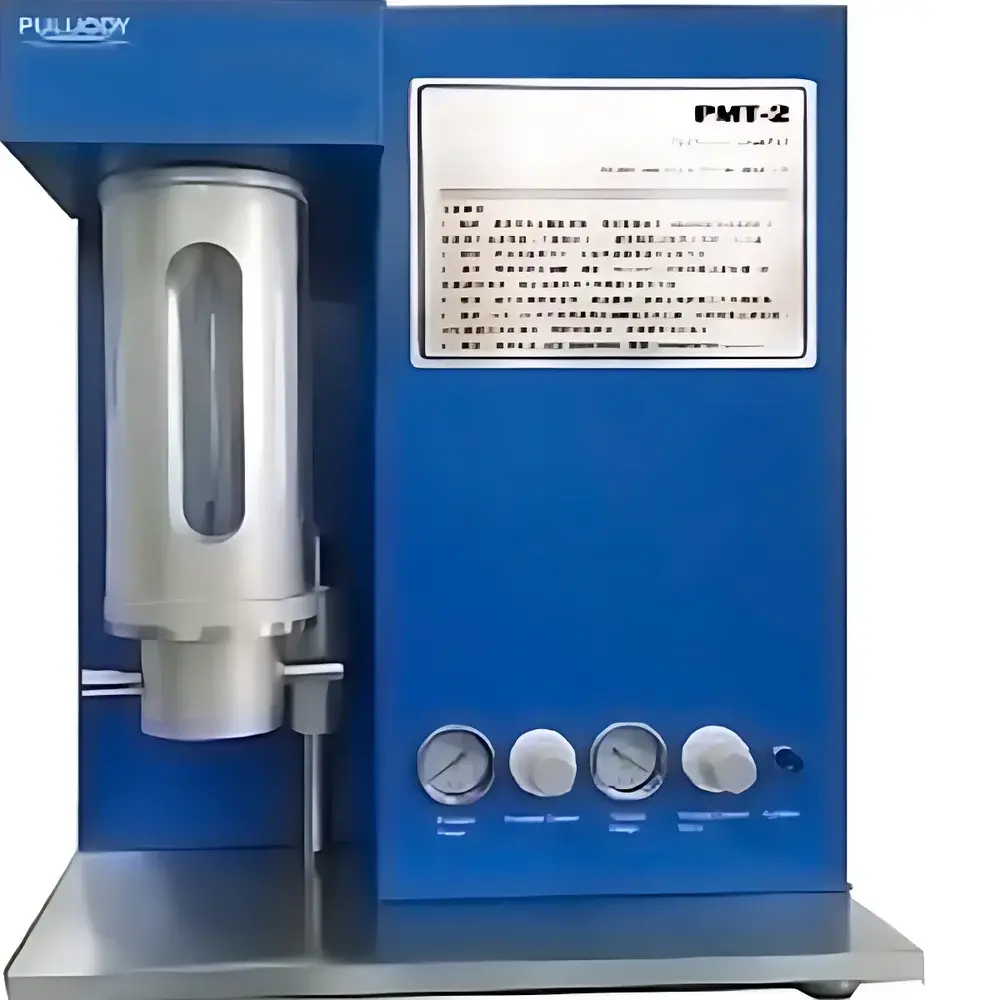
PULUODY PMT-2-31 Corrosion-Resistant Liquid Particle Counter
| Brand | PULUODY |
|---|---|
| Origin | Shaanxi, China |
| Manufacturer Type | Authorized Distributor |
| Country of Origin | China |
| Model | PMT-2-31 |
| Instrument Type | Optical Particle Counter |
| Detection Principle | Dual-Laser Narrow-Beam Light Scattering |
| Sensor Generation | 8th-Generation Dual-Laser Sensor |
| Measuring Range | 0.1–1.0 µm & 0.2–2.0 µm (standard) |
| Sampling Method | Precision Metering Piston Pump |
| Flow Control | Dual-stage electromagnetic + precision piston pump |
| Accuracy | ±5% typical |
| Volume Accuracy | <±1% |
| Coincidence Limit | 10,000 particles/mL (5% coincidence error) |
| Output | 4–20 mA analog interface with configurable particle exceedance alarm |
| Reporting | Particles per mL and ISO 4406 / NAS 1638 / SAE AS4059 contamination codes |
| Calibration Standards | JJG 1061, NIST-traceable latex spheres, ISO 21501-2 compliant |
| Software | V8.3 Integrated Analysis & Calibration Software (PC + embedded touchscreen) |
| Display & Control | Color LCD touchscreen + optional wireless keyboard/mouse |
| Power Input | 100–265 VAC, 50–60 Hz |
| Compliance | Designed for GLP/GMP environments |
Overview
The PULUODY PMT-2-31 Corrosion-Resistant Liquid Particle Counter is an advanced optical particle counter engineered for high-sensitivity, real-time monitoring of solid particulate contamination in aggressive and ultra-pure liquid media. It employs a proprietary 8th-generation dual-laser narrow-beam scattering sensor architecture—developed in collaboration with the UK-based PULUODY Analytical Testing Group—to deliver stable, reproducible detection of sub-micron particles down to 0.1 µm(c). Unlike conventional single-wavelength systems, this dual-laser design enables simultaneous intensity and scatter-angle discrimination, significantly improving signal-to-noise ratio and reducing false counts from refractive index variations or bubble interference. The instrument is specifically constructed with chemically resistant wetted materials—including fluoropolymer-lined flow cells, corrosion-inhibiting stainless-steel housings, and inert ceramic pump components—making it suitable for continuous operation in caustic cleaning agents, acidic etchants, deionized water, semiconductor process chemicals, and polymer solutions. Its primary function is quantitative particle concentration measurement (particles/mL) and automated contamination grading per ISO 4406, NAS 1638, and SAE AS4059 standards—critical for quality control in microelectronics fabrication, pharmaceutical water systems, and nanofiltration validation.
Key Features
- Corrosion-resistant fluidic path engineered for long-term stability in aggressive solvents, acids, bases, and organic media
- Dual-stage flow control system combining a precision metering piston pump and electromagnetic flow regulator for volumetric accuracy better than ±1%
- 8th-generation dual-laser narrow-beam sensor with adjustable threshold detection for 0.1 µm(c) resolution and customizable sizing channels (e.g., 4–70 µm(c))
- Embedded V8.3 analysis software with independent calibration and measurement modules—ensuring metrological separation between traceable calibration routines and routine testing workflows
- Real-time analog output (4–20 mA) with programmable alarm thresholds for integration into SCADA, DCS, or PLC-based manufacturing execution systems
- Touchscreen HMI with optional wireless keyboard/mouse support for flexible offline analysis and report generation
- Compliance-ready architecture supporting electronic signatures, user access levels, and audit trail logging in accordance with FDA 21 CFR Part 11 when validated
Sample Compatibility & Compliance
The PMT-2-31 is validated for use with a broad spectrum of non-aqueous and aqueous liquids, including but not limited to: semiconductor-grade sulfuric acid/hydrogen peroxide mixtures (SC1/SC2), ammonium hydroxide-based cleansers, photoresist developers, ultrapure water (UPW) at resistivity >18.2 MΩ·cm, polymeric solutions (e.g., PVDF, PTFE dispersions), and low-viscosity organic solvents. All wetted surfaces meet USP Class VI biocompatibility criteria and ASTM F2217 chemical resistance specifications. Calibration traceability follows JJG 1061 (Chinese national metrology regulation), ISO 21501-2 (light extinction and light scattering methods), and NIST-traceable polystyrene latex (PSL) reference standards. The system supports full documentation packages required for ISO/IEC 17025-accredited laboratories and GMP-compliant cleanroom environments.
Software & Data Management
The integrated V8.3 software suite operates in two logically segregated modes: Calibration Mode and Measurement Mode. Calibration Mode enforces password-protected access, mandatory operator identification, and immutable record generation—including timestamped calibration curves, reference standard lot numbers, and environmental condition logs. Measurement Mode permits rapid acquisition, histogram generation, trend analysis, and automated reporting in PDF, CSV, or XML formats. Data export includes raw pulse height distributions, cumulative/differential size distributions, and multi-parameter contamination grading across concurrent standards. Audit trails are stored locally with SHA-256 hashing and cannot be edited or deleted without system-level administrative privileges. Optional network connectivity enables secure remote data synchronization with LIMS platforms via TLS 1.2 encrypted HTTP(S) endpoints.
Applications
- Real-time monitoring of UPW loops in semiconductor front-end fabs to detect filter breakthrough or ion exchange resin degradation
- In-line verification of cleaning solution purity prior to wafer rinsing stages in 300 mm node manufacturing
- Validation of final rinse quality for flat-panel display glass substrates and OLED encapsulation layers
- Quantitative insoluble particle assessment in injectable drug formulations per USP and Ph. Eur. 2.9.19
- Monitoring of nanofiltration membrane integrity during production of battery-grade lithium electrolytes
- Offline verification of mobile cleanroom air shower effluent and tool purge gas condensate streams
FAQ
Is the PMT-2-31 suitable for measuring particles in highly viscous polymer solutions?
Yes—when equipped with optional low-shear flow cell geometry and temperature-controlled sample conditioning module (available as OEM add-on), the system maintains laminar flow conditions and minimizes particle settling or agglomeration artifacts.
Can the instrument be integrated into a factory automation system?
Absolutely—the 4–20 mA analog output, Modbus TCP/IP interface, and configurable digital I/O ports enable seamless integration with Siemens PCS7, Rockwell FactoryTalk, or Yokogawa CENTUM VP DCS environments.
Does the system comply with FDA 21 CFR Part 11 requirements?
When deployed with validated V8.3 software configuration, role-based access control, electronic signature enforcement, and immutable audit trail archiving, the PMT-2-31 meets predicate rules for Part 11 compliance in regulated pharmaceutical and medical device manufacturing.
What calibration standards are supported?
Primary calibration uses NIST-traceable PSL spheres per ISO 21501-2; secondary verification may employ JJG 1061-certified reference suspensions or customer-specific matrix-matched standards.
Is on-site installation qualification (IQ/OQ) support available?
Yes—PULUODY’s global service network provides IQ/OQ documentation packages, operational qualification protocols, and third-party certification support through ISO/IEC 17025-accredited partners.



