
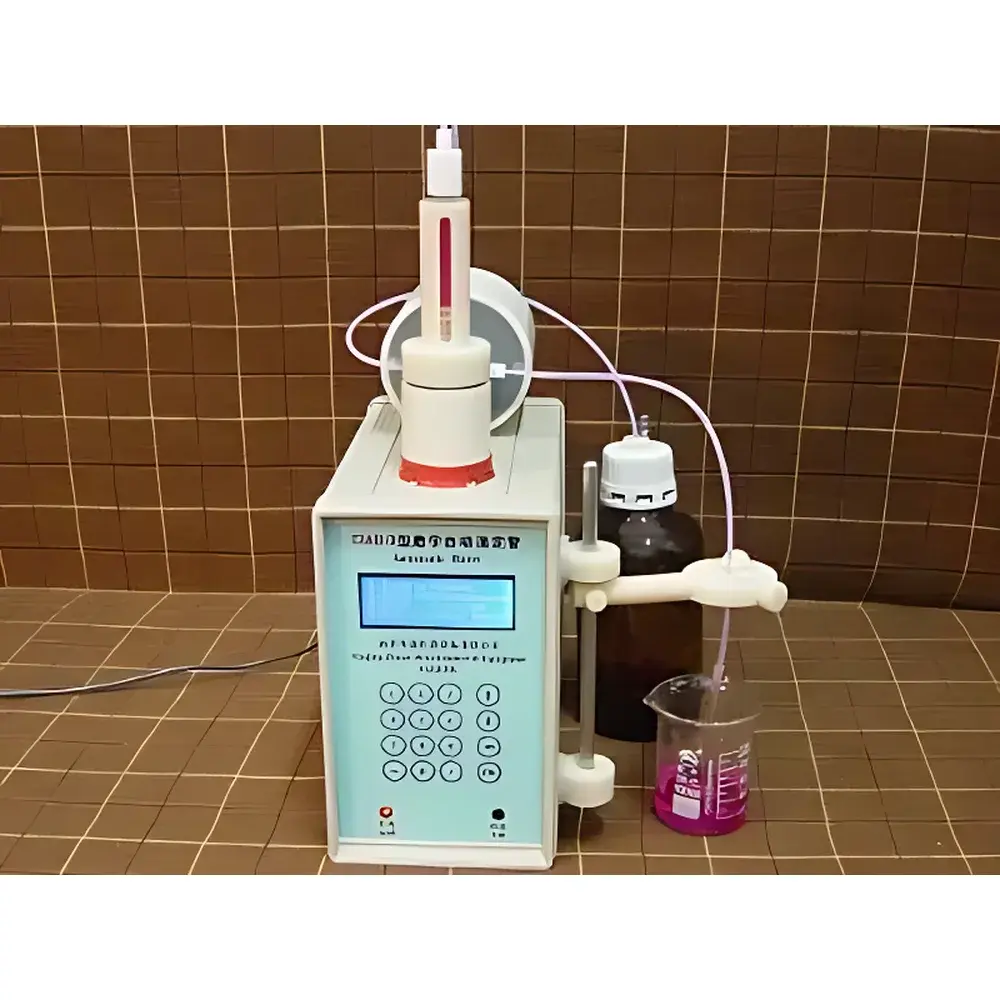
DAB-2 Digital Automatic Buret
| Origin | Jiangsu, China |
|---|---|
| Manufacturer Type | Distributor |
| Origin Category | Domestic (China) |
| Model | DAB-2 |
| Price Range | USD 700 – 7,000 |
| Instrument Type | General-Purpose Potentiometric Titrator |
| Display Resolution | 0.01 mL |
| Precision | CV ≤ 0.3% |
| Power Supply | 12 V DC (battery-compatible) |
| Communication Interface | RS232 |
| Syringe Capacity | 10 mL |
| Valve Material | PTFE rotary valve |
| Calibration | User-performed gravimetric calibration via titration factor adjustment |
| Control Signals | Busy output, pulse-triggered titration input, TTL-level stop/drop control input |
| Operating Mode | Continuous titration with auto-refill and void compensation |
Overview
The DAB-2 Digital Automatic Buret is a precision-engineered electromechanical dispensing system designed for laboratory-grade volumetric delivery in potentiometric, conductometric, photometric, polarographic, and thermometric titrations. Unlike conventional manual burets or basic motorized dispensers, the DAB-2 integrates closed-loop volumetric control with real-time digital feedback, enabling repeatable, traceable, and operator-independent reagent delivery. Its core operating principle relies on microstepping motor-driven linear displacement of a calibrated 10 mL glass syringe, where volume is derived from precise step-counting and validated through user-executed gravimetric calibration. The instrument operates on a deterministic finite-state logic architecture—automatically transitioning between aspiration, void compensation, and dispensing phases without manual intervention. This architecture ensures uninterrupted titration sequences even when the syringe empties mid-titration, maintaining cumulative volume integrity across multiple refill cycles. Designed for compliance-aware environments, the DAB-2 supports audit-ready operation through RS232 serial logging and external synchronization—making it suitable for GLP-compliant QC labs, academic research settings, and method development workflows requiring reproducible sub-0.01 mL dispensing.
Key Features
- Precision 10 mL borosilicate glass syringe with PTFE-coated plunger and chemically inert PTFE rotary valve—resistant to strong acids, bases, and common organic solvents
- Digital volumetric display with 0.01 mL resolution and cumulative volume tracking across multi-cycle titrations
- Auto-refill and void compensation logic: detects syringe depletion, initiates aspiration, performs zero-point correction, and resumes dispensing with continuous volume summation
- User-adjustable titration factor for gravimetric calibration—enabling traceable accuracy verification per ISO/IEC 17025 requirements
- Three external control interfaces: TTL-compatible “Busy” status line, edge-triggered pulse input for synchronized titration start, and level-sensitive stop/drop control (high = active, low = halt)
- Full menu-driven operation via membrane keypad; parameter entry, preset volume definition (0.01 mL minimum, no upper limit), and mode selection performed locally
- 12 V DC power architecture—compatible with portable battery packs for field use or backup operation during mains outages
- RS232 serial interface supporting ASCII command protocol for integration into custom titration systems or third-party data acquisition platforms
Sample Compatibility & Compliance
The DAB-2 accommodates aqueous, alcoholic, and moderately aggressive non-aqueous titrants—including HCl, NaOH, AgNO₃, EDTA, and ceric sulfate solutions—provided compatibility with PTFE wetted surfaces is confirmed. It is not rated for hydrofluoric acid, molten alkalis, or oxidizing halogen-based media. While the DAB-2 itself is not CE- or UL-certified as a standalone medical or industrial device, its design aligns with functional safety expectations for Class I laboratory equipment under IEC 61010-1. Its gravimetric calibration capability supports adherence to USP , ASTM E2063, and ISO 8655-3 for piston-type liquid handling devices. When integrated into automated titration systems, the instrument’s RS232 output enables timestamped volume logging compatible with 21 CFR Part 11–compliant software architectures—provided the host system implements electronic signatures, audit trails, and data integrity controls.
Software & Data Management
The DAB-2 operates autonomously without embedded firmware-based software; all configuration and control occur via hardware-level inputs and local display. Volume data is transmitted as ASCII-encoded numeric strings over RS232 at 9600 baud (8N1), including current dispensed volume, status flags (e.g., “BUSY”, “REFILLING”, “COMPLETE”), and error codes. No proprietary drivers are required—standard terminal emulators or Python/Node.js serial libraries suffice for integration. For regulatory environments, users typically route DAB-2 output through validated middleware (e.g., LabVIEW with NI-VISA, or custom C# applications with SQLite logging) to generate ALCOA+ compliant records. The instrument does not store historical data internally; persistent logging must be implemented externally. Its TTL-level control signals allow tight synchronization with pH meters, conductivity cells, or spectrophotometers—enabling true hybrid endpoint detection in multi-parameter titrations.
Applications
- Standardization of titrant solutions per ISO 6497 and AOAC Official Methods of Analysis
- Acid-base titrations in food acidity testing (e.g., titratable acidity in wines and dairy products)
- Redox titrations for iron, copper, or iodine quantification in environmental water samples
- Complexometric titrations using EDTA for hardness analysis in municipal water supplies
- Endpoint-controlled back-titrations where precise sub-mL additions are critical (e.g., residual chlorine determination)
- Method validation studies requiring volumetric repeatability assessment per ISO 5725
- Education laboratories—demonstrating fundamental titration principles with digital traceability and reduced operator variability
FAQ
What is the maximum dispensing volume per single cycle?
The DAB-2 uses a 10 mL syringe; however, its auto-refill function allows unlimited cumulative volume delivery across sequential fill-dispense cycles.
Can the DAB-2 be used with non-aqueous titrants such as perchloric acid in glacial acetic acid?
Yes—provided the titrant does not degrade PTFE or attack glass. Compatibility verification with specific solvent systems is the user’s responsibility.
Is factory calibration provided, or must all calibration be performed by the user?
The DAB-2 ships with a nominal calibration factor; final accuracy validation and adjustment must be performed gravimetrically by the end user per ISO 8655-6.
Does the instrument support programmable titration curves (e.g., incremental addition with pause intervals)?
No—the DAB-2 executes fixed-volume or endpoint-triggered dispensing only. Programmable multi-step profiles require external controller coordination via RS232 or TTL signals.
What maintenance is required for long-term reliability?
Routine cleaning of the syringe barrel and PTFE valve with appropriate solvents; periodic inspection of the rotary valve seal and syringe plunger lubricity; recalibration recommended after any mechanical servicing or every 6 months under continuous use.





