
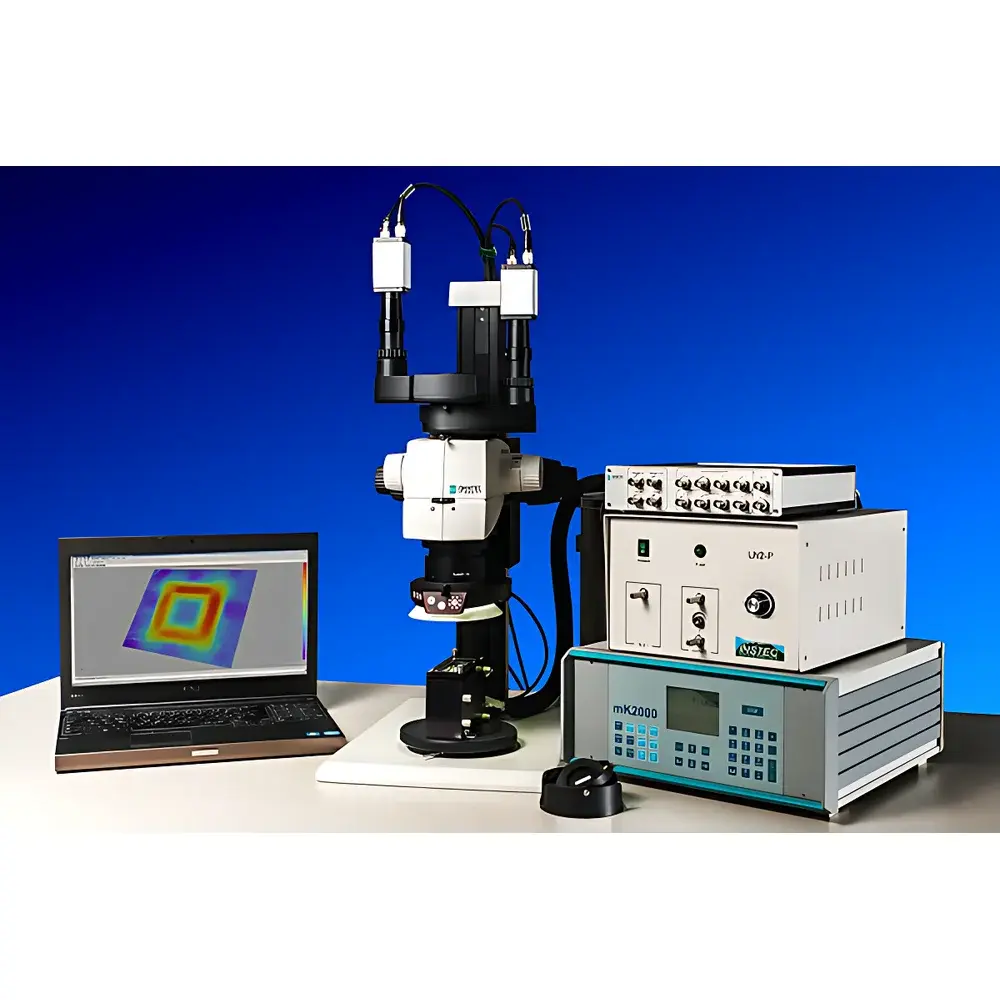
Dantec Dynamics Q-400μDIC Micro Digital Image Correlation System
| Brand | Dantec Dynamics |
|---|---|
| Origin | Germany |
| Manufacturer Status | Authorized Distributor |
| Origin Category | Imported |
| Model | Q-400μDIC |
| Pricing | Available Upon Request |
| Measurement Dimensions | 2D & 3D |
| Measurement Area | 0.1 mm × 0.1 mm to 17 mm × 17 mm |
| Displacement Resolution | 1 µm |
| Strain Resolution | 0.005% |
| Application Focus | Microelectronics, Biomaterials, Thermal Expansion Analysis, Warpage Characterization |
Overview
The Dantec Dynamics Q-400μDIC is a high-resolution micro-scale Digital Image Correlation (DIC) system engineered for non-contact, full-field deformation and displacement measurement at the microstructural level. Based on stereo-optical correlation of high-magnification digital images captured before and during mechanical or thermal loading, the Q-400μDIC applies sub-pixel intensity matching algorithms to compute local displacements across the entire field of view. Unlike strain gauges or interferometric methods, DIC does not require physical attachment or surface modification—making it ideal for delicate, heterogeneous, or temperature-sensitive specimens such as MEMS devices, solder joints, thin-film substrates, hydrogels, and tissue-engineered scaffolds. The system integrates seamlessly with inverted or upright metallurgical microscopes and supports both in-situ mechanical testing (tensile/compression stages) and thermal cycling environments (e.g., hot/cold stages with controlled ramp rates). Its optical architecture is optimized for stability under vibration-damped conditions typical of cleanroom or metrology lab settings.
Key Features
- Sub-micron displacement resolution (≤1 µm) and high-strain sensitivity (0.005% strain), validated per ISO/IEC 17025-accredited calibration protocols
- Dual-camera stereo configuration with synchronized global-shutter CMOS sensors, enabling robust 3D vector field reconstruction
- Modular optical path design compatible with standard microscope objectives (5×–100×), including long-working-distance and immersion lenses
- Real-time correlation engine capable of processing >15 frames per second at 2 MP resolution, supporting dynamic event capture (e.g., crack propagation, thermal shock response)
- Integrated LED illumination control with adjustable intensity, polarization, and diffused lighting options to optimize speckle contrast on reflective or translucent surfaces
- Compact benchtop footprint (W × D × H: 320 × 280 × 190 mm) suitable for integration into confined test chambers or SEM/AFM auxiliary setups
Sample Compatibility & Compliance
The Q-400μDIC accommodates specimens ranging from rigid silicon wafers to compliant hydrogels and anisotropic composites. Surface preparation requires only a stochastic speckle pattern—achievable via airbrushed acrylic paint, sputtered gold nanoparticles, or laser-induced periodic surface structures (LIPSS)—with no impact on material integrity. The system complies with ASTM E837 (strain gauge calibration standards), ISO 10360-5 (coordinate measuring machine performance verification), and supports audit-ready documentation for GLP/GMP-regulated environments. All measurement data files include embedded metadata (timestamp, lens ID, pixel scale, environmental conditions) to satisfy traceability requirements under FDA 21 CFR Part 11 and EU Annex 11 guidelines.
Software & Data Management
Q-400μDIC operates with DaVis 10.2 software, a modular platform developed by LaVision GmbH and certified for scientific metrology applications. Core modules include real-time image acquisition, adaptive subset-based correlation, rigid-body motion compensation, and automated ROI selection using edge-detection or template-matching algorithms. Post-processing tools support tensorial strain decomposition (εxx, εyy, γxy), principal strain mapping, curvature analysis, and CTE (coefficient of thermal expansion) derivation from thermal-displacement curves. Export formats include HDF5 (for MATLAB/Python integration), CSV (for statistical process control), and standardized TIFF stacks compatible with third-party finite element validation workflows (e.g., ANSYS Mechanical, Abaqus CAE).
Applications
- Warpage analysis of flip-chip packages and PCB substrates under reflow soldering profiles
- In-situ thermo-mechanical characterization of shape-memory alloys and polymer blends
- Local strain mapping around micro-cracks in brittle ceramics and thin-film solar cells
- Quantitative assessment of cell-substrate traction forces in mechanobiology assays
- Validation of micro-scale finite element models used in reliability simulation (JEDEC JEP122, IPC-9704)
- Non-destructive evaluation of interfacial adhesion strength in multilayer thin-film stacks
FAQ
What is the minimum measurable field of view?
The system supports fields as small as 0.1 mm × 0.1 mm when paired with 100× long-working-distance objectives and appropriate magnification adapters.
Can the Q-400μDIC be used inside environmental chambers?
Yes—its compact form factor and fiber-coupled illumination allow integration into temperature- and humidity-controlled chambers, provided optical access windows meet transmission specifications for visible/NIR wavelengths.
Does the system support automated calibration routines?
DaVis software includes NIST-traceable grid calibration procedures using certified step-height standards and focal plane alignment tools for depth-of-field optimization.
Is validation data available for ISO/IEC 17025 compliance?
Dantec Dynamics provides system-level uncertainty budgets and measurement assurance reports upon request, aligned with EURAMET cg-18 and VDI/VDE 2634 Part 2 guidelines.
How is speckle pattern quality verified prior to testing?
The software includes a real-time speckle quality index (SQI) module that evaluates contrast, density, and randomness metrics against DIC best-practice thresholds defined in ISO/TS 19229.



