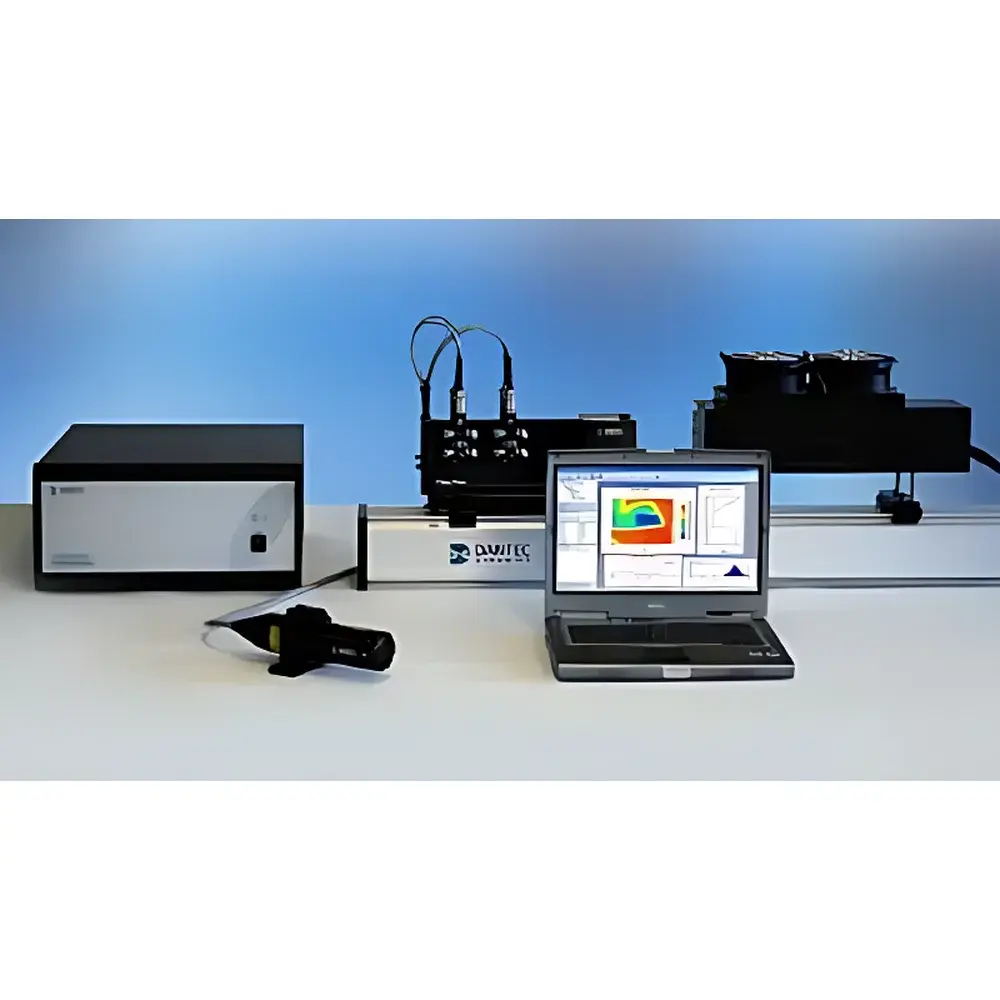
Dantec FiberFlow Laser Doppler Anemometry (LDA) System
| Brand | Dantec |
|---|---|
| Origin | Denmark |
| Model | FiberFlow |
| Flow Measurement Principle | Laser Doppler Anemometry (LDA) |
| Velocity Range | 0–1500 m/s |
| Velocity Uncertainty | < 0.1% |
| Measurement Dimensionality | 1D, 2D, and 3D vector velocity |
| Optical Stability | High (thermally compensated interferometric design) |
| Particle Requirement | Seeded flow (with reflective/scattering particles) |
| Installation Type | Benchtop or integrated rig-mount |
| Compliance | ISO 9001-manufactured, compatible with GLP/GMP data integrity workflows (audit trail, user access levels, electronic signatures via optional software modules) |
Overview
The Dantec FiberFlow Laser Doppler Anemometry (LDA) System is a high-precision, research-grade optical velocimetry platform engineered for non-intrusive, point-wise measurement of instantaneous fluid velocity in gaseous and liquid flows. Unlike thermal or electromagnetic flowmeters—whose operational principles rely on bulk property changes—the FiberFlow system operates on the fundamental Doppler shift principle: when monochromatic laser light intersects with moving seeding particles, the frequency of the scattered light shifts proportionally to particle velocity. This interferometric detection method enables sub-micrometer spatial resolution and nanosecond temporal response, making it uniquely suited for characterizing highly transient, turbulent, or reverse-flow phenomena in complex geometries. Designed for laboratory and industrial R&D environments—including combustion chambers, internal combustion engines, rotating machinery test rigs, large-scale wind tunnels, and underwater hydrodynamic facilities—the FiberFlow delivers traceable velocity data without disturbing flow fields, eliminating probe-induced blockage, wake distortion, or thermal conduction artifacts common in hot-wire or Pitot-based systems.
Key Features
- Multi-dimensional capability: Simultaneous acquisition of 1D, 2D, or 3D velocity components using configurable dual- or triple-beam optical setups.
- Ultra-wide dynamic range: Validated velocity measurement from near-zero (< 0.01 m/s) up to supersonic conditions (1500 m/s), supporting both laminar boundary layer studies and high-Mach combustion diagnostics.
- Robust signal processing architecture: Adaptive filtering, real-time burst-mode acquisition, and cross-correlation algorithms ensure reliable velocity extraction even under high-noise conditions—e.g., flame radiation, mechanical vibration, or dense particle loading (up to 10⁶ particles/cm³).
- Modular optical configuration: Interchangeable transmitting optics (e.g., fiber-coupled probes, focusing lenses, beam expanders) and receiving heads enable rapid adaptation to confined spaces, high-temperature enclosures, or submerged environments.
- Thermally stabilized interferometer: Precision-machined, low-expansion optical bench with active temperature control minimizes drift over extended measurement campaigns (>8 hours continuous operation).
- Integrated alignment aids: Motorized mirror mounts, visible alignment lasers, and real-time fringe visualization simplify setup—reducing commissioning time by >60% compared to legacy LDA platforms.
Sample Compatibility & Compliance
The FiberFlow system requires optically scattering seeding particles (e.g., TiO₂, SiO₂, or oil droplets) uniformly dispersed in the flow medium; it is compatible with air, nitrogen, helium, combustion exhaust gases, water, and aqueous suspensions. No direct contact with the fluid is required—eliminating calibration drift due to fouling or corrosion. All hardware complies with IEC 61000-6-3 (EMC emission standards) and IEC 60825-1 (laser safety Class IIIB). Software supports 21 CFR Part 11-compliant operation when configured with validated firmware and audit-trail-enabled acquisition modules. System documentation conforms to ISO/IEC 17025 requirements for metrological traceability of velocity measurements, with factory calibration certificates traceable to NIST and DTU Metrology.
Software & Data Management
The FiberFlow is operated via Dantec Dynamics’ StreamLine software—a modular, role-based application supporting three user tiers: Operator (measurement execution only), Engineer (parameter optimization and post-processing), and Administrator (system configuration, security policy, and electronic signature management). Raw photon arrival timestamps are stored in HDF5 format with embedded metadata (laser power, focal volume geometry, trigger source, ambient temperature). Real-time statistical analysis includes mean velocity, RMS fluctuation, probability density functions (PDFs), and two-point correlation. Export options include CSV, MATLAB .mat, and Tecplot-compatible PLT formats. Optional StreamLine IQ module adds automated quality assessment, outlier rejection based on signal-to-noise ratio (SNR) thresholds, and batch report generation aligned with ASTM D2983 or ISO 5167 validation protocols.
Applications
- Combustion science: Flame front propagation, swirl-stabilized burner dynamics, and soot-particle velocity coupling in gas turbine combustors.
- Powertrain development: In-cylinder gas motion during intake/compression strokes, fuel spray interaction, and EGR mixing efficiency in diesel and HCCI engines.
- Aerodynamics: Boundary layer transition detection, separation bubble characterization, and unsteady vortex shedding in low- and high-speed wind tunnels.
- Biomedical fluid mechanics: Pulsatile airflow in anatomically accurate airway models and particle deposition mapping in inhalation studies.
- Environmental engineering: Turbulent dispersion modeling in atmospheric boundary layer simulators and sediment-laden flow behavior in flume studies.
FAQ
Is the FiberFlow suitable for measuring mass flow rate directly?
No—it measures instantaneous local velocity at a defined measurement volume. Mass flow rate must be derived by integrating velocity profiles across a known cross-sectional area, requiring complementary geometric calibration and seeding uniformity verification.
Can FiberFlow operate in explosive or hazardous environments?
Yes—when equipped with intrinsically safe (ATEX/IECEx-certified) fiber-optic delivery units and remotely located laser sources, the system meets Zone 1/21 classification requirements.
What particle size range is optimal for reliable Doppler signal generation?
Typical seeding diameters range from 0.5 µm to 5 µm; Mie scattering theory governs signal strength, and optimal sizing depends on laser wavelength (commonly 532 nm or 785 nm) and flow Reynolds number.
Does the system support synchronization with other diagnostic tools?
Yes—via TTL/PECL triggers and IEEE-1588 precision time protocol (PTP), enabling phase-locked acquisition with high-speed cameras, pressure transducers, or OH* chemiluminescence detectors.
Is on-site installation and training included with purchase?
Dantec Dynamics-certified field engineers provide standard commissioning, optical alignment verification, and two-day operator training; extended support contracts cover annual performance validation and software update deployment.