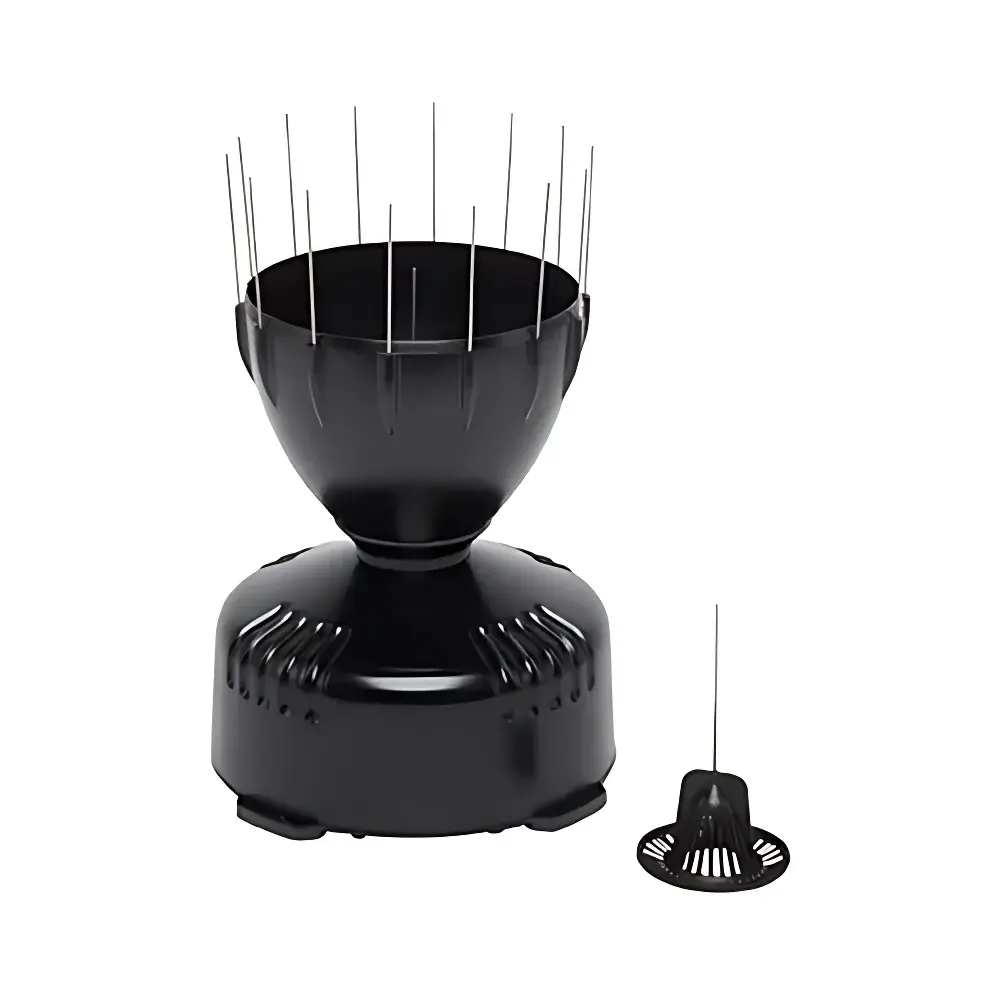
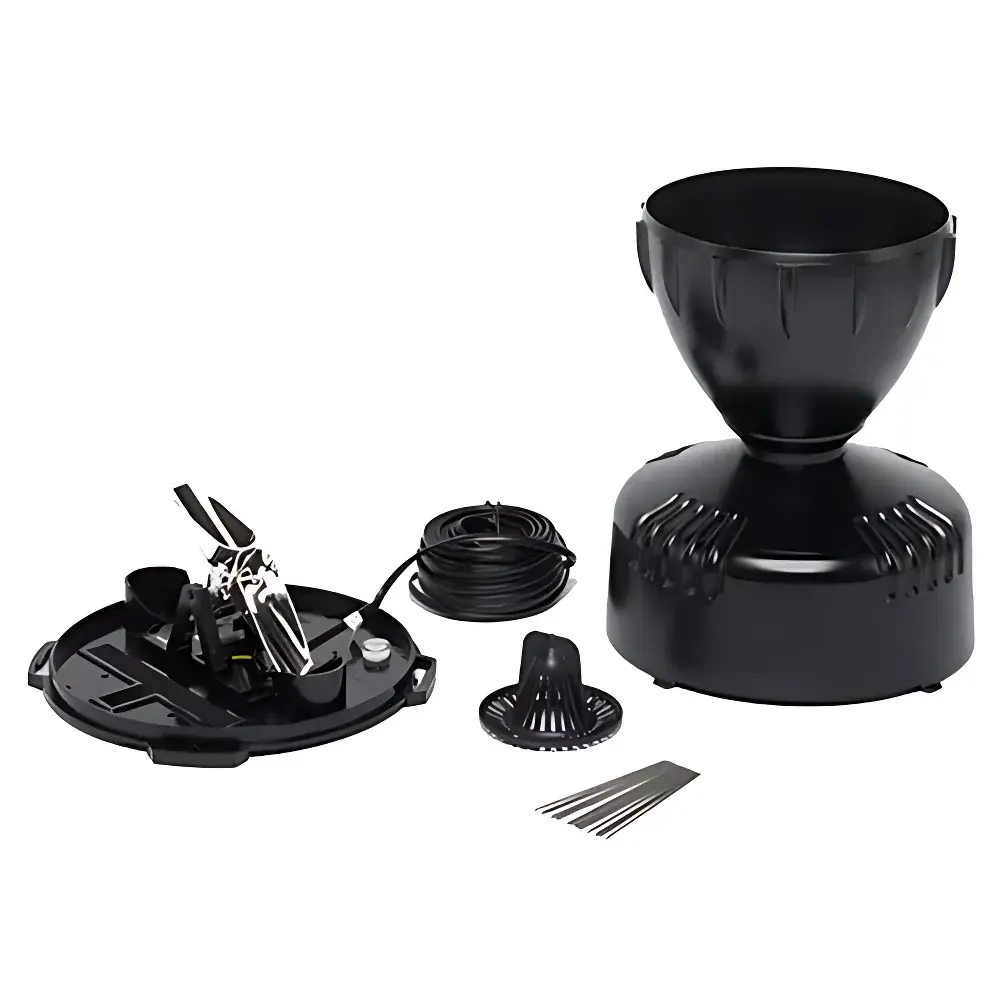
Davis 6464 Tipping Bucket Rain Gauge
| Brand | Davis |
|---|---|
| Origin | USA |
| Model | 6464 |
| Resolution | 0.2 mm per tip |
| Accuracy | ±4% of total rainfall or ±1 tip (0.2 mm), whichever is greater |
| Sensor Type | Tipping bucket with reed switch |
| Cable | 4-conductor, 26 AWG, modular RJ-11 connector |
| Standard cable length | 12 m |
| Max extended cable length | 270 m |
| Housing material | UV-stabilized ABS plastic |
| Collection area | 214 cm² |
| Dimensions (rain collector) | Ø16.5 cm × H24 cm (excl. bird spike) |
| Weight | 1.0 kg |
| Mounting | Flat-surface installation |
| Compliance | WMO-recommended design principles |
| Compatible systems | Vantage Pro2, Weather Envoy, Vantage Connect, and all Davis ISS-compatible weather stations |
Overview
The Davis 6464 Tipping Bucket Rain Gauge is an industrial-grade precipitation measurement instrument engineered for long-term outdoor deployment in professional meteorological, hydrological, and environmental monitoring applications. It operates on the well-established tipping bucket principle: rainwater enters a calibrated funnel-shaped collector, passes through a debris-resistant mesh filter, and accumulates in a precision-balanced dual-chamber bucket assembly. Each chamber has a nominal capacity corresponding to 0.2 mm of rainfall over the defined collection area (214 cm²). When one chamber fills to its threshold, gravity induces a mechanical tilt, actuating a sealed reed switch that generates a discrete digital pulse. This pulse is transmitted via shielded 4-conductor cabling to a compatible data logger or weather station console. The device’s aerodynamic profile minimizes wind-induced undercatch—a critical performance factor validated against World Meteorological Organization (WMO) Guidance on Precipitation Measurement—ensuring high reproducibility across varying wind speeds and rainfall intensities.
Key Features
- WMO-aligned mechanical design optimized for low-wind-distortion catch efficiency
- UV-stabilized ABS plastic housing and base for sustained structural integrity under prolonged solar exposure
- Precision-machined tipping mechanism with factory-calibrated 0.2 mm resolution per tip (equivalent to 0.01 inch)
- Integrated stainless-steel debris filter to prevent clogging without compromising flow dynamics
- RJ-11 modular interface enabling plug-and-play integration with Davis Vantage Pro2, Weather Envoy, and Vantage Connect systems
- Support for extended cable runs up to 270 meters using standard 26 AWG 4-conductor wiring
- Flat-mount configuration (model 6464) suitable for rooftop, platform, or ground-level installations where vertical pole mounting is impractical
Sample Compatibility & Compliance
The 6464 rain gauge is designed for continuous, unattended operation in ambient temperature ranges from –40 °C to +65 °C and relative humidity up to 100%. Its collection geometry adheres to WMO-recommended aperture-to-height ratios and rim geometry standards to reduce turbulence and splash error. While not certified to ISO 9060 or ASTM D3624 as a standalone metrological standard, it meets functional equivalence requirements for Class B operational rain gauges per WMO No. 8 (Guide to Instruments and Methods of Observation). It is routinely deployed in networks compliant with national hydrometric protocols—including USGS Hydro-Climatic Data Network (HCDN) and NOAA’s COOP program—and supports GLP-aligned data traceability when integrated with Davis logging platforms that maintain timestamped event logs.
Software & Data Management
Each tip generates a binary closure signal interpreted as a 0.2 mm precipitation increment by compatible Davis consoles. Raw pulse data is time-stamped at the host logger level with microsecond resolution (dependent on host system clock stability). When used with Vantage Connect or WeatherLink Live, data is automatically uploaded to WeatherLink.com cloud infrastructure, supporting CSV export, API access, and third-party integration via HTTPS/JSON endpoints. Firmware-upgradable hosts enable configurable sampling intervals, accumulation periods (e.g., 1-min, 15-min, hourly totals), and diagnostic alerts (e.g., tip rate anomaly detection). All stored records include metadata such as sensor ID, firmware version, and connection status—facilitating audit-ready documentation per FDA 21 CFR Part 11–aligned workflows when deployed in regulated environmental monitoring contexts.
Applications
- Real-time precipitation monitoring for flood forecasting and watershed modeling
- Calibration reference for radar-based quantitative precipitation estimation (QPE)
- Long-term climate station networks requiring NIST-traceable field instrumentation
- Agricultural irrigation scheduling and evapotranspiration (ET) modeling inputs
- Urban stormwater management systems and green infrastructure performance validation
- Academic atmospheric science field campaigns requiring ruggedized, low-maintenance sensors
FAQ
What is the effective collection area of the Davis 6464 rain gauge?
The calibrated orifice area is 214 cm², directly traceable to the 0.2 mm per-tip resolution specification.
Can the 6464 be installed on a standard meteorological tower?
No—the 6464 is specifically configured for flat-surface mounting; use model 6466 for pole or mast installation.
Is calibration certificate included with purchase?
Units are factory-calibrated to 0.2 mm per tip; formal NIST-traceable calibration certificates are available upon request as a value-added service.
How does wind affect measurement accuracy?
The aerodynamic shape and low-profile rim reduce wind-induced undercatch to <5% at 8 m/s horizontal wind speed, consistent with WMO guidance thresholds.
What maintenance is required for long-term reliability?
Biannual visual inspection of the funnel, filter, and bucket pivot points; cleaning with deionized water if particulate buildup is observed; no lubrication or recalibration needed under normal operating conditions.