
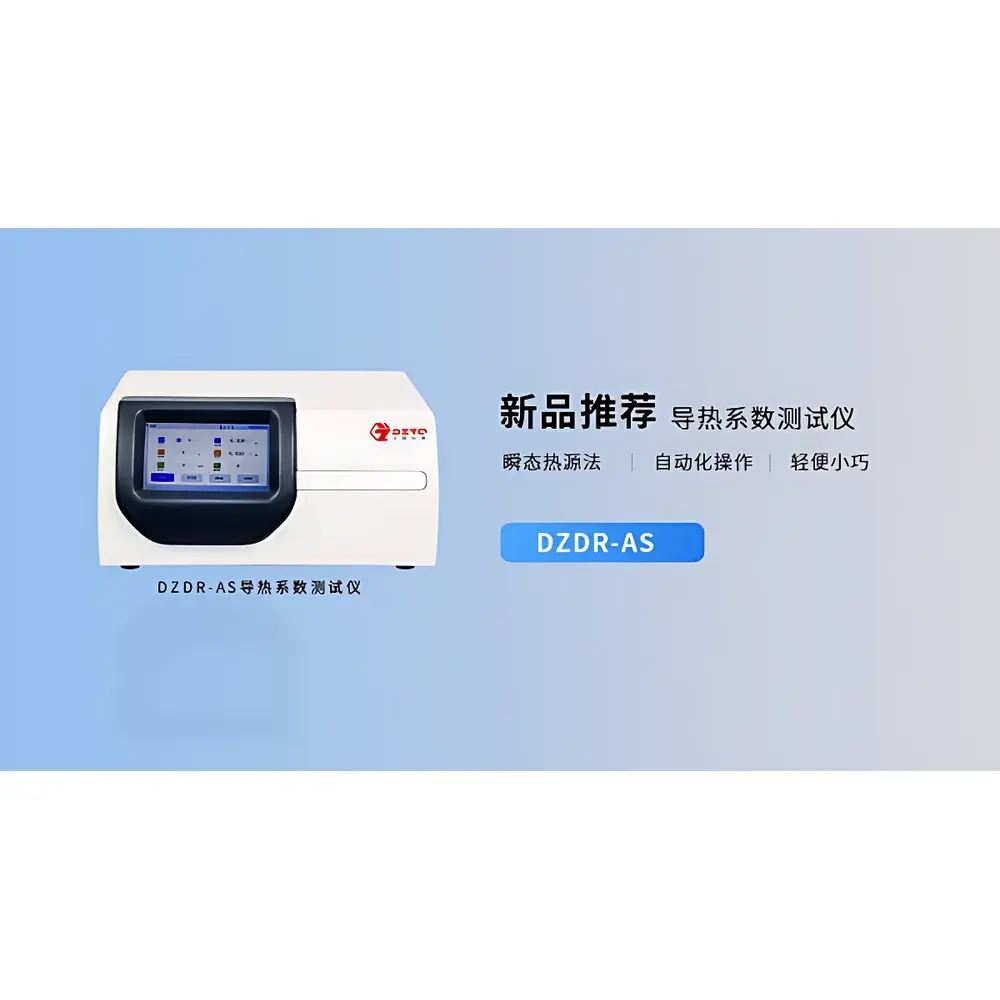
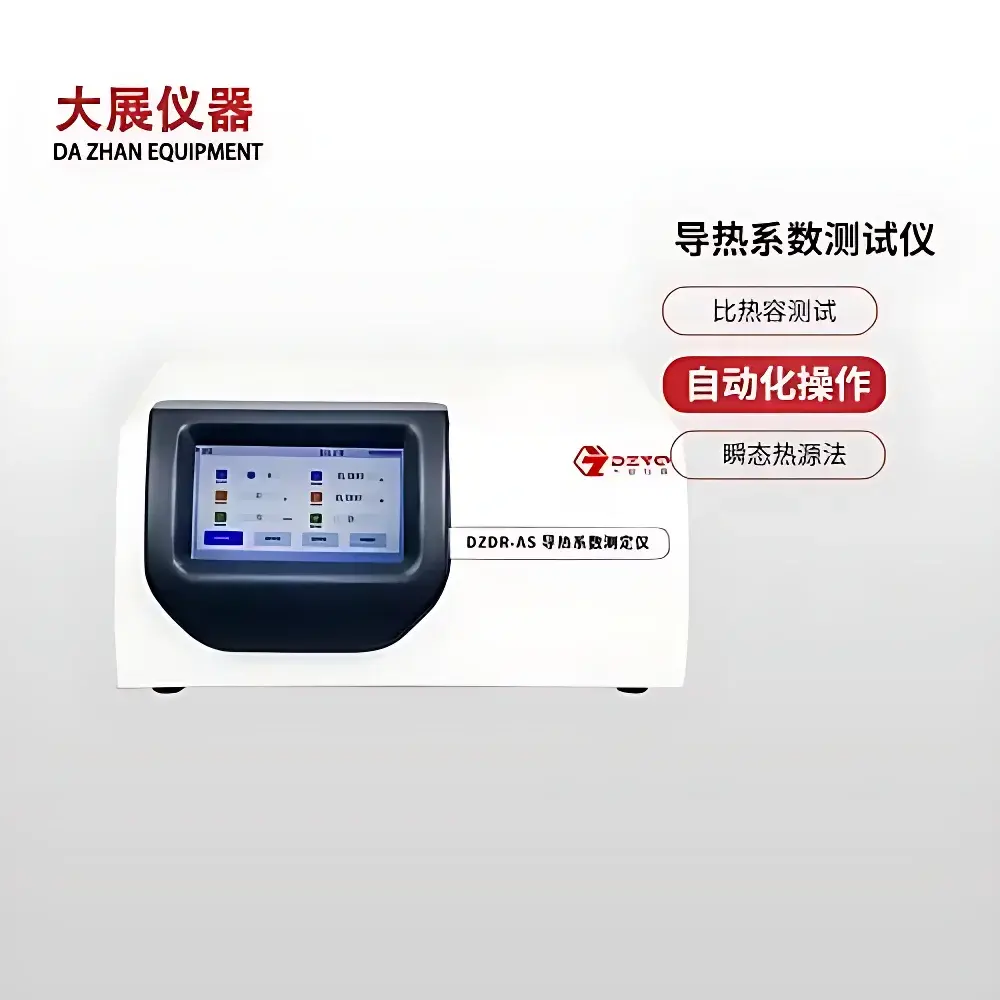
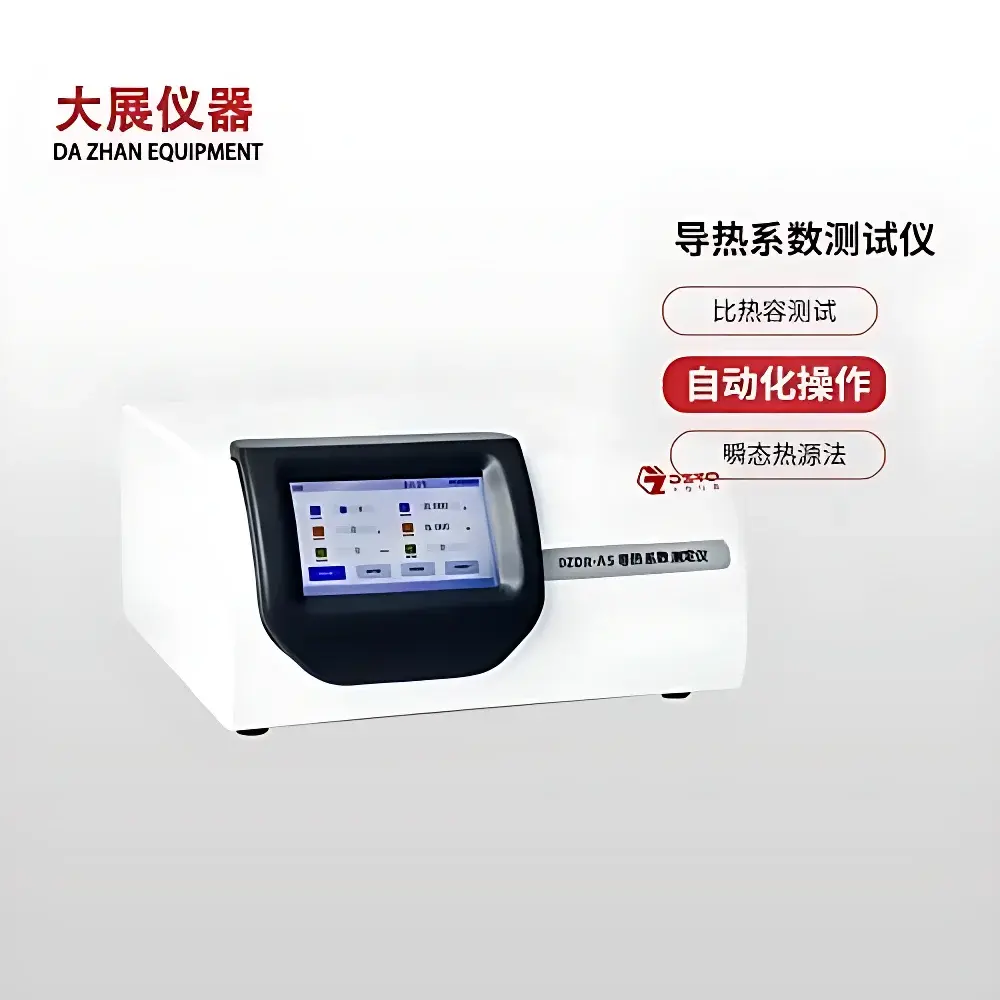
DAZHAN DZDR-AS Automated Transient Plane Source (TPS) Thermal Conductivity Analyzer
| Brand | DAZHAN |
|---|---|
| Origin | Jiangsu, China |
| Manufacturer Type | Authorized Distributor |
| Instrument Type | Transient Plane Source (TPS) Method |
| Sample Throughput | Single-sample mode |
| Test Environment | Ambient temperature operation |
| Thermal Conductivity Range | 0.00001–50 W/(m·K) |
| Resolution | 0.00001 W/(m·K) |
| Repeatability | ≤1% |
| Accuracy | ±1% |
| Temperature Range | −30 °C to 200 °C |
| Sample Forms | Solids (bulk, metallic, thin films), powders, granules, liquids, gels, pastes, and insulating materials |
| Probe Configuration | Dual high-precision TPS sensors (standard) |
| Minimum Solid Sample Dimensions | 15 mm × 15 mm × 7.5 mm (Probe #1) |
| Liquid/Powder Sample Volume | 18 mL via dedicated fixture |
| Measurement Time | ≤160 s per test |
| Power Consumption | <300 W |
Overview
The DAZHAN DZDR-AS Automated Transient Plane Source (TPS) Thermal Conductivity Analyzer is an engineered solution for rapid, high-fidelity thermal property characterization across diverse material classes. Based on the internationally standardized transient plane source method (ISO 22007-2, ASTM D7984), the instrument applies a known amount of electrical energy to a thin, sandwiched sensor acting simultaneously as heat source and temperature sensor. The resulting transient temperature rise is recorded with microsecond resolution, enabling direct calculation of thermal conductivity (λ), thermal diffusivity (α), and volumetric heat capacity (Cpρ) from first-principles physics—without requiring steady-state equilibration or iterative calibration assumptions. Designed for laboratory and QC environments where throughput and cross-material flexibility are critical, the DZDR-AS delivers reliable data in under 160 seconds per measurement while maintaining traceable accuracy of ±1% and repeatability better than 1%—performance validated against NIST-traceable reference materials.
Key Features
- Automated baseline and power optimization: Real-time adaptive control eliminates manual tuning, ensuring optimal signal-to-noise ratio across low-conductivity polymers (e.g., aerogels, foams) and high-conductivity metals (e.g., aluminum, copper).
- Dual-probe architecture: Two interchangeable TPS sensors support broad geometric compatibility—from small-format solids (≥15 mm × 15 mm × 7.5 mm) to large-area samples (≥30 mm × 30 mm × 15 mm) and bulk liquids/powders (18 mL fixture).
- Full bidirectional control: Synchronized operation between embedded color touchscreen interface and PC-based software enables remote monitoring, parameter scripting, and real-time data visualization without hardware reconfiguration.
- Integrated heat capacity calculation: Unlike conventional TPS instruments, the DZDR-AS firmware solves the coupled heat conduction equation to derive Cpρ directly from the same transient dataset—eliminating need for separate DSC or calorimetry runs.
- Rugged industrial-grade enclosure: Fan-cooled thermal management and EMI-shielded electronics ensure stable performance during extended operation within ambient labs (−30 °C to 200 °C environmental range).
Sample Compatibility & Compliance
The DZDR-AS accommodates unrestricted sample morphology—including rigid solids, flexible films, metallic alloys, ceramics, porous insulation, slurries, Newtonian and non-Newtonian liquids, cohesive powders, and viscoelastic pastes—without requiring surface metallization, vacuum chambers, or contact-pressure optimization. All measurements comply with ISO 22007-2 (Plastics — Determination of thermal conductivity and thermal diffusivity — Part 2: Transient plane source (hot disc) method) and align with ASTM D7984 (Standard Test Method for Thermal Conductivity of Polymer Matrix Composites Using a Transient Plane Source Technique). Data integrity meets GLP/GMP documentation requirements through built-in audit trail logging, user-access controls, and timestamped metadata embedding. Optional anti-magnetic probe variants enable testing in electromagnetic-sensitive settings (e.g., near MRI systems or RF chambers).
Software & Data Management
The proprietary DZDR Analysis Suite (v4.2+) provides full instrument control, automated report generation (PDF/CSV/XLSX), and advanced post-processing tools—including multi-curve overlay, temperature-dependent λ(θ) fitting, statistical batch analysis, and uncertainty propagation modeling per GUM (Guide to the Expression of Uncertainty in Measurement). Software supports 21 CFR Part 11-compliant electronic signatures, role-based permissions, and encrypted local database storage. Raw transient voltage/time datasets are preserved in open HDF5 format for third-party validation or integration into LIMS/QMS platforms.
Applications
- Quality control of thermal interface materials (TIMs), phase-change composites, and battery thermal management pads.
- R&D screening of polymer nanocomposites, aerogel formulations, and ceramic matrix composites for aerospace and EV applications.
- Regulatory submission support for medical device packaging (ISO 11607), building insulation (ASTM C518), and food-contact materials (FDA 21 CFR 177).
- Academic research in condensed matter physics, geothermal material science, and cryogenic thermal transport phenomena.
- Process validation of sintering, extrusion, and coating parameters via in-line thermal property correlation.
FAQ
What standards does the DZDR-AS comply with for thermal conductivity measurement?
It adheres to ISO 22007-2 and ASTM D7984 for transient plane source methodology, with traceability to national metrology institutes via certified reference materials.
Can the instrument measure anisotropic materials?
Yes—by orienting the probe normal to principal axes and comparing orthogonal measurements; directional thermal conductivity tensors can be reconstructed using the included anisotropy analysis module.
Is calibration required before each test?
No—automated baseline compensation and self-referencing algorithms eliminate routine recalibration; annual verification with SRM 1450c (fiberglass board) or NIST 1470 (stainless steel) is recommended.
How is data security ensured in regulated environments?
Through 21 CFR Part 11–compliant audit trails, electronic signature workflows, encrypted local storage, and configurable user privilege levels.
What maintenance is needed for long-term stability?
Annual sensor resistance verification and thermal interface compound replacement; no optical alignment or mechanical recalibration required due to solid-state probe design.



