
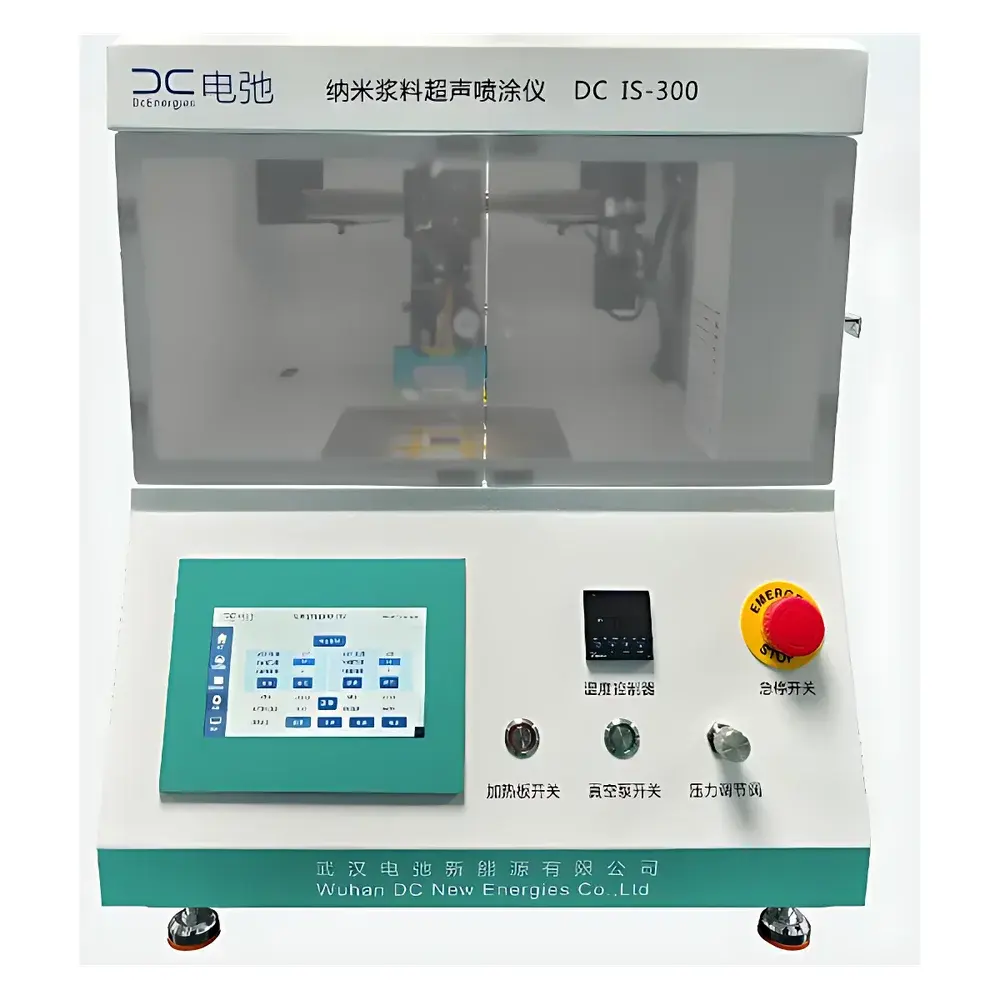
DC-Energies DC Ultrasonic Nano-Slurry Spray Coater
| Brand | DC-Energies |
|---|---|
| Model | DC |
| Type | Ultrasonic Spray Coating System for Catalyst Inks |
| XY Travel Range | 200 × 200 mm |
| Z-Axis Travel | 50 mm |
| Dispensing System | Programmable Flow Rate Control |
| Hotplate Dimensions | 220 × 220 mm |
| Heating Temperature | Up to 200 °C |
| Vacuum Substrate Hold-Down | Integrated |
| Power Supply | 220 VAC, 50 Hz, <800 W |
| Overall Dimensions | 630 × 600 × 630 mm (W×D×H) |
| Weight | <50 kg |
| Max Coating Area | 200 × 200 mm² |
| Compatible Processes | CCS, CCM, Thermal Transfer |
Overview
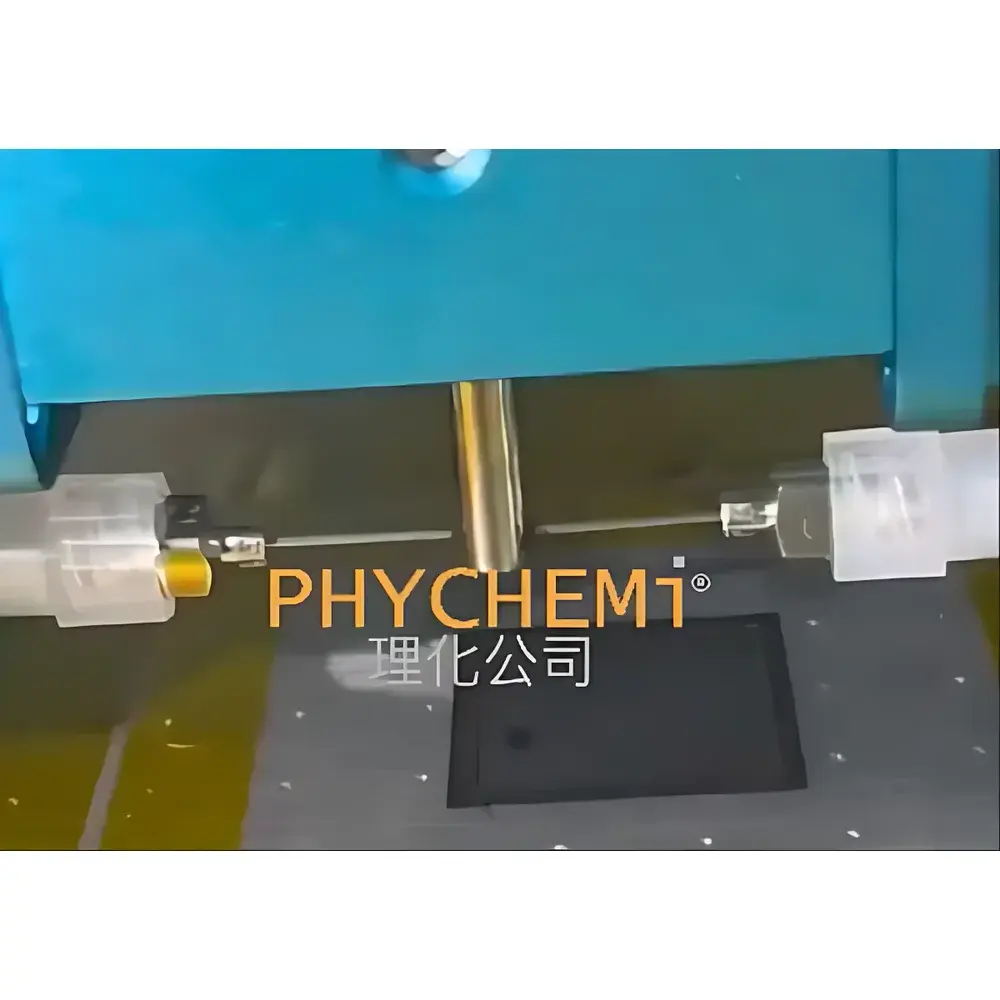
The DC-Energies DC Ultrasonic Nano-Slurry Spray Coater is an engineered platform designed for precise, repeatable deposition of nanoparticle-based catalyst inks—particularly aqueous or solvent-based slurry formulations—onto porous or polymer substrates. It operates on the principle of high-frequency ultrasonic atomization (typically 1.6–2.4 MHz), where piezoelectric transducers convert electrical energy into mechanical vibration, inducing capillary wave formation at the liquid surface and generating a fine, monodisperse aerosol mist. This mechanism avoids nozzle clogging commonly associated with pneumatic or pressure-driven spray systems, making it uniquely suitable for suspensions containing nanoparticles (e.g., Pt/C, IrO₂, NiFe LDH) with solids loading up to 30 wt% and viscosities ≤ 50 mPa·s. The system is purpose-built for membrane electrode assembly (MEA) fabrication in PEM fuel cell and electrolyzer R&D, supporting critical process pathways including catalyst-coated substrate (CCS), catalyst-coated membrane (CCM), and thermal transfer methods. Its closed-loop motion control, integrated vacuum chuck, and programmable thermal management enable deterministic coating uniformity across substrates ranging from gas diffusion layers (GDLs) to proton exchange membranes (PEMs), bridging the gap between lab-scale formulation development and pilot-scale process validation.
Key Features
- Ultrasonic atomization module with adjustable frequency and amplitude—ensures stable mist generation without nozzle fouling, even with nanoscale particulates or aggregated slurries.
- High-precision XYZ stage: 200 × 200 mm XY travel with ±1 µm repeatability; 50 mm Z-axis lift range for dynamic standoff distance control during deposition.
- Integrated heated vacuum chuck (220 × 220 mm): Uniform temperature distribution (<±2 °C deviation across surface), vacuum hold-down force ≥ 60 kPa, compatible with flexible and brittle substrates (e.g., Nafion®, carbon paper, Ti mesh).
- Programmable dispensing system: Syringe pump or peristaltic feed with flow rate control (0.1–5 mL/min), synchronized with stage motion for linear or raster pattern deposition.
- Compact footprint (0.38 m²) and modular architecture—designed for integration into gloveboxes (N₂/Ar atmosphere) or fume hoods; compliant with ISO 14644-1 Class 7 cleanroom operational practices when enclosed.
- Robust industrial-grade construction: Aluminum alloy frame with ESD-safe surface finish; CE-marked power supply and safety interlocks per IEC 61000-6-2/6-4.
Sample Compatibility & Compliance
The DC coater accommodates substrates up to 200 × 200 mm² and thicknesses from 25 µm (thin PEMs) to 500 µm (reinforced GDLs). It supports both hydrophilic and hydrophobic surfaces without pre-treatment, provided surface energy exceeds 32 mN/m. Slurry compatibility includes water-, isopropanol-, ethanol-, and NMP-based dispersions containing metal nanoparticles, metal oxides, conductive carbons, and ionomers (e.g., Nafion® dispersion). All wetted components are chemically resistant (316 stainless steel, PTFE, fused silica). The system meets functional requirements outlined in ASTM D7247-16 (Standard Practice for Evaluating Fuel Cell Catalyst Ink Deposition) and aligns with DOE Hydrogen Program targets for MEA manufacturing reproducibility (CV ≤ 5% for catalyst loading across 10 cm² zones). Full audit trail capability—including parameter logs, timestamped motion profiles, and thermal history—is available for GLP/GMP-aligned workflows.
Software & Data Management
The system runs on embedded Linux with a web-accessible GUI (HTTPS-secured, responsive HTML5 interface). Users define deposition protocols via intuitive drag-and-drop path editors or import G-code/CSV-defined trajectories. Real-time monitoring includes stage position feedback (encoder-resolved), substrate temperature (PT100 sensor, ±0.5 °C accuracy), and dispensing volume (pulse-count calibrated). All operational data—including setpoints, actuals, alarms, and user actions—are stored locally in SQLite format with optional export to CSV or direct upload to LIMS via REST API. Audit trail records comply with FDA 21 CFR Part 11 requirements when paired with network-authenticated user accounts and electronic signature modules. Firmware updates are delivered over secure OTA channels with SHA-256 verification.
Applications
- Development and optimization of low-Pt-loading catalyst inks for PEMFC cathodes and anodes.
- Rapid prototyping of structured catalyst layers with controlled thickness gradients (e.g., 5–50 µm wet film, yielding 1–15 µm dry catalyst layers).
- Deposition of iridium/ruthenium oxide catalysts onto titanium substrates for PEM water electrolysis anodes.
- Functional coating of electrospun nanofiber mats for hybrid electrode architectures.
- Preparation of reference electrodes and calibration standards for electrochemical impedance spectroscopy (EIS) and cyclic voltammetry (CV).
- Scalable process mapping: Correlation of spray parameters (frequency, flow rate, dwell time) to electrochemical active surface area (ECSA) and mass activity metrics.
FAQ
What types of catalyst slurries are compatible with this system?
Aqueous, alcoholic, and aprotic solvent-based nanoparticle dispersions with viscosities below 50 mPa·s and particle sizes under 500 nm are routinely processed. Slurries containing ionomer binders (e.g., Nafion®, Sustainion®) require shear-stable formulation but remain fully compatible.
Can the system operate inside a nitrogen-filled glovebox?
Yes—the unit is designed for inert-atmosphere operation with feedthrough-compatible electrical and vacuum ports. Optional purge fittings and sealed cable glands are available upon request.
Is remote operation supported?
Full remote access is enabled via encrypted web interface; no proprietary client software is required. Secure SSH and VNC fallback options are included for advanced diagnostics.
How is coating uniformity verified?
Users may integrate in-line optical profilometry or post-deposition SEM/EDS mapping. The system’s motion repeatability and thermal stability support ≤±3% thickness variation across 100 cm² areas when operated within specified environmental conditions (23±2 °C, 40–60% RH).
Does the system meet regulatory requirements for pharmaceutical or battery R&D use?
While not certified for GMP production, its audit trail, user access controls, and parameter locking features satisfy baseline data integrity expectations for preclinical battery electrode development and catalyst screening under ISO 17025-accredited labs.



