
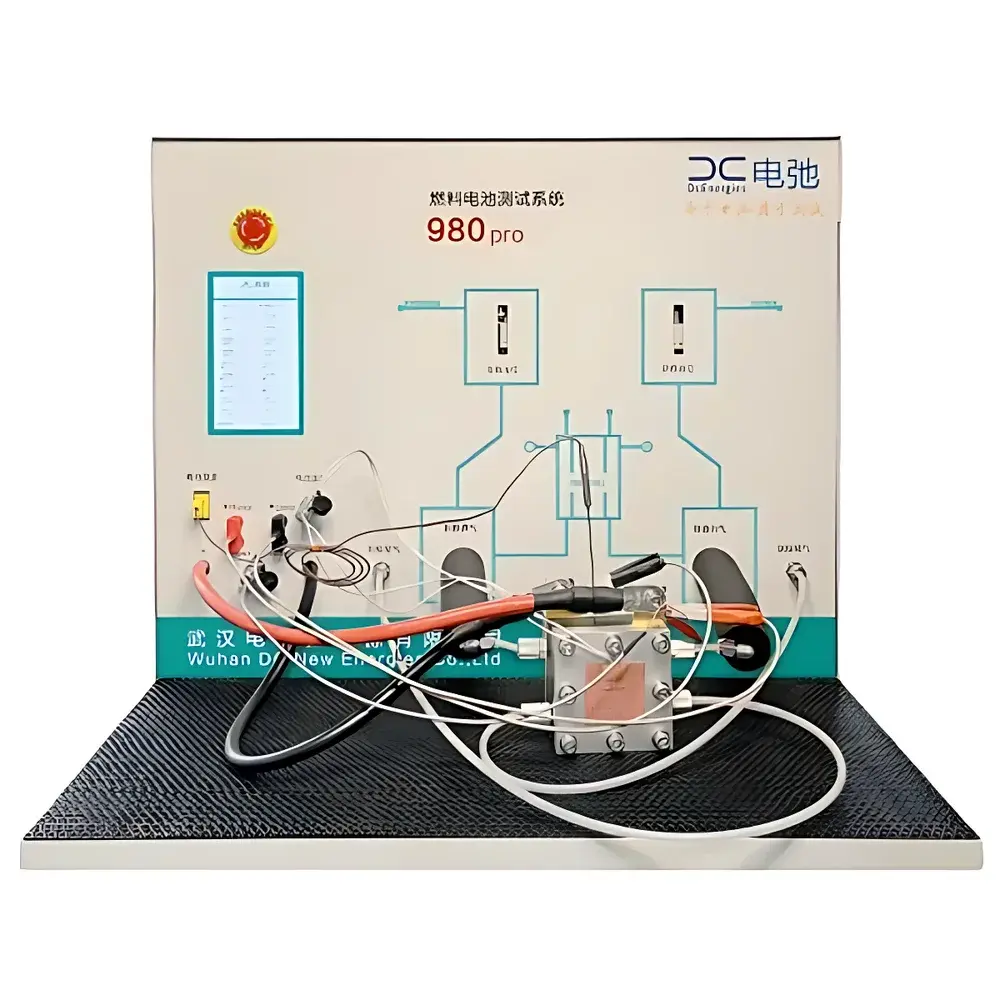
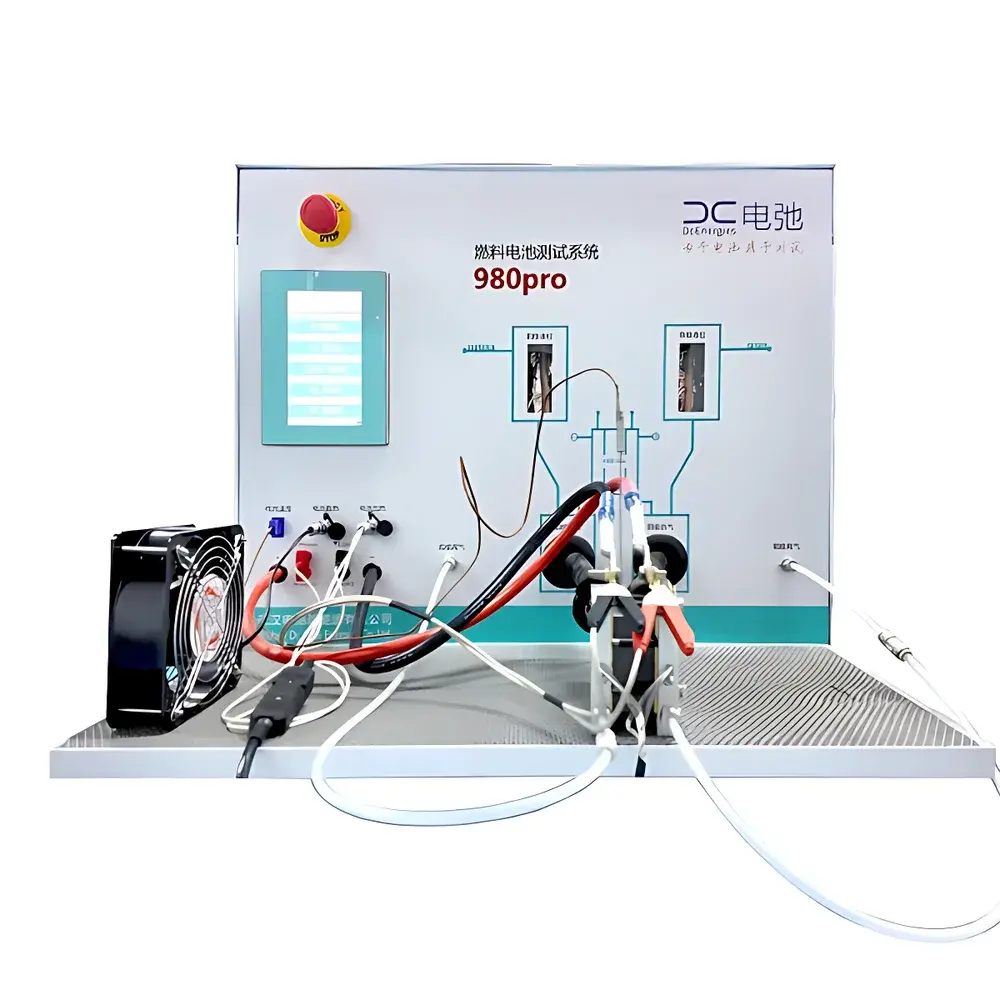
DC980Pro PEM Fuel Cell Testing System
| Brand | dc-energies |
|---|---|
| Origin | Wuhan, Hubei, China |
| Model | DC980Pro |
| Gas Flow Control Accuracy | ±(0.4% RD + 0.2% F.S.) (optional), ±(0.8% RD + 0.2% F.S.) (standard) |
| Anode/Cathode Backpressure Control Range | 0–0.3 MPa (gauge), Auto-regulated |
| Humidification Method | Bubble-type with PID temperature control (25–90 °C) |
| Gas Flow Ranges | Anode up to 5 SLPM, Cathode up to 10 SLPM |
| Pressure Measurement Range | 0–1 MPa (gauge), ±0.5% accuracy |
| Temperature Control Accuracy | ±1 °C (steady state) |
| Voltage Range | –3.3 V to 10 V per cell |
| Resolution | 0.05/0.25 mV |
| Current Range | 0–24 A / 0–240 A (customizable) |
| Resolution | 0.4–4 mA |
| Power Rating | 1.6 kW (electronic load) |
| Max. Single-cell Test Power | 100 W |
| Safety | Integrated H₂ sensor (1000–40000 ppm configurable), dual-mode emergency shutdown, N₂ auto-purge, multi-level interlock logic |
| Dimensions | 705 mm (W) × 830 mm (D) × 730 mm (H) |
| Net Weight | 110 kg |
Overview
The DC980Pro PEM Fuel Cell Testing System is a compact, research-grade benchtop platform engineered for rigorous characterization and durability evaluation of proton exchange membrane (PEM) fuel cells. Designed and manufactured by dc-energies (Wuhan, China), the system implements a Couette-flow-aligned gas delivery architecture coupled with closed-loop pressure regulation, precise thermal management, and high-fidelity electrochemical monitoring. Its core measurement methodology integrates real-time galvanostatic/potentiostatic/current-interrupt impedance protocols with synchronized gas stoichiometry, humidification control, and thermal profiling—enabling reproducible acquisition of polarization curves, activation/diffusion/mass transport losses, and degradation kinetics under ISO 8528-10, ASTM D6335, and DOE Hydrogen and Fuel Cell Program-recommended test protocols. The sub-0.5 m³ footprint ensures compatibility with university teaching labs, small-scale R&D facilities, and GLP-compliant validation environments where space-constrained deployment is critical.
Key Features
- Automated dual-channel backpressure regulation (anode & cathode, 0–0.3 MPa gauge) with real-time PID feedback and pressure transducer redundancy
- High-accuracy mass flow control: ±(0.4% RD + 0.2% F.S.) optional on both anode (up to 5 SLPM) and cathode (up to 10 SLPM) gas streams
- Dual-mode humidification: bubble-type saturators with T-type thermocouple feedback and PID-controlled temperature range (25–90 °C), plus optional membrane humidifier bypass
- Integrated thermal management system covering cell stack, anode/cathode gas lines, and humidifiers—each independently controlled with ±1 °C stability
- Real-time dry/wet mode switching for both anode and cathode, triggered automatically via software-defined humidity setpoints
- N₂ auto-purge sequence with programmable duration and flow rate, initiated on shutdown or safety event
- Dual-display interface: primary operator screen with live voltage/current/power overlay; secondary diagnostics panel showing gas pressures, dew points, and safety status flags
- Hardware-enforced safety architecture: redundant H₂ leak detection (0–40,000 ppm configurable threshold), emergency stop button, and cascaded interlock logic (load dump, heater cutoff, fuel isolation, N₂ purge)
- Modular electronics: 1.6 kW programmable electronic load supporting constant-current, constant-voltage, constant-power, and dynamic cycling profiles
- AC impedance capability via built-in 1 kHz AC current injection and four-terminal resistance measurement (range ≤30 Ω, auto-ranging)
Sample Compatibility & Compliance
The DC980Pro accommodates standard PEM single-cell configurations including 5 cm², 25 cm², and 100 cm² active area membrane electrode assemblies (MEAs), with mechanical adaptability for custom gasketed fixtures. It supports hydrogen/air, hydrogen/oxygen, reformate/H₂, and CO-poisoned gas mixtures via its dual-mixing manifold. All operational parameters—including gas composition, stoichiometry, backpressure, relative humidity, and thermal boundary conditions—are traceable and auditable in accordance with ISO/IEC 17025 requirements. The embedded firmware and host software comply with FDA 21 CFR Part 11 principles for electronic records and signatures, featuring role-based access control, audit trail logging, and immutable data archiving. System calibration certificates are provided per manufacturer’s SOPs, aligned with NIST-traceable reference standards for flow, pressure, temperature, and electrical metrology.
Software & Data Management
The proprietary FuelCell Studio software provides native support for experiment scripting, real-time visualization, and post-test analytics. It enables user-defined test sequences (e.g., accelerated stress tests per DOE protocol), automated data tagging by operator, batch export in CSV/Excel-compatible formats, and offline replay of time-synchronized voltage, current, pressure, temperature, and flow traces. The API supports Python and MATLAB integration for custom algorithm development—facilitating machine learning–driven degradation forecasting or model-based parameter identification. All raw data files include embedded metadata (timestamp, operator ID, calibration IDs, environmental conditions), ensuring full traceability for regulatory submissions or peer-reviewed publication. Audit logs record every parameter change, manual override, safety event, and software update—retained for ≥12 months unless externally archived.
Applications
- Single-cell MEA activation and break-in procedures under controlled humidity and stoichiometric ratios
- Polarization curve generation across low-, medium-, and high-current density regimes (0–240 A), with ohmic correction via current-interrupt
- Accelerated durability testing (ADT) per DOE targets: voltage cycling (0.6–0.95 V), start-stop cycling, and OCV hold protocols
- Fuel impurity tolerance studies (CO, NH₃, H₂S) using precisely metered contaminant spikes into anode stream
- Mass transport analysis via limiting current experiments under variable backpressure and stoichiometry
- Thermal gradient mapping across active area using distributed thermocouple inputs
- System-level validation of novel catalyst layers, microporous layers, or gas diffusion media
- Teaching laboratory exercises on electrochemical kinetics, water management, and failure mode analysis
FAQ
What is the maximum operating temperature for membrane humidification?
The bubble humidifiers support stable operation from ambient +10 °C up to 90 °C, with PID-controlled temperature regulation and T-type thermocouple feedback.
Does the system support electrochemical impedance spectroscopy (EIS)?
Yes—integrated 1 kHz AC current injection and four-terminal voltage sensing enable rapid in-situ EIS measurements without external hardware.
Can the DC980Pro be integrated into a larger test stand or automated lab environment?
Yes—the system provides Ethernet (TCP/IP) and RS-232 interfaces with documented SCPI-like command syntax for remote orchestration and data streaming.
Is compliance with GLP or GMP documentation requirements supported?
Yes—audit trails, electronic signatures, calibration history tracking, and 21 CFR Part 11–compliant user access controls are natively implemented.
What safety certifications does the DC980Pro carry?
The system meets CE marking requirements for electromagnetic compatibility (EN 61326-1) and low-voltage directive (EN 61010-1); third-party functional safety assessment per IEC 61508 SIL2 is available upon request.





