
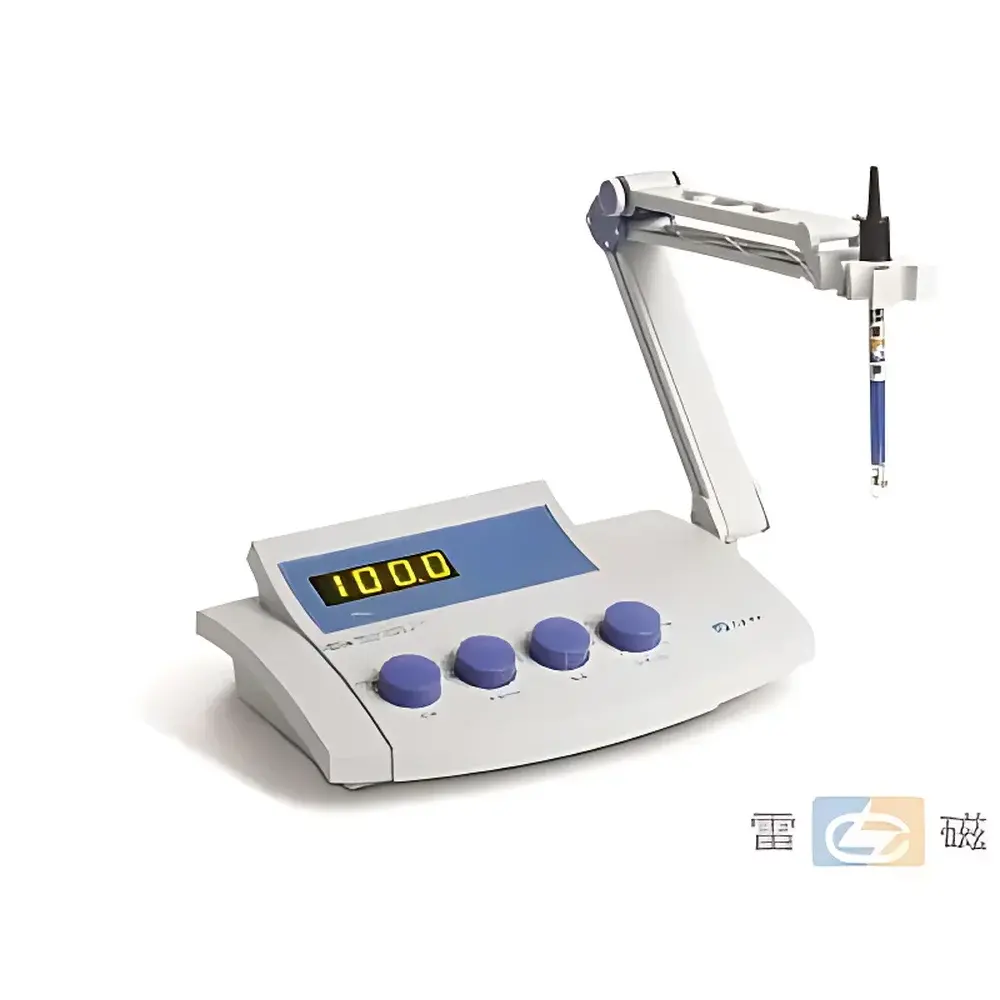
DDS-307 Conductivity Meter
| Origin | Shanghai, China |
|---|---|
| Manufacturer Type | Authorized Distributor |
| Origin Category | Domestic (PRC) |
| Model | DDS-307 |
| Pricing | Available Upon Request |
| Display | 3.5-digit LED |
| Temperature Compensation | Manual, 15.0–35.0 °C |
| Temp. Coefficient | 2 %/°C |
| Output Signal | 0–10 mV DC |
| Electrode Compatibility | DJS-1C platinized platinum electrode (standard), optional Ti alloy electrode (K = 0.01 cm⁻¹) |
| Measurement Range | 0.00 μS/cm to 100 mS/cm |
| Accuracy | ±0.5% FS |
| Stability | (±0.33% FS ±1 digit)/3 h |
| Power Supply | AC 220 V ±10%, 50 Hz ±1 Hz |
| Dimensions (W×D×H) | 290 × 210 × 95 mm |
| Weight | 1.5 kg |
| Enclosure Code | WXS-A000-1 |
| Electrode Constant Calibration Support | K = 0.01, 0.1, 1.0, 10.0 cm⁻¹ |
Overview
The DDS-307 Conductivity Meter is a benchtop electrochemical instrument engineered for reliable, repeatable measurement of electrical conductivity in aqueous solutions across research laboratories, quality control facilities, and industrial process monitoring environments. It operates on the principle of two-electrode AC conductometry—applying a low-frequency alternating current across a pair of electrodes immersed in the sample and measuring the resulting conductance, which is converted to conductivity (σ) using the cell constant (K) via σ = G × K. Designed to meet the performance requirements of ISO 7888 (water quality — determination of electrical conductivity) and aligned with ASTM D1125 guidance for conductivity testing of purified water, the DDS-307 delivers Class 1.0 accuracy per JJG 376–2007 (Chinese National Verification Regulation for Conductivity Meters). Its architecture prioritizes operational stability over extended periods, with drift controlled to ≤(±0.33% FS ±1 digit) over 3 hours—critical for unattended batch verification or calibration validation workflows.
Key Features
- 3.5-digit LED display with high-contrast numeric readout for rapid visual interpretation under variable ambient lighting conditions
- Manual temperature compensation (15.0–35.0 °C) using a fixed 2 %/°C coefficient—suitable for routine applications where precise thermal profiling is not required but ambient correction is necessary
- Isolated 0–10 mV analog output for integration with PLCs, data loggers, or centralized SCADA systems without signal grounding interference
- Dual-electrode compatibility: ships standard with DJS-1C platinized platinum electrode (K = 1.0 cm⁻¹) for general-purpose measurements; supports optional titanium alloy electrode (K = 0.01 cm⁻¹) with sealed measurement chamber for ultrapure water analysis (e.g., pharmaceutical WFI, semiconductor rinse water)
- Modular cell constant configuration: supports four discrete electrode constants (0.01, 0.1, 1.0, 10.0 cm⁻¹), enabling optimized range selection—from sub-μS/cm ultrapure water to concentrated brines up to 100 mS/cm—without hardware modification
- Robust mechanical design: compact footprint (290 × 210 × 95 mm), lightweight aluminum-alloy chassis (1.5 kg), and IP20-rated enclosure suitable for controlled indoor laboratory environments
Sample Compatibility & Compliance
The DDS-307 accommodates liquid samples with conductivity spanning six decades—from deionized water (0.00 μS/cm) to saturated NaCl solutions (~100 mS/cm)—when paired with appropriate electrode geometry and cell constant. Its sealed titanium measurement cell minimizes polarization effects and contamination risk during high-purity water analysis, complying with USP recommendations for conductivity testing of Purified Water and Water for Injection. While the instrument does not include automated temperature sensing, its manual compensation interface allows alignment with calibrated reference thermometers traceable to NIST standards. The device meets electromagnetic compatibility (EMC) requirements per GB/T 18268.1–2010 (equivalent to IEC 61326-1) and electrical safety per GB 4793.1–2007 (IEC 61010-1). It is intended for use in GLP-compliant labs where operator-defined temperature input and documented electrode calibration records satisfy audit requirements.
Software & Data Management
The DDS-307 is a standalone analog-digital hybrid instrument with no embedded microprocessor-based data storage or USB/Bluetooth connectivity. All measurement data must be recorded manually or captured externally via its 0–10 mV analog output using third-party acquisition hardware (e.g., National Instruments DAQ devices or Yokogawa GM10 loggers). For regulated environments requiring electronic record integrity, users may integrate the analog output into 21 CFR Part 11–compliant data acquisition platforms that provide audit trails, user authentication, and electronic signatures. Calibration verification—performed using certified KCl standard solutions (e.g., 1413 μS/cm at 25 °C)—must be documented in lab notebooks or LIMS entries, with electrode constant confirmation conducted prior to each analytical series.
Applications
- Pharmaceutical water system validation (PW, WFI, SW) per EU GMP Annex 1 and USP
- Boiler feedwater and condensate monitoring in power generation facilities
- Monitoring reverse osmosis (RO) and electrodeionization (EDI) effluent purity
- Electroplating bath concentration control in metal finishing operations
- Environmental water quality assessment (surface water, groundwater, wastewater effluent)
- Educational laboratory instruction in analytical chemistry and instrumental methods
FAQ
Does the DDS-307 support automatic temperature compensation (ATC)?
No. It provides manual temperature entry within 15.0–35.0 °C; an external Pt100 or thermistor probe is not supported.
Can I use the DDS-307 for conductivity measurements below 0.1 μS/cm?
Only with the optional K = 0.01 cm⁻¹ titanium electrode and strict procedural controls (e.g., air-free handling, shielded measurement cell, temperature-stabilized environment); detection limit is application-dependent and not specified as a factory guarantee.
Is the instrument compliant with ISO/IEC 17025 requirements?
The DDS-307 itself is not accredited, but it may be used within ISO/IEC 17025-accredited laboratories when operated per validated SOPs, with documented calibration against traceable standards and periodic intermediate checks.
What is the recommended calibration frequency?
Daily calibration is advised for critical applications; weekly calibration suffices for non-GxP routine monitoring—always before first use and after electrode cleaning or replacement.
Does the DJS-1C electrode require activation or conditioning before first use?
Yes. New platinized platinum electrodes must be soaked in 0.1 mol/L KCl solution for ≥2 hours and rinsed thoroughly with deionized water to stabilize surface capacitance and minimize initial drift.
Related Products






