
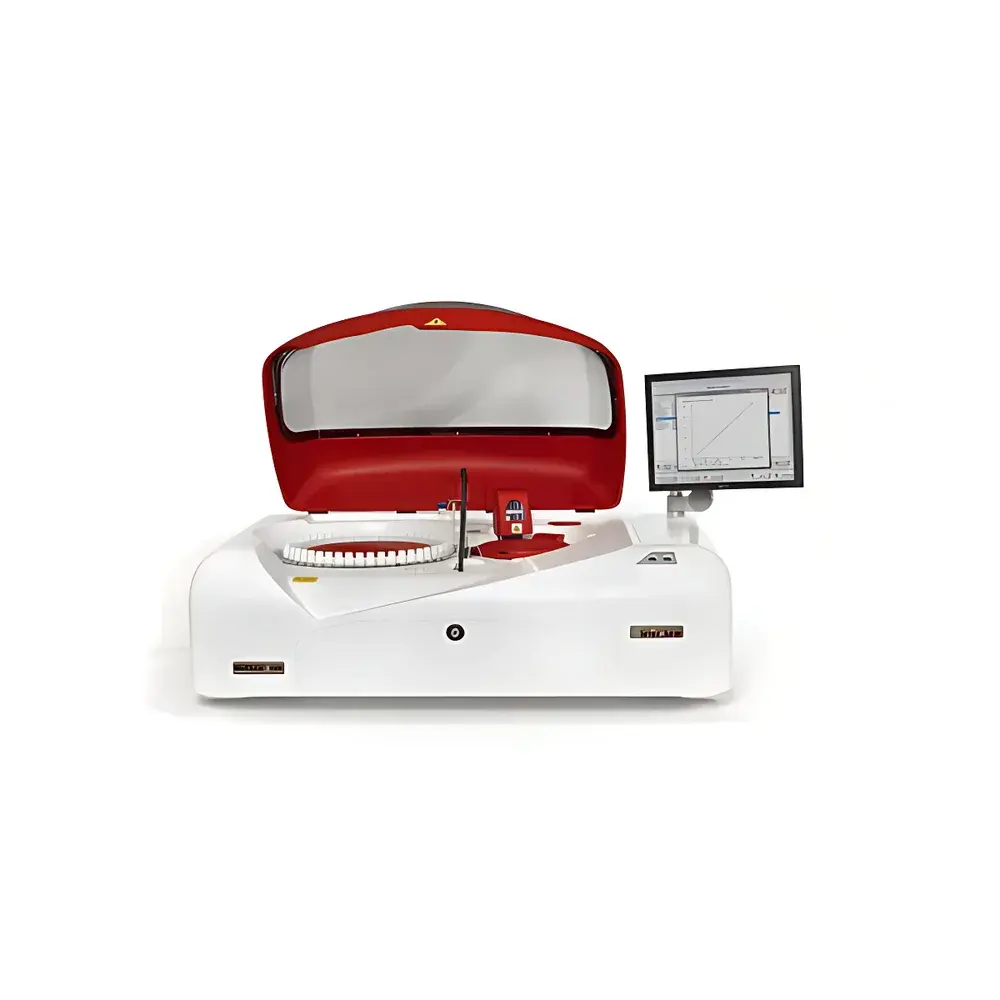
DeChem-Tech CleverChem 380Plus Fully Automated Discrete Analyzer for Tobacco and Water Quality Analysis
| Brand | DeChem-Tech |
|---|---|
| Origin | Germany |
| Model | CleverChem 380Plus |
| Measurement Principle | Photometric Discrete Chemistry (Colorimetric Reaction in Quartz Cuvettes) |
| Sample Capacity | 119 positions |
| Reagent Positions | 49 (with optional refrigerated storage) |
| Throughput | Up to 350 samples per hour |
| Optical Cell | 64-position quartz cuvette carousel, 1 cm path length |
| Cleaning | 8-step ultrasonic washing station with optical validation |
| Dilution Capability | On-cuvette dilution up to 100× (1 mL dilutor volume) |
| Software | Dual-language (English/Chinese), supports true sample blank & reagent blank correction |
| Compliance | Methods aligned with GB (People’s Republic of China National Standards), designed for GLP-compliant environments |
Overview
The DeChem-Tech CleverChem 380Plus is a fully automated discrete analyzer engineered for high-precision, low-maintenance analysis of inorganic and low-molecular-weight analytes in complex matrices—including tobacco extracts, digested plant tissues, and environmental water samples. Unlike continuous-flow or segmented-flow systems, the CleverChem 380Plus employs discrete chemistry: each sample and reagent combination is dispensed into an individual quartz cuvette, where controlled colorimetric reactions occur under standardized temperature and timing conditions. This architecture eliminates cross-contamination, minimizes carryover, and ensures metrological traceability per measurement—critical for regulatory reporting and method validation. The system is optimized for routine determination of nitrogenous compounds (ammonia-N, nitrate-N, nitrite-N, total N), phosphorus species (orthophosphate, total P), halides (chloride), sulfur species (sulfate), and redox-active metals (Cr(VI)), with detection based on photometric absorbance at defined wavelengths (typically 340–880 nm). Its modular design supports both single-analyte and multi-parameter workflows without hardware reconfiguration.
Key Features
- Fully automated discrete analysis platform with 119-sample capacity and 49 reagent positions—enabling unattended batch processing of heterogeneous sample sets.
- 64-position quartz cuvette carousel with 1 cm optical path; cuvettes are rigorously optically validated post-cleaning before reuse, ensuring long-term photometric stability.
- Integrated 8-step ultrasonic cleaning station with optical integrity verification—eliminating manual cuvette handling and reducing maintenance downtime.
- On-cuvette dilution capability (up to 100×) using a precision 1 mL dilutor; automatic dilution of out-of-range samples and dynamic standard curve generation performed within the same cuvette.
- Intelligent liquid-level and obstruction sensing across all fluidic paths, coupled with real-time fault logging and audible/visual alerts—reducing operator intervention and instrument downtime.
- Fourth-generation microdispensing technology: sample and reagent consumption reduced to ≤2% of conventional manual methods, lowering consumables cost and hazardous waste volume.
- Sealed waste collection system with integrated vapor containment—preventing release of volatile acids, heavy metal vapors, or toxic reaction byproducts during digestion or color development steps.
Sample Compatibility & Compliance
The CleverChem 380Plus accepts pre-treated liquid samples—including acid-digested tobacco homogenates, filtered surface water, wastewater effluents, and soil leachates—without requiring additional filtration or clarification prior to loading. It accommodates turbid or particulate-laden matrices when paired with optional centrifugation or membrane filtration modules (not included). All validated methods comply with GB/T standards for environmental and agricultural testing (e.g., GB/T 7479–1987 for ammonia-N, GB/T 11893–1989 for total phosphorus). While not certified to ISO/IEC 17025 out-of-the-box, the system’s audit-ready software logs—including timestamped method parameters, calibration history, raw absorbance values, and user actions—support laboratory accreditation under ISO/IEC 17025, EPA Method compliance frameworks, and internal GLP/GMP quality systems. Reagent refrigeration (2–8 °C) is configurable to stabilize light- or temperature-sensitive reagents such as sulfanilamide or N-(1-naphthyl)ethylenediamine dihydrochloride.
Software & Data Management
The CleverChem Control Software provides dual-language (English/Chinese) interface with role-based access control, electronic signature support, and full 21 CFR Part 11 readiness—including secure user authentication, immutable audit trails, and version-controlled method storage. Each analysis session generates a complete digital record: raw photometric data (absorbance vs. time), background-corrected peak signals, dilution factors, calibration curves (linear/non-linear), and QC flagging (e.g., drift, outlier rejection, limit-of-quantitation warnings). Data export conforms to ASTM E1382-22 (Standard Practice for Electronic Data Interchange in Analytical Laboratories) and supports direct integration with LIMS via CSV, XML, or ODBC. Blank correction routines include independent sample blank subtraction and reagent blank normalization—essential for high-color matrices like tobacco extracts or humic-rich waters.
Applications
The CleverChem 380Plus delivers reproducible quantification for regulatory and research applications across multiple sectors: tobacco leaf quality control (N/P/K ratio profiling, nitrosamine precursor monitoring); municipal and industrial wastewater compliance (TN, TP, NH₃-N, Cr(VI)); drinking water safety screening (nitrate, chloride, sulfate); and agricultural runoff assessment (phosphate, orthophosphate, nitrite). Its discrete architecture ensures method robustness in high-salinity, high-humic, or oxidant-rich samples where flow-based systems suffer from clogging or baseline instability. Laboratories performing ISO 5667-based water sampling programs or USP total organic carbon (TOC) surrogate assays benefit from its low reagent carryover and stringent blank management.
FAQ
Does the CleverChem 380Plus require daily calibration verification?
Yes—calibration verification standards are run at user-defined intervals (e.g., every 10 samples or hourly); the software flags deviations exceeding ±2% RSD against primary calibrants.
Can the system analyze undiluted digested tobacco samples directly?
Yes, provided samples are clarified by centrifugation or filtration to <5 µm particle size; matrix-matched calibrants are recommended for accurate recovery.
Is remote monitoring and troubleshooting supported?
The system includes Ethernet connectivity and optional VPN-enabled remote desktop access for DeChem-Tech technical support—subject to customer network security policies.
What maintenance is required beyond daily cleaning?
Quarterly optical alignment verification, annual pump tubing replacement, and biannual spectrophotometer wavelength calibration using NIST-traceable filters.
Are method transfer packages available for EPA or ISO standard methods?
DeChem-Tech provides validated method templates for EPA 353.2 (nitrate), ISO 6771 (phosphate), and ISO 11905-1 (ammonia), including reagent formulations, timing protocols, and QC acceptance criteria.
Related Products







