
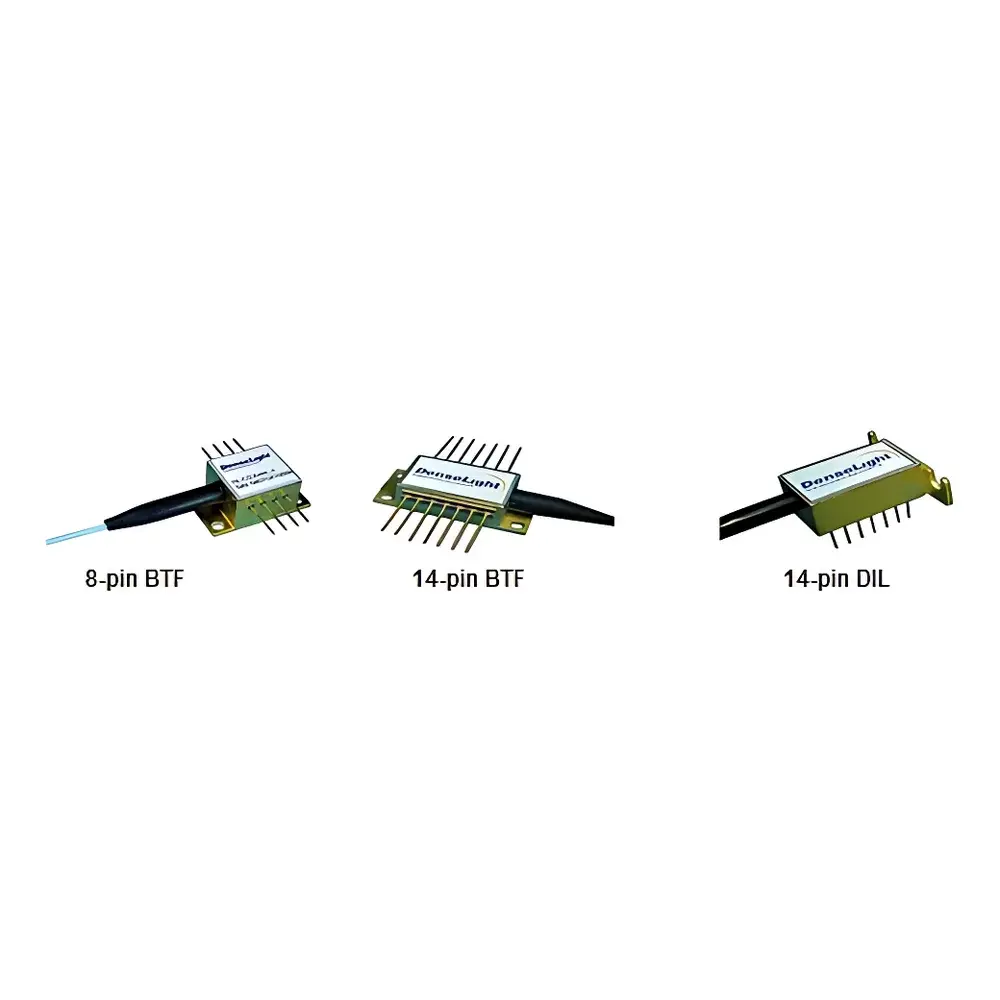
Denselight DL-CS Series Superluminescent Diode (SLD) Module
| Brand | Denselight Semiconductor |
|---|---|
| Origin | Singapore |
| Manufacturer Type | Authorized Distributor |
| Origin Category | Imported |
| Model | DL-CS Series |
| Light Source Type | Broadband ASE Source |
| Illumination Mode | Internal-Fiber-Coupled Illumination |
| Compliance | RoHS, Telcordia GR-468-CORE |
| Packaging Options | 14-pin Butterfly (BTF), Dual-In-Line (DIL), or Custom 8-pin Mini-Module |
| Fiber Output | Single-Mode (SMF-28), Optional Polarization-Maintaining (PM) Fiber |
| Operating Temperature | –20 °C to +70 °C |
| Power Stability | < ±0.01 dB (over 8 hrs, constant current & temperature) |
| Modulation Bandwidth | Analog — up to 20 MHz (–3 dB), Digital — rise time < 1 ns |
| Optical Isolation | Integrated >30 dB |
| Noise Performance | Relative Intensity Noise (RIN) < –135 dB/Hz (typ. at 1 MHz) |
| Monitoring Port | Tap port with photodiode for real-time output power feedback |
| Electro-Optic Efficiency | Up to 15% (W/W), enabling low drive current and thermal load |
Overview
The Denselight DL-CS Series Superluminescent Diode (SLD) Module is a high-performance, fiber-coupled broadband light source engineered for applications demanding high spatial coherence, low temporal coherence, and exceptional spectral stability. Based on amplified spontaneous emission (ASE) in semiconductor waveguides, the DL-CS leverages Denselight’s proprietary InP-based epitaxial technology and wafer-level passivation processes to deliver stable, low-polarization, and low-noise optical output across the 1200–1700 nm wavelength window—spanning the O-, E-, S-, C-, L-, and U-bands of optical fiber transmission. Unlike conventional LEDs or laser diodes, SLDs combine the broad spectral bandwidth (typically 20–100 nm FWHM) of LEDs with the high brightness and directional coupling efficiency of lasers, making them ideal for interferometric and coherence-gated systems where minimal coherence length (< 50 µm) is critical.
Key Features
- Wavelength coverage from 1200 nm to 1700 nm, with discrete center wavelengths including 1310 nm, 1350 nm, 1450 nm, 1550 nm, 1625 nm, and 1650 nm—each optimized for low spectral ripple (< 0.35 dB peak-to-valley)
- Output power options ranging from 0.2 mW to 50 mW (fiber-coupled, SMF-28), with scalable configurations supporting both low-power sensing and high-sensitivity metrology
- Integrated optical isolator (>30 dB isolation) ensures immunity to back-reflections—a critical requirement for OCT and fiber-optic sensor systems operating in reflective or multi-path environments
- Real-time monitoring via integrated tap port and calibrated photodiode enables closed-loop power stabilization and long-term drift compensation in automated test platforms
- Low drive current architecture (e.g., 100–700 mA depending on model) reduces thermal loading, extends device lifetime, and simplifies thermal management in compact OEM modules
- Compliant with Telcordia GR-468-CORE reliability standards for hermetic packaging, shock/vibration tolerance, and accelerated life testing (≥2000 hrs MTTF under nominal conditions)
Sample Compatibility & Compliance
The DL-CS Series is designed for seamless integration into single-mode fiber infrastructures, with standard FC/APC or SC/APC connectors and optional polarization-maintaining (PM) fiber pigtails aligned to the slow axis. All units conform to RoHS Directive 2011/65/EU and are manufactured under ISO 9001-certified processes. The devices meet IEC 61215 and IEC 60825-1 safety classifications for Class 1 laser products when operated within specified current and temperature limits. For regulated industries—including medical device manufacturing and aerospace-grade instrumentation—the module supports traceable calibration certificates and can be configured with firmware-locked operational parameters to satisfy FDA 21 CFR Part 11 audit trail requirements when embedded in validated systems.
Software & Data Management
While the DL-CS operates as a standalone analog/digital modulated source, it is fully compatible with industry-standard instrument control frameworks. Analog modulation accepts 0–5 V DC or ±2.5 V differential input for linear intensity control; digital TTL-compatible inputs support pulse widths down to 2 ns. When integrated into automated test benches (e.g., via PXIe chassis or USB-GPIB adapters), the monitoring photodiode output can be digitized using DAQ systems (National Instruments, Keysight) for real-time power logging, statistical process control (SPC), and GLP-compliant data archiving. Denselight provides SDKs for LabVIEW, Python (PyVISA), and MATLAB, enabling script-driven sweep sequences, temperature-compensated power ramping, and failure mode logging aligned with ISO/IEC 17025 documentation workflows.
Applications
- Fiber Optic Sensing: Distributed temperature/strain sensing (DTS/DSS) using Rayleigh/Brillouin OTDR/BOTDR, interferometric hydrophone arrays, and smart structure monitoring in civil infrastructure
- Biomedical Imaging: Swept-source and spectral-domain Optical Coherence Tomography (OCT) systems for ophthalmology, dermatology, and endoscopic diagnostics—leveraging high instantaneous bandwidth and low coherence noise
- Telecom Test & Measurement: Characterization of WDM components (MUX/DEMUX, FBGs, isolators), insertion loss mapping, and chromatic dispersion analysis across C+L bands
- Industrial Metrology: White-light interferometry for surface profilometry, thin-film thickness measurement, and semiconductor wafer inspection
- Gas & Chemical Sensing: Tunable diode laser absorption spectroscopy (TDLAS) reference sources and photoacoustic spectroscopy excitation in mid-IR overtone regions
- Defense & Aerospace: Fiber-optic gyroscopes (FOGs), coherent LIDAR seed sources, and secure free-space optical communication pre-amplifiers
FAQ
What is the typical coherence length of the DL-CS SLD modules?
Coherence length ranges from ~15 µm (at 40 nm bandwidth, 1550 nm) to ~55 µm (at 15 nm bandwidth, 1310 nm), calculated as λ²/Δλ (FWHM), and is verified per unit using Michelson interferometry.
Can the DL-CS be used in a temperature-stabilized OCT engine?
Yes—its low thermal sensitivity (< 0.005 dB/°C power drift) and integrated thermistor enable precise TEC feedback control; many OEM OCT subsystems use DL-CS with external PID controllers achieving < ±0.003 dB power variation over 12 hours.
Is PM fiber output available for all DL-CS models?
Polarization-maintaining (PM) fiber pigtails are available as a factory option for all BTF-packaged models; DIL variants support PM fiber upon request with additional lead time.
Does Denselight provide spectral calibration data with each unit?
Yes—every shipped DL-CS module includes a NIST-traceable spectral power distribution (SPD) report measured on an OSA (Yokogawa AQ6370D or equivalent) at 0.05 nm resolution, along with polarization extinction ratio (PER) and near-field beam profile data.
How does the DL-CS compare to ASE fiber sources in terms of size and power efficiency?
The DL-CS achieves comparable spectral density (mW/nm) in a footprint less than 25 cm³ (BTF package), with wall-plug efficiency >12%, eliminating the need for pump lasers, isolators, and thermal management subsystems required by EDFA-based ASE sources.






