
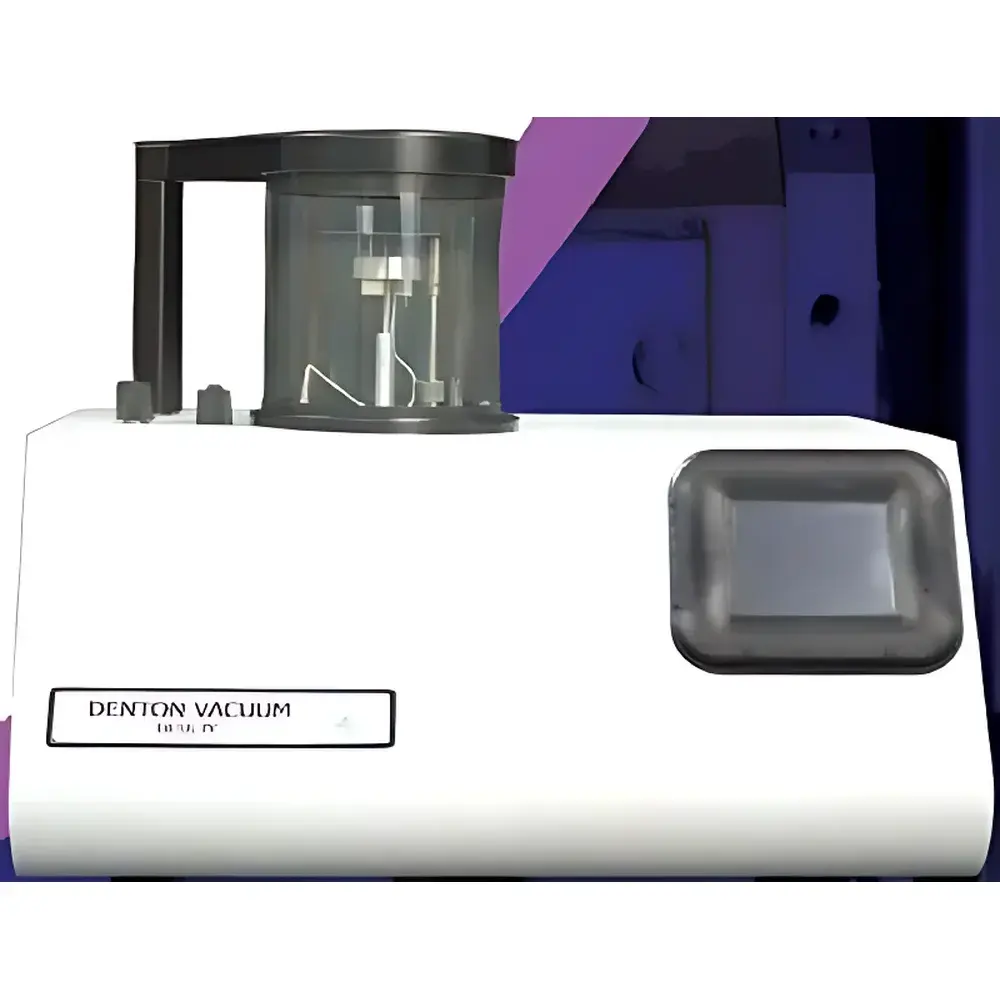
Denton Desk V HP Gold/Carbon Coater
| Brand | DENTON |
|---|---|
| Origin | USA |
| Manufacturer Type | Authorized Distributor |
| Origin Category | Imported |
| Model | Desk V HP |
| Pricing | Available Upon Request |
Overview
The Denton Desk V HP Gold/Carbon Coater is a compact, high-performance benchtop thermal evaporation system engineered for precise and reproducible conductive coating of non-conductive specimens prior to electron microscopy analysis. Designed specifically for SEM, TEM, and FE-SEM sample preparation, it operates on resistive thermal evaporation principles—utilizing high-purity tungsten or molybdenum filaments to vaporize gold, carbon, or other compatible metals and non-metals under high vacuum (typically <5 × 10⁻⁶ Torr). Its integrated vacuum architecture eliminates external pump interfacing, enabling rapid chamber evacuation (<90 seconds to operational base pressure) and consistent film nucleation across diverse substrate geometries. The system adheres to fundamental requirements for electron microscopy specimen integrity: minimal topographic masking, low contamination risk, and sub-nanometer thickness control fidelity.
Key Features
- Integrated dual-stage vacuum system with oil-free scroll pump and turbomolecular pump—no external roughing pump required
- Programmable deposition timing (0.1–300 s) with real-time filament current monitoring for process repeatability
- Color TFT touchscreen interface with intuitive graphical workflow navigation and parameter logging
- Dual-mode operation: standard metal/carbon evaporation and plasma-assisted argon etch cleaning (pre-deposition surface activation)
- Adjustable crucible positioning and sample stage rotation (0–60 rpm) for uniform coating on irregular or multi-specimen arrays
- Modular target holder accommodating 0.1 mm diameter wire, 0.25 mm rod, or 3 mm pellet configurations
- Onboard thickness calibration via quartz crystal microbalance (QCM), traceable to NIST standards
Sample Compatibility & Compliance
The Desk V HP accommodates standard 32 mm SEM stubs, 3.05 mm TEM grids, and custom substrates up to 76 mm in diameter. It supports direct mounting of brittle or temperature-sensitive samples—including biological cryo-sections, polymer films, and ceramic powders—without mechanical clamping stress. All internal wetted surfaces are electropolished stainless steel; chamber seals meet ISO-KF 25 specifications. The system complies with CE safety directives (2014/30/EU EMC, 2014/35/EU LVD), conforms to UL 61010-1 for laboratory equipment, and supports audit-ready documentation for GLP and ISO/IEC 17025-accredited laboratories. Optional IQ/OQ documentation packages are available for regulated environments requiring FDA 21 CFR Part 11–compliant instrument qualification.
Software & Data Management
Control firmware v3.2 provides local parameter storage (≥100 user-defined recipes), timestamped event logging (pump status, filament burnout, pressure excursions), and CSV export via USB 2.0 port. No cloud connectivity or proprietary software installation is required—operation is fully self-contained within the embedded Linux-based HMI. Audit trails include operator ID (via optional RFID badge reader), session start/stop timestamps, and critical process deviations (e.g., pressure rise >1 × 10⁻⁵ Torr during deposition). Raw QCM data and vacuum profile curves are exportable for post-acquisition thickness modeling using third-party tools such as MATLAB or Python-based thin-film optics libraries.
Applications
- High-resolution SEM imaging of insulating geological samples, polymers, and biological tissues
- TEM grid coating for enhanced electron transparency and reduced charging artifacts
- FE-SEM nanoscale morphology characterization of battery cathode materials and MOFs
- Preparation of reference standards for EDS quantification and WDS calibration
- Routine quality control of MEMS device packaging integrity and microfluidic channel surface homogeneity
- Research-scale fabrication of transparent conductive electrodes using ultra-thin Au/C bilayer architectures
FAQ
What vacuum level is achieved before evaporation begins?
Base pressure ≤5 × 10⁻⁶ Torr is attained within 90 seconds using the integrated turbomolecular pump; process pressure during deposition is maintained at 1–5 × 10⁻⁶ Torr.
Can the system deposit alloys or multi-layer films?
Yes—sequential evaporation from two independent filament sources enables bilayer deposition (e.g., Cr/Au adhesion layers); alloy co-evaporation requires manual filament current synchronization and is not automated.
Is remote monitoring or network integration supported?
No Ethernet or Wi-Fi interface is provided; all operation and diagnostics occur locally via the touchscreen or USB export. Networked control would require external industrial PLC integration.
What maintenance intervals are recommended for the turbomolecular pump?
Annual bearing inspection and rotor balancing per Pfeiffer Vacuum service guidelines; scroll pump oil replacement every 6,000 operating hours.
Does the system comply with ISO 14644-1 Class 5 cleanroom requirements?
The Desk V HP itself is not rated for cleanroom installation; however, its oil-free pumping configuration minimizes hydrocarbon backstreaming, making it suitable for use in Class 5–7 supporting labs when housed in appropriate enclosures.



