
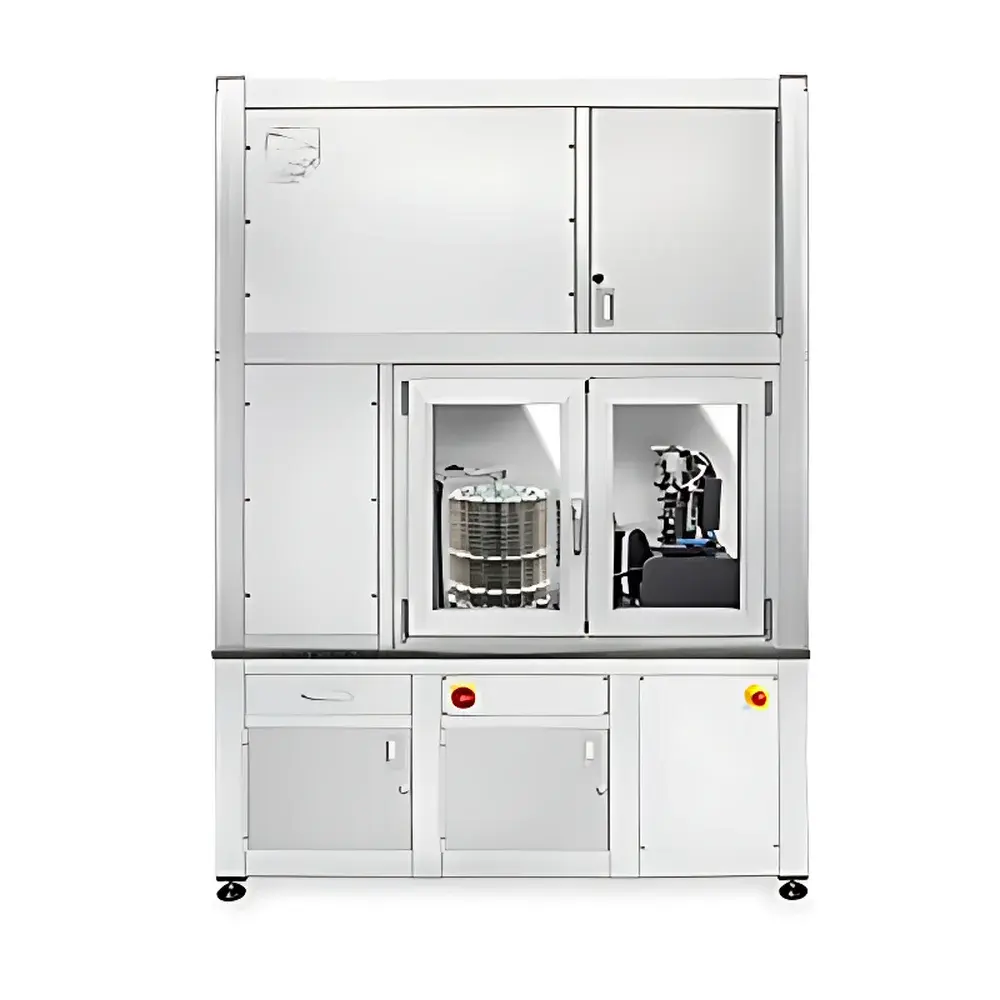
Derenda AWS-1 Automated Filter Weighing System
| Brand | Derenda |
|---|---|
| Origin | Germany |
| Model | AWS-1 Automated Filter Weighing System |
| Flow Range | 0.2–1.2 m³/h (16.67 L/min) |
| Vacuum Pressure | >40,000 Pa |
| Flow Stability | ≤±2% over 24 h |
| Maximum Flow Error | ≤±2% |
| Operating Duration at Max Flow & Resistance | 1 min–999 h |
| Rated Service Life at Max Flow & Resistance | 50,000 h |
| Balance Resolution | 0.001 mg |
| Balance Stabilization Time | ≤6 s |
| Temperature Control Range | 15–32 °C (±0.1 °C accuracy) |
| Relative Humidity Control Range | 35–55 %RH (±1 %RH accuracy) |
| Dew Point Control Accuracy | ±0.1 °C |
| Dimensions (L×W×H) | 1620 × 900 × 2325 mm |
| System Weight | 600 kg |
| Power Consumption | 1400 W |
| Ambient Operating Temperature | 5–40 °C |
Overview
The Derenda AWS-1 Automated Filter Weighing System is a fully integrated, ISO/IEC 17025-aligned gravimetric platform engineered for high-precision mass determination of particulate matter (PM) filters used in ambient air and stack emission monitoring. It implements a closed-loop, contamination-controlled workflow grounded in the principles of controlled-environment gravimetry—where filter mass change is quantified under rigorously stabilized temperature and humidity conditions to meet the traceability and repeatability requirements of regulatory methods including EPA Method IO-4.2, EN 12341:2014, and ISO 12103-1. Unlike manual or semi-automated systems, the AWS-1 eliminates operator-induced variability by automating filter encoding, conditioning, identification, transport, desiccation, and weighing—all within a sealed, vibration-isolated chamber. Its architecture complies with GLP and GMP environmental data integrity standards, supporting audit-ready metadata generation for regulatory submissions.
Key Features
- Fully automated end-to-end workflow: mechanical edge coding (non-sampling zone), optical filter recognition via high-resolution imaging, ionized air static neutralization, and robotic 3D positioning for precise placement on a 0.001 mg resolution microbalance
- Hermetically sealed weighing chamber with Class ISO 5 (Class 100) clean-air environment maintained by FFU (Fan Filter Unit) system and continuous particle monitoring
- Independent dual-climate control module: thermoelectric + PID-driven humidification/dehumidification delivering ±0.1 °C temperature stability and ±1 %RH humidity control across 15–32 °C / 35–55 %RH operating range
- Triple-stage anti-vibration design: isolated balance support island (150 kg mass inertia), passive pneumatic damping, and structural decoupling from mechanical actuators and HVAC subsystems
- Dual-control interface: local touchscreen HMI with real-time status visualization and remote PC-based operation with full command scripting, event logging, and secure authentication
- Comprehensive data governance: embedded SQL database storing timestamped weight values, environmental parameters, image metadata, error logs, and user actions—exportable as CSV/PDF with digital signature support
Sample Compatibility & Compliance
The AWS-1 accommodates standard PM filter media—including quartz fiber (QFF), Teflon-coated glass fiber, polytetrafluoroethylene (PTFE), and cellulose ester membranes—in diameters from 37 mm to 110 mm. Each filter undergoes pre-conditioning per ISO 8513:2021 (conditioning duration: ≥24 h at defined T/RH) before weighing. The system conforms to ASTM D7520-21 (Standard Practice for Gravimetric Determination of Particulate Matter Mass on Filters), supports US EPA 40 CFR Part 53 and Part 58 compliance verification workflows, and meets data integrity requirements of FDA 21 CFR Part 11 when deployed with electronic signature and audit trail modules. All internal surfaces are electropolished stainless steel; no lubricants or outgassing polymers contact filter pathways.
Software & Data Management
Derenda AWSSuite v3.2 firmware provides role-based access control (admin/operator/auditor), configurable weighing protocols (single-point, multi-cycle averaging, drift-compensated acquisition), and automated report generation compliant with ISO/IEC 17025 clause 7.8. Data export includes raw sensor outputs (temperature, RH, dew point, balance load cell voltage), environmental deviation alerts, and image thumbnails of each filter prior to and after weighing. Audit trails record all parameter changes, user logins, calibration events, and system restarts with cryptographic timestamps. Optional integration with LIMS via HL7 or RESTful API enables seamless transfer of certified mass values into laboratory information management systems.
Applications
- Ambient air quality monitoring networks requiring PM2.5 and PM10 filter mass certification per EU Directive 2008/50/EC and China’s HJ 656-2013
- Source testing laboratories performing stack emission measurements under ISO 9096 and EPA Method 5/17
- Reference laboratories engaged in inter-laboratory comparison studies (e.g., EMEP, GAW) where inter-operator reproducibility must remain below 2 µg absolute deviation
- Research institutions conducting aerosol hygroscopicity and volatility studies requiring sequential weighings under controlled RH ramps
- Calibration service providers maintaining traceability to national metrology institutes (e.g., PTB, NIST) through documented uncertainty budgets
FAQ
Does the AWS-1 require external HVAC or dedicated lab infrastructure?
No—the integrated climate control module eliminates dependency on building-level environmental systems. It operates independently within ambient temperatures of 5–40 °C.
How does the system ensure long-term balance stability under continuous operation?
The balance rests on a dynamically isolated support island, mechanically decoupled from all moving components. Thermal mass buffering and active temperature compensation algorithms maintain sensor zero stability over 50,000 h MTBF.
Can the AWS-1 be validated for GLP-compliant studies?
Yes—full IQ/OQ/PQ documentation packages are available, including uncertainty budget calculations per GUM (JCGM 100:2008), traceable calibration certificates, and 21 CFR Part 11 readiness assessment reports.
What filter coding methods are supported?
Mechanical edge notching of non-sampling zones (per EN 14907 Annex B) and optical recognition of manufacturer-embedded barcodes or QR codes on certified filter lots.
Is remote diagnostics and software update capability included?
Yes—secure TLS-encrypted remote access allows authorized service engineers to perform health checks, firmware updates, and configuration backups without physical presence.







