
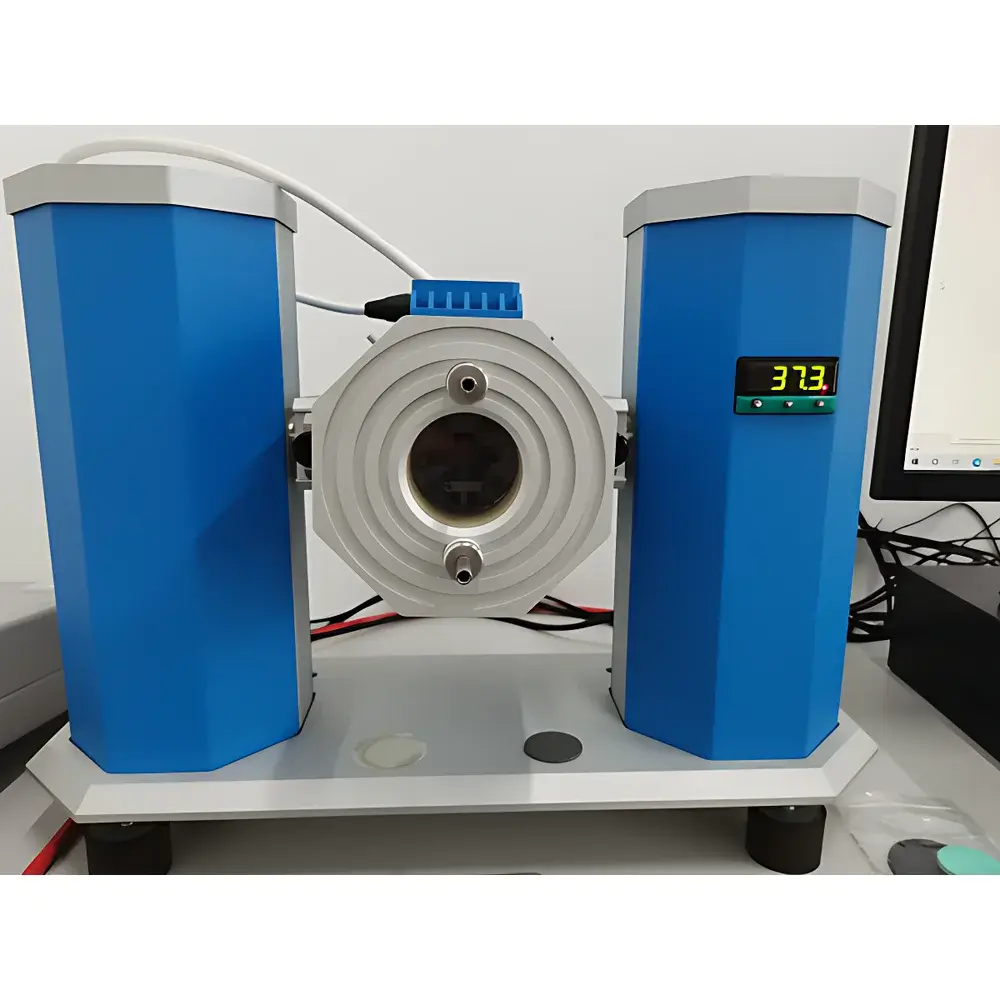
DETA DS6000 Dielectric Relaxation Spectrometer
| Brand | Lacerta |
|---|---|
| Origin | United Kingdom |
| Model | DS6000 |
| Type | Dielectric Relaxation Spectrometer |
| Cooling Range | Down to cryogenic temperatures (e.g., −160 °C with optional liquid nitrogen cryostat) |
| Electrode Configuration | Liquid-compatible cup electrodes |
| Humidity Control | Integrated humidity chamber option for hygroscopic sample studies |
| Software Interface | Windows-based, wizard-driven acquisition and analysis suite |
| Compliance | Designed to support ASTM D150, ISO 257-1/2, IEC 60250, and GLP-compliant data traceability (21 CFR Part 11 ready) |
Overview
The DETA DS6000 Dielectric Relaxation Spectrometer is a high-precision, frequency-domain impedance analyzer engineered for comprehensive dielectric characterization of insulating and semi-crystalline materials across broad temperature and humidity ranges. Based on the fundamental principles of broadband dielectric spectroscopy (BDS), the system measures complex permittivity (ε* = ε′ − jε″) and electric modulus (M* = 1/ε*) as functions of frequency (typically 10−2 Hz to 107 Hz), temperature (−160 °C to +400 °C, depending on configuration), and ambient relative humidity (10–95% RH). Its core architecture employs a four-terminal sensing topology with low-noise current-voltage conversion, enabling accurate determination of relaxation times, activation energies, dipole mobility, and interfacial polarization phenomena in polymers, pharmaceuticals, biomaterials, and ionic liquids.
Key Features
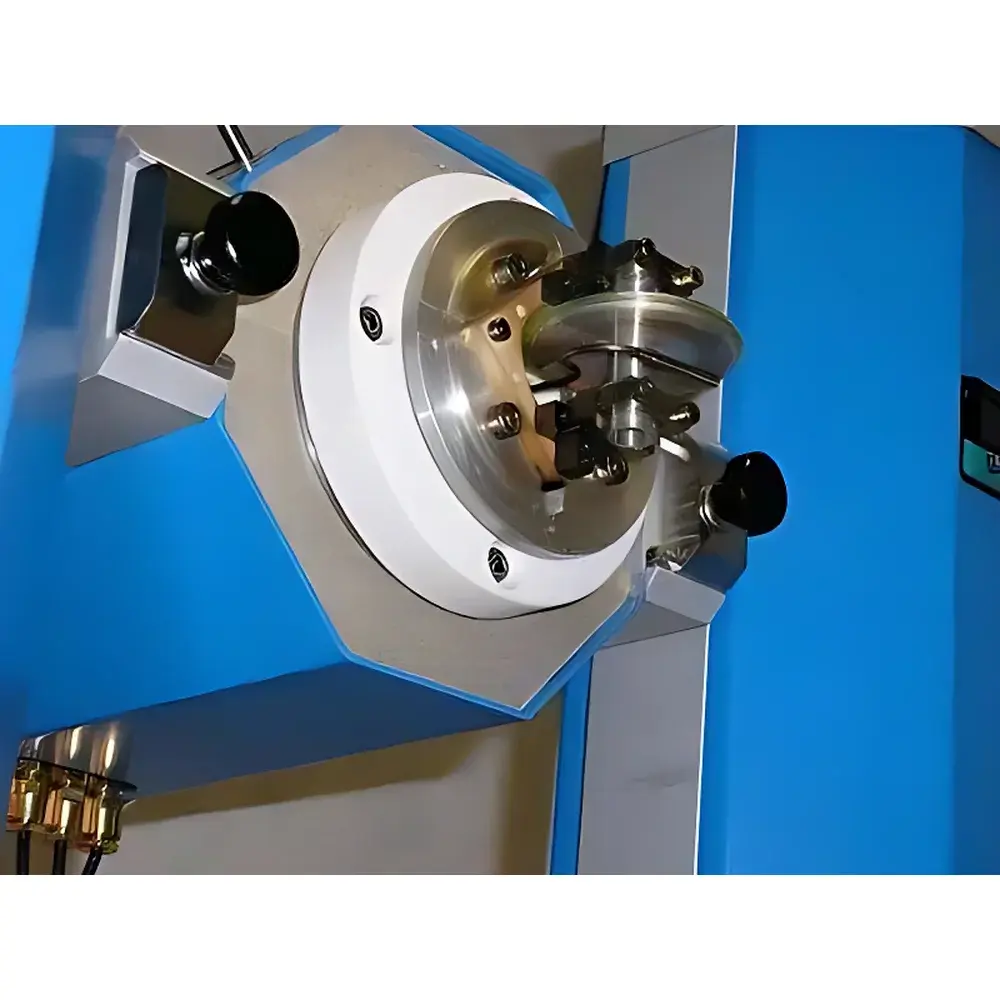
- Rotating measurement head: Minimizes parasitic capacitance drift and mechanical stress during thermal cycling; ensures reproducible electrode-sample contact across wide temperature gradients.
- Cryogenic cooling capability: Supports rapid, stable cooling to −160 °C using integrated liquid nitrogen delivery or closed-cycle refrigeration — critical for resolving β-relaxations and glass transition dynamics in amorphous regions.
- Liquid-compatible cup electrodes: Precision-machined stainless-steel or gold-plated electrodes with PTFE insulation, optimized for low-loss measurements of solvents, electrolyte solutions, and colloidal dispersions.
- Humidity-controlled DETA mode: Optional environmental chamber enables synchronized control of RH and temperature, allowing quantitative assessment of water plasticization effects on dielectric loss peaks and conductivity dispersion.
- Modular hardware architecture: Expandable with auxiliary modules including high-voltage bias units (±1 kV), ferroelectric hysteresis analyzers, and time-resolved step-response acquisition for deep trap analysis.
- Calibration-traceable operation: Factory-calibrated against NIST-traceable standards; includes built-in self-diagnostic routines for impedance accuracy verification at key frequencies.
Sample Compatibility & Compliance
The DS6000 accommodates solid films (25–500 µm thick), powder compacts, bulk thermoplastics, thin-film coatings, and low-conductivity liquids (σ < 10−6 S/m). Sample holders conform to ASTM D257 and IEC 60270 geometries. All measurement sequences adhere to ISO/IEC 17025 documentation requirements. Data files embed metadata (operator ID, timestamp, calibration certificate ID, instrument firmware version) and support audit-ready export in HDF5 and .tdms formats. The system satisfies essential elements of FDA 21 CFR Part 11 for electronic records and signatures when deployed with validated user access controls and audit trail logging enabled.
Software & Data Management
Lacerta’s DETA Studio software provides a modular, workflow-oriented interface for experiment design, real-time monitoring, and advanced modeling. Key capabilities include automatic Cole-Cole and Havriliak-Negami fitting, Arrhenius and Vogel-Fulcher-Tammann parameter extraction, derivative loss peak analysis (dε″/df), and multi-dimensional contour mapping (ε′ vs. T vs. f). Raw data are stored in encrypted project databases with versioned backups. Export options include CSV, MATLAB (.mat), and publication-ready SVG/PDF plots. Integration with LabArchives ELN and Thermo Fisher SampleManager LIMS is supported via RESTful API.
Applications
- Characterization of polymer chain mobility and segmental dynamics near Tg
- Quantification of ion conduction mechanisms in solid-state electrolytes for Li-ion batteries
- Stability assessment of amorphous active pharmaceutical ingredients (APIs) under accelerated humidity stress
- Interfacial water layer analysis in bio-nanocomposites and hydrated membranes
- Detection of space charge accumulation in HVDC cable insulation materials
- Time-temperature superposition (TTS) validation for viscoelastic modeling
FAQ
What frequency range does the DS6000 cover?
The standard configuration operates from 10 mHz to 10 MHz; extended low-frequency modules (down to 1 µHz) and RF extensions (up to 1 GHz) are available as factory options.
Can the DS6000 measure conductive samples?
It is optimized for low-conductivity dielectrics (σ < 10−4 S/m); highly conductive metals or aqueous electrolytes require specialized guard-ring electrodes or alternative techniques such as electrochemical impedance spectroscopy (EIS).
Is humidity control integrated or optional?
Humidity regulation is an optional add-on module featuring dual-sensor RH feedback, programmable ramping, and condensation prevention logic — not included in base configurations.
How is temperature calibrated across the full range?
Primary calibration uses Pt100 sensors traceable to ITS-90, verified at ≥5 points per decade with NIST-certified reference thermometers; cryogenic ranges rely on calibrated Cernox™ sensors.
Does the system support automated long-term aging studies?
Yes — scheduled measurement sequences (e.g., isothermal holds at fixed T/RH for 1000+ hours) are fully scriptable, with auto-recovery after power interruption and event-triggered alerts via SMTP/OPC UA.
Related Products






