
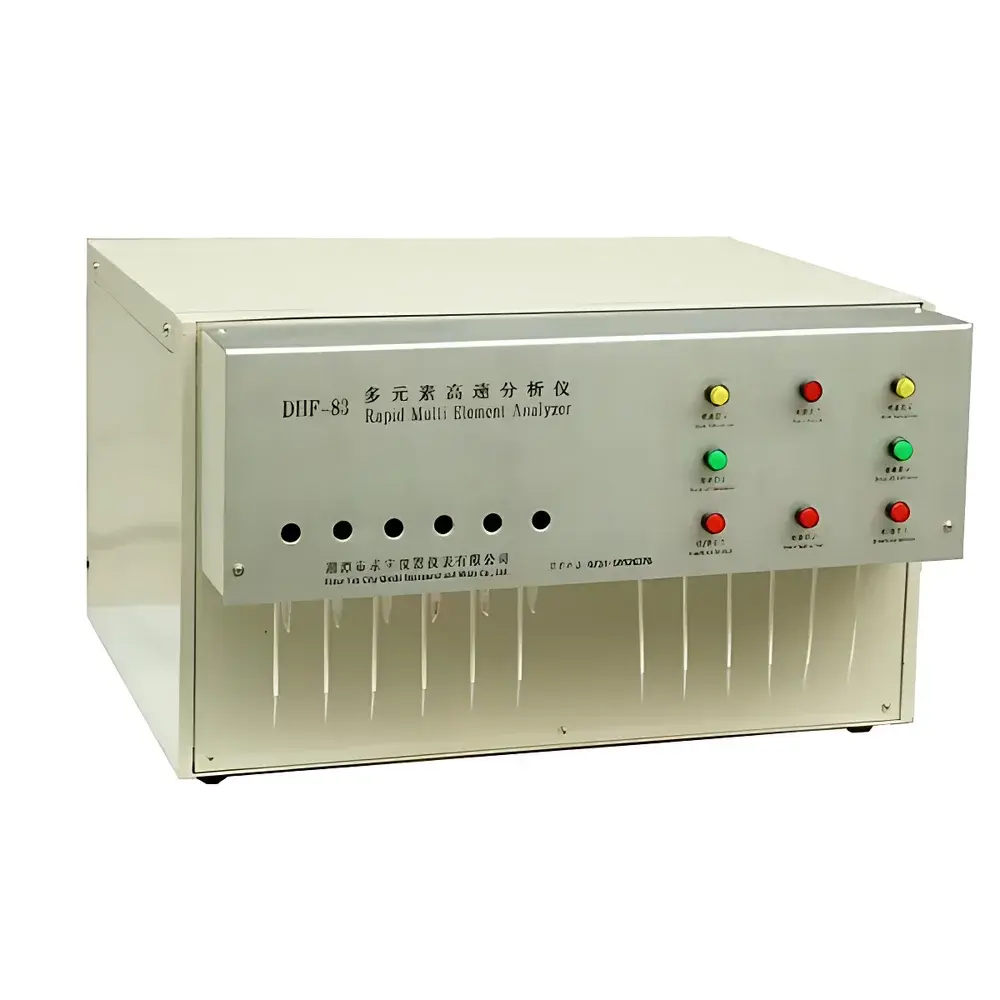
DHF83 Multi-Element Rapid Analyzer
| Origin | Hunan, China |
|---|---|
| Manufacturer Type | Distributor |
| Origin Category | Domestic |
| Model | DHF83 |
| Price Range | USD 1,400 – 7,200 |
Overview
The DHF83 Multi-Element Rapid Analyzer is a benchtop wet-chemical elemental analyzer engineered for high-throughput, quantitative determination of major and minor oxide constituents in inorganic non-metallic and metallurgical materials. It operates on the principle of colorimetric spectrophotometry coupled with controlled acid digestion and selective chromogenic reaction pathways—each element quantified via its characteristic absorbance at defined wavelengths (e.g., Fe²⁺/Fe³⁺ with 1,10-phenanthroline, Al³⁺ with chrome azurol S, SiO₂ with molybdenum blue). Unlike XRF or ICP-based systems, the DHF83 delivers trace-level accuracy without plasma excitation or vacuum optics, making it especially suited for routine QC/QA labs where operational simplicity, reagent economy, and regulatory traceability are prioritized over ultra-trace detection limits. Designed as an evolution of the DHF82 platform, it integrates three patented microfluidic dispensing mechanisms (CN200720062652.3, CN200720062653.8, CN200720062654.2) to enable precise sub-milliliter reagent delivery, reducing consumable use by 80–90% while maintaining compliance with national standard methods (e.g., GB/T 4734–2022 for ceramic raw materials, GB/T 205–2008 for cement, YB/T 5189–2015 for refractories).
Key Features
- 6 independent optical measurement channels with dual-beam photometric detection, enabling simultaneous multi-element readout per sample cycle
- Patented high-precision micro-dosing system (±0.5% volumetric repeatability) with six dedicated liquid-handling paths for automated reagent addition, sample dilution, and blank correction
- Integrated flame photometer module for direct alkali metal (Na, K) quantification—eliminating separate instrument dependency and cross-lab calibration drift
- Automated sample sequencing for ≥10 unattended analyses; full eight-oxide (SiO₂, Al₂O₃, Fe₂O₃, TiO₂, K₂O, Na₂O, CaO, MgO) analysis completed within 2–3 hours from sample weighing
- Thermally stabilized optical bench and temperature-compensated detector array ensuring <±0.3% RSD over 8-hour continuous operation
- Modular hardware architecture supporting field-upgradable reagent kits for extended element coverage (B₂O₃, ZrO₂, PbO, ZnO, MnO, Cr₂O₃, BaO, NiO, CoO, P₂O₅, Li₂O, SnO, Mo)
Sample Compatibility & Compliance
The DHF83 accommodates solid powdered samples (particle size ≤75 µm) subjected to fusion or acid digestion protocols compliant with ISO 12677:2014 (geochemical silicates), ASTM C114–22 (cement), and GB/T 24129–2009 (refractory ceramics). Validated matrices include: clay-based ceramic bodies and glazes; alumina-silica refractories; soda-lime and borosilicate glasses; Portland and specialty cements; feldspathic and quartzitic geological specimens; and base-metal concentrates (e.g., MnO-rich pyrolusite, NiO-containing laterites, V₂O₅ calcines, MoO₃ roasts). All analytical procedures adhere to GLP principles: full audit trail logging, electronic signature support, and data integrity safeguards aligned with FDA 21 CFR Part 11 requirements when used with validated software configuration.
Software & Data Management
The embedded DHF-Analysis Suite v4.2 provides ISO/IEC 17025-compliant workflow control—from sample registration and digestion protocol selection to calibration curve fitting (linear, quadratic, or polynomial regression) and uncertainty propagation per GUM (JCGM 100:2008). Raw absorbance values, peak area integrals, and internal standard ratios are stored in encrypted SQLite databases with immutable timestamps. Export options include ASTM E1382-compliant .csv, PDF analytical reports with digital signatures, and LIMS-ready XML schemas. Calibration verification checks against NIST-traceable reference materials (e.g., NIST SRM 694, GBW07105a) are programmable and auto-documented.
Applications
- Quality control of raw material batches in ceramic tile and sanitaryware manufacturing
- Composition verification of refractory linings for steel ladles and glass melting furnaces
- Batch release testing of cement clinker and blended hydraulic cements
- Geochemical mapping of kaolin deposits and feldspar quarries
- Process monitoring of metallurgical intermediates including roasted molybdenum concentrates, nickel oxide sinter, and cobalt carbonate precipitates
- R&D formulation development for low-expansion glazes, high-alumina refractories, and bioactive glass compositions
FAQ
What sample preparation methods are required prior to analysis?
Samples must be dried at 105°C, ground to ≤75 µm, and fused with lithium tetraborate (Li₂B₄O₇) or sodium carbonate (Na₂CO₃) fluxes under controlled temperature ramping—protocols fully documented in the included SOP manual.
Does the system support method validation per ISO/IEC 17025?
Yes—the instrument’s firmware and software package include built-in tools for linearity assessment, limit of detection (LOD) calculation, intermediate precision evaluation, and recovery spike testing per ISO 8466-1.
Can the DHF83 be integrated into an existing LIMS environment?
It supports ODBC and HL7 v2.5 interfaces for bidirectional data exchange; API documentation and driver packages are provided upon request for IT integration.
What maintenance intervals are recommended for long-term reliability?
Optical path cleaning every 200 runs; peristaltic pump tubing replacement every 6 months or 1,000 cycles; annual photometric verification using certified neutral density filters.
Is technical support available outside mainland China?
Global distributor network provides local-language application engineering, remote diagnostics, and on-site service contracts—response time guaranteed within 72 business hours for critical issues.
Related Products





