
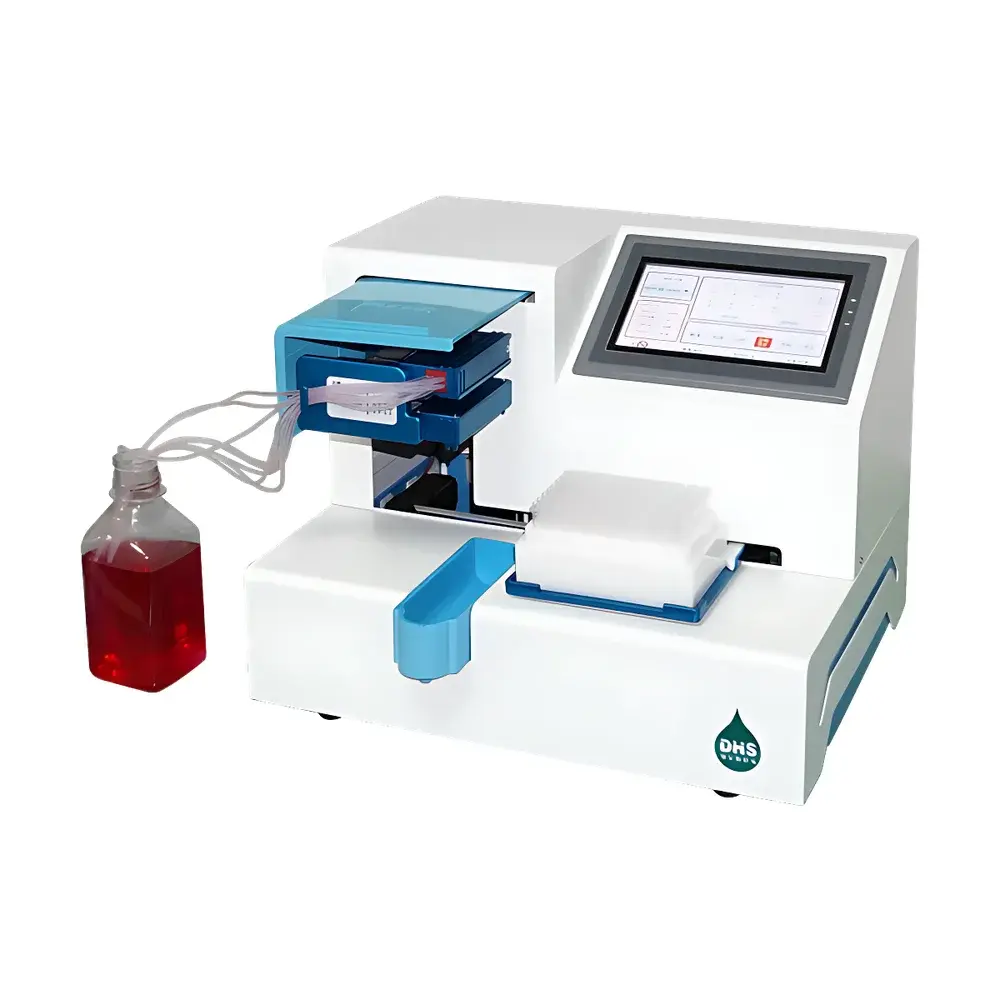
DHS MD-8/MD-12 Automated Microplate Liquid Dispenser
| Brand | DHS |
|---|---|
| Origin | Tianjin, China |
| Model | MD-8 / MD-12 |
| Instrument Type | Automated Microplate Dispenser |
| Dispensing Principle | Peristaltic Pump |
| Dispensing Accuracy | ≤±3% for 10–20 µL |
| Sample Throughput | 96-well plate compatibility |
| Dispensing Flexibility | Column-selectable dispensing (any column(s) in 96-well format) |
| Dispensing Range | 5 µL to 10 mL per well (with interchangeable dispensing manifolds) |
| Dispensing Height Adjustment | 5–85 mm |
| User Interface | 7-inch high-resolution capacitive touchscreen |
| Onboard Program Storage | Up to 100 user-defined protocols |
| Preloaded Assay Protocols | Coagulation assay & ELISA workflows |
| Residual Liquid Aspiration | Integrated post-dispense aspiration to minimize carryover and cross-contamination |
| Cleaning & Mixing Functions | Built-in tube rinse cycle and plate shaking (orbital mixing) |
| Dispensing Manifold | Sterilizable, removable, autoclavable (121°C, 20 min) |
| Dispense Speed | 5 adjustable speed levels |
| Compliance | Designed for GLP-compliant laboratory environments |
Overview
The DHS MD-8 and MD-12 Automated Microplate Liquid Dispensers are precision-engineered benchtop instruments designed for high-throughput, reproducible reagent dispensing into standard microplates—including 96-well, 384-well, PCR plates, and deep-well plates. Utilizing a calibrated peristaltic pump system driven by high-resolution stepper motors, these dispensers deliver consistent volumetric accuracy across a wide dynamic range (5 µL to 10 mL per well), making them suitable for applications ranging from ELISA and coagulation assays to cell-based screening and nucleic acid preparation. The dual-channel architecture—eight-channel (MD-8) and twelve-channel (MD-12)—enables parallel processing while maintaining full column-level dispensing control, supporting flexible experimental design without hardware reconfiguration.
Key Features
- Column-selective dispensing: Users may define dispensing patterns at the individual column level (e.g., columns 1–3 and 7–9), eliminating unnecessary reagent use and enabling multiplexed assay setups.
- Adjustable dispensing height (5–85 mm): Accommodates diverse plate formats—from low-profile PCR strips to 50 mL deep-well plates—without manual recalibration.
- Autoclavable, modular dispensing manifolds: Each manifold is fully removable and compatible with steam sterilization (121°C, 20 min), ensuring compliance with biosafety and contamination control requirements in clinical and regulated labs.
- Five-speed dispensing control: Optimizes fluid dynamics for viscous or volatile reagents—slower speeds reduce foaming and splashing; higher speeds maximize throughput during bulk buffer loading.
- Integrated aspiration function: Automatically draws residual liquid back into tubing after dispensing, minimizing carryover between wells and reducing reagent waste by up to 25% compared to passive drain systems.
- Onboard protocol management: Stores up to 100 user-defined methods with full parameter logging (dispense volume, column selection, speed, pause intervals, mixing cycles). Preloaded templates for coagulation and ELISA workflows accelerate method development.
- Touchscreen-driven workflow interface: A 7-inch capacitive display consolidates all setup, calibration, and execution functions into a single intuitive screen—no external PC required for routine operation.
Sample Compatibility & Compliance
The MD-8/MD-12 supports ANSI/SLAS-standard microplates (SBS footprint), including flat-bottom, U-bottom, V-bottom, skirted, semi-skirted, and non-skirted variants. It is validated for use with common labware materials (polystyrene, polypropylene, cyclic olefin copolymer) and compatible with aqueous buffers, serum-containing media, glycerol solutions (up to 40% v/v), and detergent-based lysis reagents. From a regulatory standpoint, the instrument’s deterministic dispense logic, timestamped execution logs, and protocol versioning support adherence to Good Laboratory Practice (GLP) and quality-controlled workflows aligned with ISO/IEC 17025. While not FDA 21 CFR Part 11-certified out-of-the-box, its audit trail functionality—including operator ID tagging and immutable log export via USB—facilitates integration into validated environments when paired with site-specific procedural controls.
Software & Data Management
All configuration, calibration, and run execution occur natively on the embedded Linux-based controller. No proprietary software installation is required. Protocol files are stored internally and exportable as CSV or XML for archival or cross-platform review. Calibration data—including pump tube wear compensation and volume verification points—is retained per manifold and persists through power cycles. The system generates a run report upon completion, listing actual dispense volumes (where verified), elapsed time, error codes (if any), and operator ID. For laboratories requiring electronic record integrity, optional firmware upgrades can enable encrypted log export and digital signature support—compatible with LIMS integration via RS-232 or USB virtual COM port.
Applications
- High-volume ELISA and immunoassay plate coating and detection reagent dispensing
- Coagulation cascade analysis (PT, aPTT, fibrinogen) requiring precise citrated plasma dilution
- Cell culture reagent addition (media, supplements, transfection reagents) into multiwell plates
- qPCR and RT-qPCR master mix distribution into 96- or 384-well plates
- Automated serial dilution workflows using programmable stepwise volume reduction
- Library normalization and NGS library prep where consistent input volume is critical
- Quality control testing of diagnostic kits under ISO 13485-aligned production environments
FAQ
What types of tubing are compatible with the peristaltic pump system?
Standard silicone or PharMed® BPT tubing (ID 1.6 mm or 2.4 mm) is supported; tube selection must match the installed manifold’s channel count and flow profile. DHS provides certified tubing sets validated for 500+ dispense cycles.
Can the instrument be integrated into robotic workcells?
Yes—the MD-8/MD-12 includes TTL-compatible I/O ports (3 inputs, 3 outputs) for synchronization with third-party handlers, stackers, or readers. Modbus RTU over RS-485 is available as an optional communication module.
How often does the dispensing manifold require recalibration?
Under normal usage (≤100 plates/day), recalibration is recommended every 6 months or after manifold replacement. Built-in volume verification routines guide users through gravimetric or photometric validation steps.
Is remote monitoring or control possible?
Local network connectivity is not native, but USB-host mode allows direct connection to a Windows/Linux host for script-based control via command-line interface (CLI) and JSON-RPC protocol documentation.
Does the system support traceable calibration certificates?
DHS offers optional NIST-traceable calibration services performed in accordance with ISO/IEC 17025-accredited procedures, including uncertainty budgets and certificate issuance with unique identifiers.
Related Products



