
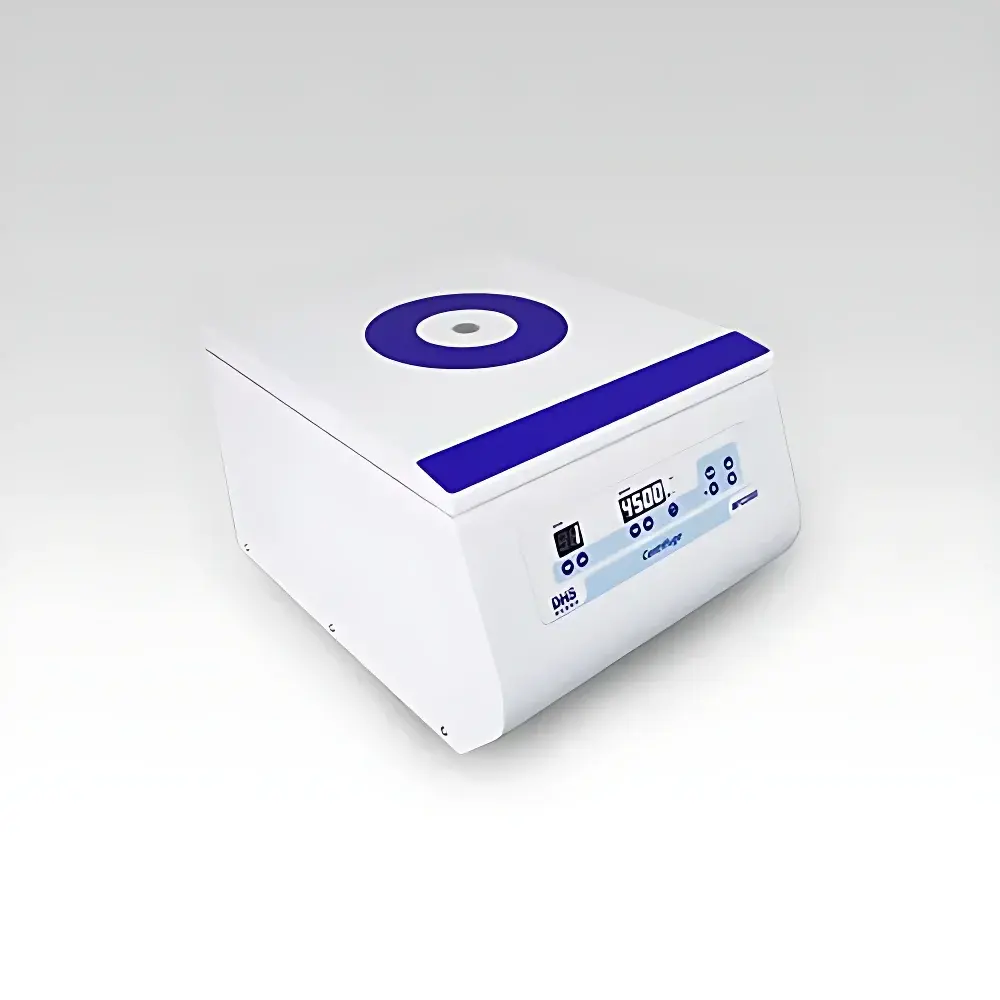
DHS MPC2000 96-Well Microplate Centrifuge
| Brand | DHS |
|---|---|
| Origin | Beijing, China |
| Model | MPC2000 |
| Instrument Type | Benchtop Centrifuge |
| Centrifugation Category | Low-Speed Centrifuge (≤4500 rpm) |
| Rotor Configuration | Horizontal Swing-Out Rotor |
| Maximum Capacity | 6 × 96-well ELISA plates / 2 × deep-well plates / 2 × PCR plates (with adapter) |
| Max Speed | 4500 rpm |
| Max RCF | 2860 × g |
| Dimensions (L×W×H) | 280 × 380 × 480 mm |
| Noise Level | <56 dB(A) |
| Motor | Brushless DC Direct Drive |
| Speed Range | 500–4500 rpm |
| Timer Range | 1–99 min + continuous mode |
| Power Supply | 220 V / 50 Hz / 350 W |
| Weight | 35 kg |
| Temperature Rise | <10 °C during operation |
Overview
The DHS MPC2000 is a purpose-engineered benchtop centrifuge optimized exclusively for high-throughput microplate processing in life science and clinical laboratories. Unlike general-purpose centrifuges adapted for plate handling, the MPC2000 employs a dedicated horizontal swing-out rotor architecture designed to accommodate standardized 96-well formats—including ELISA, PCR, and deep-well microplates—without requiring manual repositioning or auxiliary adapters for basic operation. Its operational principle relies on uniform radial acceleration generated by controlled rotational motion, ensuring consistent sedimentation of biological samples (e.g., cell pellets, precipitated nucleic acids, antibody-coated beads) across all wells with minimal edge effects. Engineered for precision and reproducibility in routine sample preparation workflows, it supports critical pre-analytical steps required prior to ELISA, qPCR, NGS library normalization, and high-content screening assays.
Key Features
- Dedicated horizontal swing-out rotor with universal 96-well plate compatibility—accepts full-skirted, half-skirted, and non-skirted PCR plates when used with the included PCR plate adapter
- Brushless DC motor with direct drive ensures maintenance-free operation, extended service life, and stable speed control across the full 500–4500 rpm range
- Independent rpm/rcf toggle key and real-time dual-display (LED) for simultaneous monitoring of rotational speed and relative centrifugal force
- Programmable timer (1–99 minutes) plus continuous mode and momentary “pulse” function for precise, operator-defined centrifugation cycles
- Integrated electronic lid lock with automatic rotor recognition and imbalance detection—compliant with IEC 61010-2-020 safety requirements for laboratory centrifuges
- Low-noise design (<56 dB[A]) suitable for shared lab environments; thermal management limits internal temperature rise to <10 °C under nominal load conditions
Sample Compatibility & Compliance
The MPC2000 accommodates up to six standard 96-well ELISA plates, two 96-well deep-well plates (up to 2.2 mL/well), or two 96-well PCR plates per run—enabling parallel processing of up to 576 samples without cross-contamination risk. All rotors and adapters are manufactured from autoclavable anodized aluminum alloy, meeting ISO 13485 material traceability standards for diagnostic device manufacturing environments. The instrument conforms to electromagnetic compatibility (EMC) directive 2014/30/EU and low-voltage directive 2014/35/EU. While not classified as a medical device under FDA 21 CFR Part 820, its performance parameters align with common validation protocols referenced in CLSI EP05-A3 and ISO 20943 for microplate-based assay preparation systems.
Software & Data Management
The MPC2000 operates via embedded microprocessor-based control firmware with non-volatile memory for storing up to 10 user-defined protocols. No external software or PC connection is required for routine operation; however, audit trails—including date/time stamps, speed settings, duration, and cycle count—are retained internally for GLP-compliant recordkeeping. Though lacking network connectivity or remote monitoring capabilities, its deterministic control logic and hardware-based safety interlocks satisfy essential requirements for regulated environments where electronic records must demonstrate integrity per ALCOA+ principles (Attributable, Legible, Contemporaneous, Original, Accurate).
Applications
- Centrifugation of ELISA plates prior to optical density measurement to eliminate bubbles and ensure uniform liquid column height
- Post-PCR spin-down of reaction mixtures to collect condensate and prevent evaporation-related concentration artifacts
- Normalization of pooled cDNA or gDNA libraries prior to sequencing input quantification
- Cell pellet compaction in high-throughput cytotoxicity or transfection assays using 96-well culture plates
- Removal of residual ethanol or isopropanol from silica-membrane column eluates in automated nucleic acid extraction workflows
FAQ
What types of microplates can be processed simultaneously on the MPC2000?
The MPC2000 supports mixed loading: up to six 96-well ELISA plates, or two deep-well plates plus two PCR plates (using the included PCR adapter), provided total mass balance remains within ±5 g per rotor arm.
Is the rotor autoclavable?
Yes—the aluminum swing-out rotor and all plate adapters are rated for steam sterilization at 121 °C for 20 minutes; repeated autoclaving does not compromise dimensional stability or balance tolerance.
Does the MPC2000 meet regulatory requirements for GMP labs?
While not certified as a GMP-grade instrument, its mechanical reliability, repeatable speed/RCF accuracy (±20 rpm / ±10 × g), and built-in electronic log functionality support IQ/OQ documentation and routine operational verification per Annex 11 and FDA guidance on computerized system validation.
Can the MPC2000 be used for centrifuging blood collection tubes?
No—it is engineered solely for microplate formats; tube rotors or conical adapters are not available or validated for this model.
What is the expected service life of the brushless motor?
Rated for ≥20,000 hours of operation under typical laboratory duty cycles (average 4 hrs/day, 5 days/week), with no scheduled brush replacement or commutator maintenance required.



