
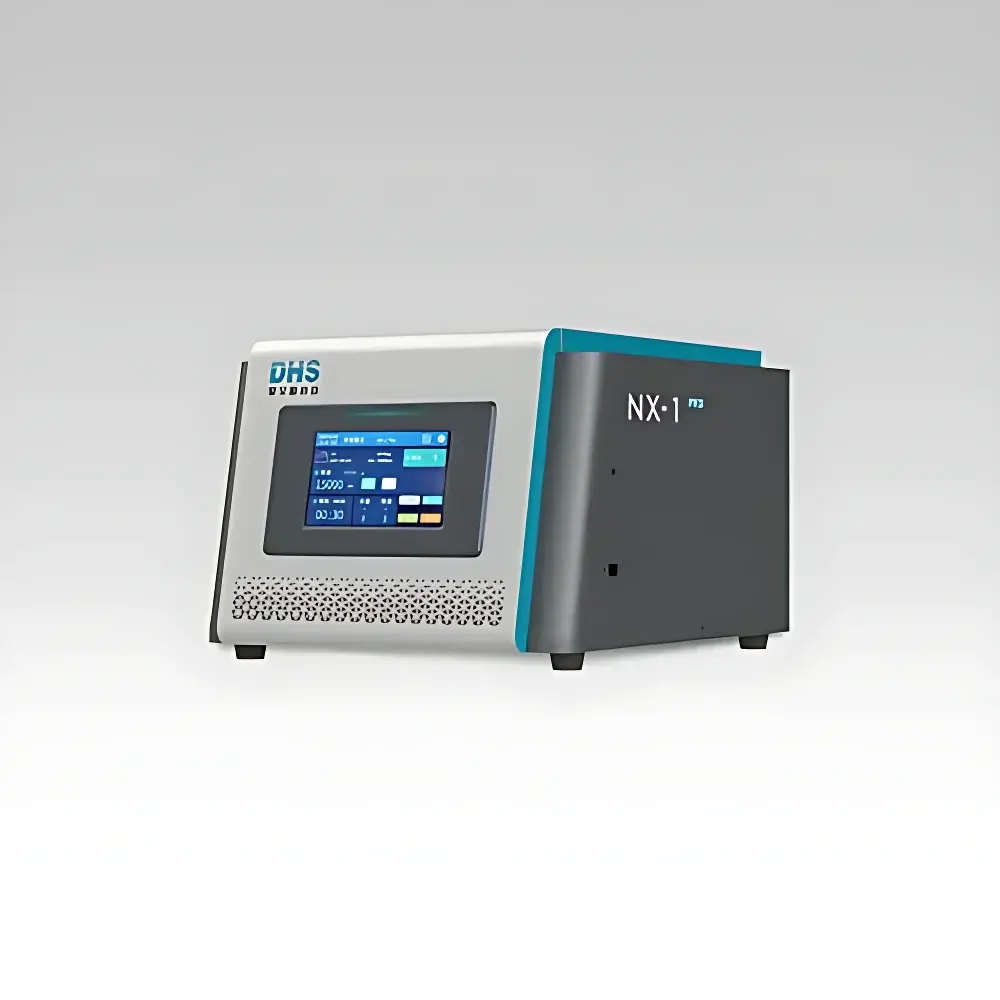
DHS NX-1 Pro High-Speed Microcentrifuge
| Brand | DHS |
|---|---|
| Origin | Tianjin, China |
| Model | NX-1 Pro |
| Instrument Type | Benchtop Centrifuge |
| Speed Range | 200–17,500 rpm |
| Max RCF | 23,300 × g |
| Max Capacity | 12 × 5 mL (angle rotor) |
| Dimensions (W×D×H) | 295 × 227 × 395 mm |
| Noise Level | ≤58 dB(A) at max speed |
| Acceleration/Deceleration | 10-step programmable ramp control |
| Programmable Methods | 100 user-defined protocols |
| Display | 5-inch capacitive touch screen |
| Compliance | CE, ISO 13485 (manufacturing), IEC 61010-1 safety standard |
Overview
The DHS NX-1 Pro High-Speed Microcentrifuge is an engineered benchtop solution for rapid, reproducible separation of microliter-scale biological samples. Designed around a brushless DC motor and precision-balanced rotor assembly, it operates on the principle of sedimentation centrifugation—applying controlled radial acceleration to separate particles based on size, density, and shape in viscous media. Its optimized mechanical architecture supports routine isolation of nucleic acids, proteins, organelles, and cellular debris from volumes ranging from 0.2 mL to 5 mL per tube. The instrument targets laboratories performing molecular biology, clinical diagnostics, proteomics, and cell culture workflows where consistent RCF delivery, thermal stability during prolonged runs, and operational repeatability are critical—notably in applications requiring high g-force resolution without sample denaturation or aerosol generation.
Key Features
- High-resolution 5-inch capacitive touchscreen interface with intuitive icon-based navigation, real-time parameter feedback, and graphical run progress visualization.
- Brushless motor drive system delivering stable rotational performance up to 17,500 rpm with ±50 rpm speed accuracy across the full operating range.
- Dual-chamber acoustic enclosure integrated with vortex-guided airflow channels reduces operational noise to ≤58 dB(A) at maximum speed—enabling use in shared lab environments without acoustic interference.
- Programmable acceleration and deceleration profiles (10-step ramp control) minimize shear stress on fragile macromolecular complexes and membrane-bound vesicles.
- Onboard memory stores up to 100 user-defined centrifugation methods, including multi-segment protocols with variable speed, time, and temperature (if equipped with refrigerated version—note: NX-1 Pro is air-cooled).
- Automatic rotor recognition via embedded RFID tag ensures correct speed limits and safety interlocks for each compatible angle rotor (e.g., 12-place 5 mL rotor, optional 24-place 1.5/2.0 mL rotor).
- Dual mechanical and electronic safety systems: lid-lock detection, imbalance sensing (<±2 g mass asymmetry), overspeed protection, and automatic shutdown upon abnormal vibration or thermal threshold exceedance.
Sample Compatibility & Compliance
The NX-1 Pro accommodates standard microcentrifuge tubes (0.2–5 mL), PCR strips, and low-retention conical tubes. It is validated for use with common biological matrices including lysates, serum, plasma, bacterial suspensions, and enzymatic reaction mixtures. All mechanical and electrical design complies with IEC 61010-1:2010 for laboratory equipment safety and meets CE marking requirements under the EU Machinery Directive. While not inherently GLP/GMP-certified as a standalone unit, its audit-ready operation log (timestamped start/stop, speed, time, RCF, error codes) supports traceability in regulated environments when paired with documented SOPs. It conforms to ISO 13485 quality management standards at the manufacturer level (Tianjin DHS Co., Ltd.).
Software & Data Management
The NX-1 Pro operates autonomously without external software dependency. All method creation, execution, and history tracking occur locally via the embedded OS. Each run generates a non-editable digital record containing date/time stamp, selected protocol ID, actual vs. setpoint rpm and duration, final RCF, and any triggered safety events. These logs are exportable via USB flash drive in CSV format for integration into LIMS or internal QA documentation systems. No cloud connectivity or remote access is implemented—ensuring data sovereignty and alignment with institutional IT security policies. Firmware updates are performed offline using signed binary packages distributed through authorized service channels.
Applications
- Precipitation and pelleting of plasmid DNA, genomic DNA, and RNA from alkaline lysis or column-eluted fractions.
- Clarification of cell lysates prior to SDS-PAGE or Western blot analysis.
- Separation of mitochondria, nuclei, and synaptosomes in subcellular fractionation protocols.
- Routine spin-down of enzymatic reactions, antibody binding assays, and ELISA plate preparations.
- Concentration of viral vectors, exosomes, and nanocarriers in translational research settings.
- Removal of residual ethanol or isopropanol after nucleic acid precipitation steps.
FAQ
What rotor configurations are supported out-of-the-box?
The NX-1 Pro ships standard with a 12-position fixed-angle rotor for 5 mL tubes. Optional rotors include a 24-place 1.5/2.0 mL rotor and a 30-place PCR strip rotor—each certified for full-speed operation and validated for RCF uniformity.
Is refrigeration available on this model?
No—the NX-1 Pro is an air-cooled, non-refrigerated platform. For temperature-sensitive separations below ambient, users should pre-chill samples and utilize short-duration protocols or consider the NX-1 Pro Cryo variant (separate model designation).
Does the device support regulatory compliance for FDA-submitted studies?
While the instrument itself does not carry FDA 510(k) clearance, its design, documentation, and operational logging meet baseline requirements for inclusion in analytical method validation packages under USP and ICH Q5C, provided site-specific IQ/OQ/PQ protocols are executed.
Can I integrate the NX-1 Pro into a laboratory automation workflow?
It lacks native RS-232, Ethernet, or Modbus interfaces; however, optional TTL-triggered start/stop signals are available via accessory I/O module (part #NX-IO-1), enabling basic synchronization with liquid handlers or robotic arms.
What maintenance intervals are recommended?
Annual calibration of speed and timer accuracy is advised. Rotor lifetime is tracked via built-in cycle counter; aluminum rotors require replacement after 10,000 cycles or 5 years, whichever occurs first—per manufacturer’s fatigue testing data.



