
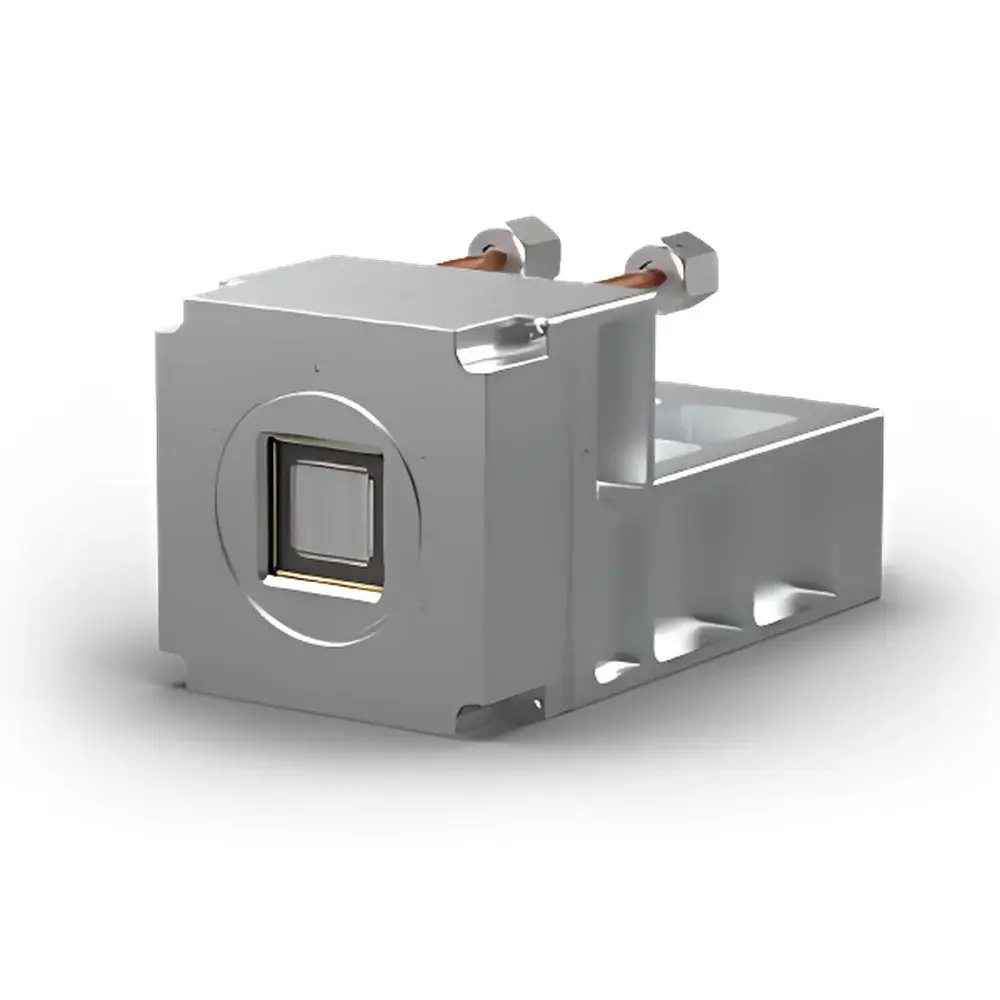
Dhyana XV95 Soft X-ray sCMOS Camera
| Brand | TUCSEN |
|---|---|
| Sensor Type | Back-Illuminated sCMOS (Anti-Reflection Coating-Free, EUV-Optimized) |
| Resolution | 2048 × 2048 |
| Pixel Size | 11 µm × 11 µm |
| Chip Format | 2-inch |
| Diagonal | 31.9 mm |
| Active Area | 22.5 mm × 22.5 mm |
| Full Well Capacity | 90 ke⁻ (typ.) |
| Dynamic Range | 90 dB |
| QE Peak | ~100% @ 80–1000 eV |
| Read Noise | 1.6 e⁻ (median, high-gain) |
| Frame Rate | 48 fps (STD), 24 fps (HDR) |
| Exposure Time | 21 µs – 10 s |
| Shutter | Rolling |
| Linearity | >99% |
| Bit Depth | 12/16-bit |
| Cooling | Water-cooled, ΔT ≤ 70 °C below ambient |
| Operating Temp | –50 °C @ 20 °C ambient |
| Dark Current | 0.1 e⁻/pixel/s @ –50 °C |
| Vacuum Compatibility | ≤10⁻⁵ Pa |
| Binning | 2×2, 4×4 |
| ROI Support | Yes |
| Timestamp Accuracy | 1 µs |
| Trigger | Hardware & Software (MX12-4 interface) |
| Interface | USB 3.0 |
| Power | 12 V / 8 A |
| Power Consumption | 40 W |
| Dimensions | 110 mm × 110 mm × 155.5 mm |
| Weight | 3 kg |
| SDK | C/C++/C# |
| Compatible Software | Mosaic, SamplePro, LabVIEW, MATLAB, Micro-Manager, MetaMorph |
| OS | Windows, Linux |
Overview
The Dhyana XV95 is a high-performance, vacuum-compatible soft X-ray and extreme ultraviolet (EUV) sCMOS camera engineered for quantitative imaging in synchrotron beamlines, laser-plasma diagnostics, EUV lithography metrology, and laboratory-scale X-ray microscopy. It employs a custom back-illuminated sCMOS sensor—Gpixel GSENSE400BSI, EUV-enhanced variant—optimized for photon energies between 80 eV and 1000 eV without anti-reflection coating. This architecture eliminates front-side absorption losses and enables peak quantum efficiency approaching 100% across the water window (284–543 eV) and broader soft X-ray bands. The sensor’s 2048 × 2048 pixel array, with 11 µm square pixels and 22.5 mm × 22.5 mm active area, delivers 4 MP resolution while maintaining high full-well capacity (90 ke⁻) and low read noise (1.6 e⁻ median at high gain). Its deep-cooling capability (–50 °C at ambient 20 °C, ΔT ≤ 70 K) and ultra-low dark current (0.1 e⁻/pixel/s) ensure exceptional signal fidelity during long-exposure experiments typical in coherent diffraction imaging (CDI) or ptychography.
Key Features
- Vacuum-rated mechanical and thermal design: Hermetically sealed housing certified for operation down to 10⁻⁵ Pa, compatible with UHV beamline end-stations and plasma chamber integration.
- EUV-optimized back-illuminated sCMOS sensor: No AR coating, maximizing native QE across 80–1000 eV; validated performance in 1st–6th order soft X-ray diffraction patterns.
- High-speed, high-dynamic-range acquisition: 48 fps at full resolution (STD mode); 24 fps in HDR mode with extended well depth utilization; rolling shutter with precise 1 µs timestamping.
- Low-noise imaging infrastructure: Water-cooled thermal management ensures stable sub–50 °C sensor operation; combined with 99% linearity, enabling photon-starved quantification.
- Flexible control and synchronization: Hardware-triggered acquisition via MX12-4 I/O interface; software trigger support; ROI selection; binning (2×2, 4×4); 12/16-bit output depth.
Sample Compatibility & Compliance
The Dhyana XV95 is designed for direct integration into vacuum-based optical paths requiring radiation-hardened, low-outgassing imaging components. Its stainless-steel and ceramic-sealed construction meets standard UHV material compatibility requirements (per ASTM E1557 and ISO 10110-7). While not intrinsically certified to GLP or FDA 21 CFR Part 11, its deterministic triggering, hardware timestamping, and audit-ready metadata logging (via SDK and supported platforms like Micro-Manager and LabVIEW) facilitate compliance with traceability requirements in regulated research environments. The camera supports reproducible calibration workflows—including flat-field correction, dark frame subtraction, and gain mapping—aligned with ISO 15739 (image sensor noise measurement) and ISO 17850 (EUV detector characterization guidelines).
Software & Data Management
The Dhyana XV95 ships with a cross-platform SDK supporting C, C++, and C# for embedded integration into custom acquisition engines. Native drivers and APIs are provided for widely adopted scientific platforms: Mosaic (for synchrotron control), SamplePro (materials science workflows), LabVIEW (NI ecosystem), MATLAB Image Acquisition Toolbox, Micro-Manager (open-source microscopy), and MetaMorph (cell imaging pipelines). All supported software layers preserve metadata integrity—including exposure time, temperature, trigger source, and ROI coordinates—in standardized formats (e.g., TIFF with embedded EXIF/XMP tags or HDF5 with NeXus-compliant headers). Time-synchronized multi-camera setups are enabled via TTL-compatible external trigger input/output, supporting pump-probe or multi-angle EUV imaging configurations.
Applications
- Synchrotron-based X-ray ptychography and holography requiring high spatial coherence and single-photon sensitivity in the 100–1000 eV range.
- Laser-produced plasma diagnostics: time-resolved imaging of EUV emission from tin or xenon plasmas at 13.5 nm and harmonics.
- Transmission X-ray microscopy (TXM) and scanning transmission X-ray microscopy (STXM) beamlines operating in the carbon, nitrogen, and oxygen K-edges.
- Reflectometry and mask inspection in EUV lithography development, where high dynamic range and sub-pixel stability are critical for defect detection.
- Tabletop high-harmonic generation (HHG) experiments demanding vacuum-compatible, low-noise detection with microsecond-level timing precision.
FAQ
Is the Dhyana XV95 suitable for ultra-high vacuum (UHV) environments?
Yes—the camera is rated for continuous operation at pressures ≤10⁻⁵ Pa and features low-outgassing materials and hermetic sealing compliant with standard UHV integration protocols.
What is the spectral responsivity limitation of the bare back-illuminated sensor?
The sensor exhibits peak quantum efficiency (~100%) between 80 eV and 1000 eV, with strong response across the water window (284–543 eV); it is not optimized for hard X-rays (>5 keV) or visible light without optional filters or coatings.
Can the camera be synchronized with pulsed lasers or RF triggers?
Yes—hardware triggering via the MX12-4 interface supports TTL-compatible input/output with sub-microsecond jitter, enabling precise pump-probe alignment in time-resolved soft X-ray studies.
Does the SDK support real-time image processing pipelines?
The C/C++ SDK provides low-latency frame access, ROI streaming, and memory-mapped buffers—enabling integration with CUDA-accelerated or FPGA-based preprocessing modules for on-the-fly background subtraction or centroid analysis.
Is cooling performance affected by ambient temperature fluctuations?
Water-cooling ensures thermal stability independent of ambient conditions; the system maintains sensor temperature within ±0.1 °C under steady-state operation, critical for long-duration diffraction experiments.






