
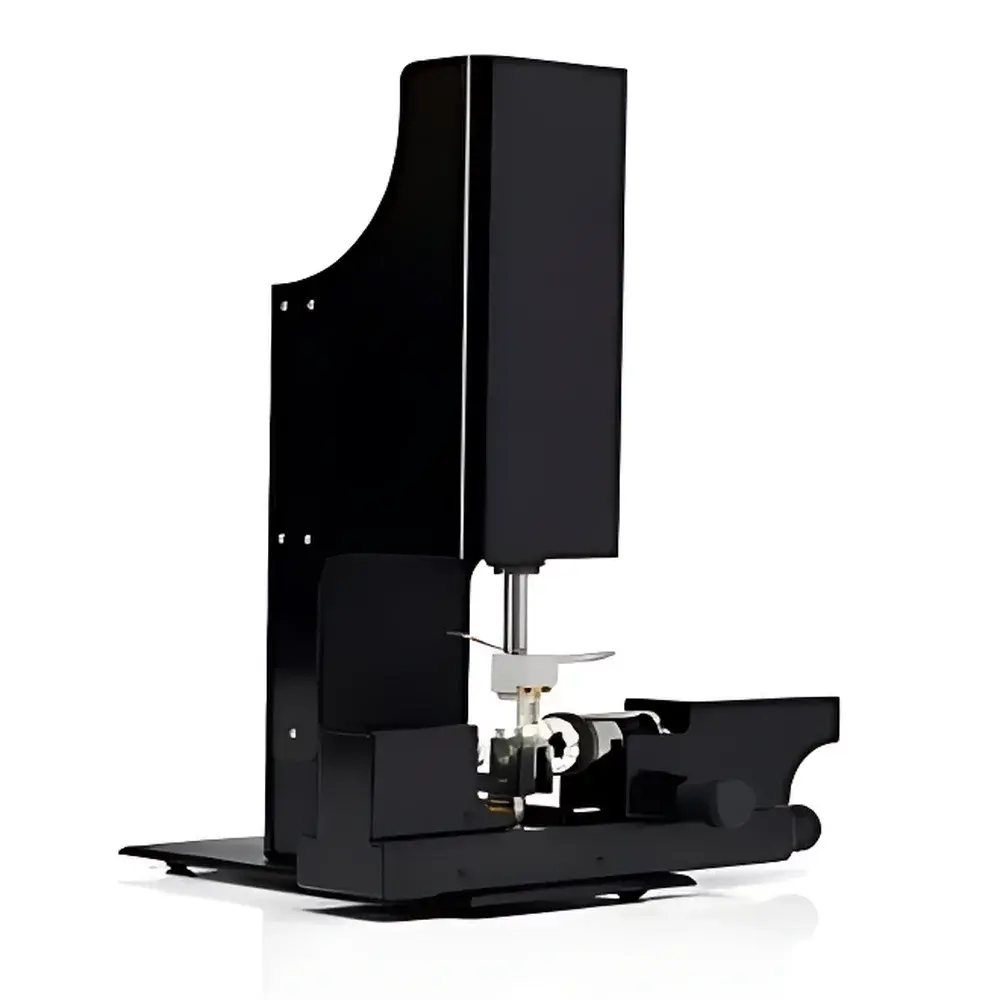
Dia-stron LEX820 IFSS Module for Interfacial Shear Strength Measurement
| Brand | Dia-stron |
|---|---|
| Origin | United Kingdom |
| Model | IFSS / LEX820 |
| Application | Micro-debonding force measurement on single fibers and filaments |
| Optical Imaging | Integrated high-resolution camera and coaxial LED illumination for real-time visualization and failure mode capture |
| Compatible Fiber Types | Glass, carbon, ceramic, aramid, basalt, natural fibers (e.g., flax, hemp, cellulose) |
Overview
The Dia-stron LEX820 IFSS Module is a precision-engineered micro-debonding testing system designed to quantify interfacial shear strength (IFSS) between reinforcing fibers and matrix materials at the single-filament level. It operates on the principle of controlled micro-droplet debonding—where a polymer micro-droplet is deposited onto an individual fiber, cured, and subsequently subjected to axial displacement until interfacial failure occurs. The resulting debonding force, combined with measured droplet geometry (diameter, height), enables calculation of IFSS using the Kelly–Grove equation or its modified forms. This method is widely accepted in composite material science for evaluating fiber–matrix adhesion quality, surface treatment efficacy (e.g., sizing, plasma activation, silane coupling), and interfacial durability under thermal or environmental aging. The LEX820 platform provides sub-micron displacement resolution and nanonewton-level force sensitivity—critical for reproducible, ASTM D7264-22 and ISO 11359-compliant measurements.
Key Features
- Modular integration with the LEX820 universal tensile tester—enabling rapid switching between IFSS, tensile, flexural, and creep modules without recalibration.
- Coaxial high-intensity LED illumination and 5-megapixel machine vision system with 10× macro lens, delivering real-time, high-contrast imaging of fiber–droplet interface during loading.
- Automated video capture synchronized with force–displacement data acquisition (up to 100 fps), supporting frame-by-frame analysis of crack initiation, propagation, and final debonding morphology.
- Motorized XYZ stage with ±0.1 µm positioning repeatability, ensuring precise alignment of the micro-droplet centroid relative to the fiber axis prior to testing.
- Thermally stabilized sample chamber (optional) for controlled-temperature IFSS evaluation (−20 °C to +80 °C), facilitating studies of thermal residual stress and temperature-dependent interfacial behavior.
- Compliance with GLP documentation requirements: audit-trail enabled software logs operator ID, timestamp, calibration status, and raw data checksums for regulatory traceability.
Sample Compatibility & Compliance
The IFSS module accommodates monofilaments ranging from 5 µm to 500 µm in diameter—including continuous glass, carbon, ceramic, aramid (e.g., Kevlar®, Twaron®), basalt, and natural fibers such as flax, jute, and regenerated cellulose. Both synthetic and bio-based matrices are supported: epoxy, polyester, vinyl ester, polypropylene, PLA, and thermoplastic elastomers. Sample preparation follows standardized protocols per ASTM D3379 (single-filament tensile test) and ISO 11566 (microbond test). All mechanical and optical subsystems are CE-marked and compliant with IEC 61000-6-2/6-4 electromagnetic compatibility standards. Data integrity meets FDA 21 CFR Part 11 requirements when used with validated software configurations.
Software & Data Management
Dia-stron’s proprietary IFSS Analysis Suite (v4.2+) runs on Windows 10/11 and provides full workflow automation—from droplet deposition guidance and autofocus calibration to force–displacement curve fitting and IFSS calculation. Software includes built-in geometric measurement tools for droplet contact angle, base diameter, and meniscus height; automated detection of debond onset point using first-derivative thresholding; and export of ASCII, CSV, and PDF reports with embedded images and metadata. Raw data files (.dsm) are encrypted and digitally signed to prevent tampering. Integration with LIMS via ODBC and support for electronic signatures enable seamless incorporation into GMP/QA environments.
Applications
- Quantifying the effect of fiber surface modifications (oxidation, grafting, coating) on interfacial adhesion energy.
- Evaluating sizing formulation performance across batch-to-batch production for carbon and glass fiber manufacturers.
- Assessing interfacial degradation kinetics after hygrothermal aging, UV exposure, or chemical immersion per ASTM D570 and ISO 62.
- Supporting development of sustainable composites by benchmarking natural fiber–biopolymer interfaces.
- Providing input parameters for micromechanical finite element models of composite strength and fracture behavior.
FAQ
What fiber diameters are supported by the IFSS module?
Standard operation covers 5–500 µm; custom fixtures are available for sub-5 µm nanofibers upon request.
Can the system measure IFSS in thermoplastic matrices?
Yes—using hot-stage accessories and controlled cooling rates to solidify droplets without thermal shock-induced interfacial defects.
Is video analysis performed in real time or post-test?
Both: live preview with adjustable contrast/gain is available during testing, while synchronized high-frame-rate recording enables detailed post-test failure mode classification.
How is calibration traceability maintained?
Force transducers are calibrated annually against NPL-traceable deadweight standards; displacement encoders are verified using laser interferometry per ISO 9283.
Does the software support multi-user role-based access control?
Yes—administrator, analyst, and reviewer roles with configurable permissions for data viewing, editing, and electronic signing are enforced via Windows Active Directory integration.
Related Products






