Dia-stron SIRTAKI Automated Hair Combing Instrument
| Brand | Dia-stron |
|---|---|
| Origin | United Kingdom |
| Manufacturer Type | Authorized Distributor |
| Origin Category | Imported |
| Model | SIRTAKI |
| Pricing | Upon Request |
Overview
The Dia-stron SIRTAKI Automated Hair Combing Instrument is a precision-engineered mechanical testing system designed specifically for the quantitative evaluation of hair fiber resistance to combing-induced mechanical stress. It operates on the principle of controlled, repetitive combing motion applied to standardized hair tresses under defined torque and frequency parameters—mimicking real-world grooming conditions in a reproducible laboratory environment. Unlike subjective manual assessment methods, the SIRTAKI delivers objective, time-stamped data on hair breakage, tangling resistance, and surface integrity loss during combing cycles. This makes it an essential tool for formulation scientists developing shampoos, conditioners, leave-in treatments, and keratin-based repair systems—where mechanical durability of hair under routine handling is a critical performance metric aligned with consumer expectations and regulatory benchmarking (e.g., ISO 19764:2018 “Cosmetics — Hair care products — Method for determination of combing force”).
Key Features
- Programmable combing frequency range: 1.0–2.3 Hz, adjustable in 0.1 Hz increments for precise simulation of slow-to-rapid combing actions.
- Constant-torque drive mechanism ensures consistent mechanical load across all test cycles, eliminating variability from motor slip or speed fluctuation.
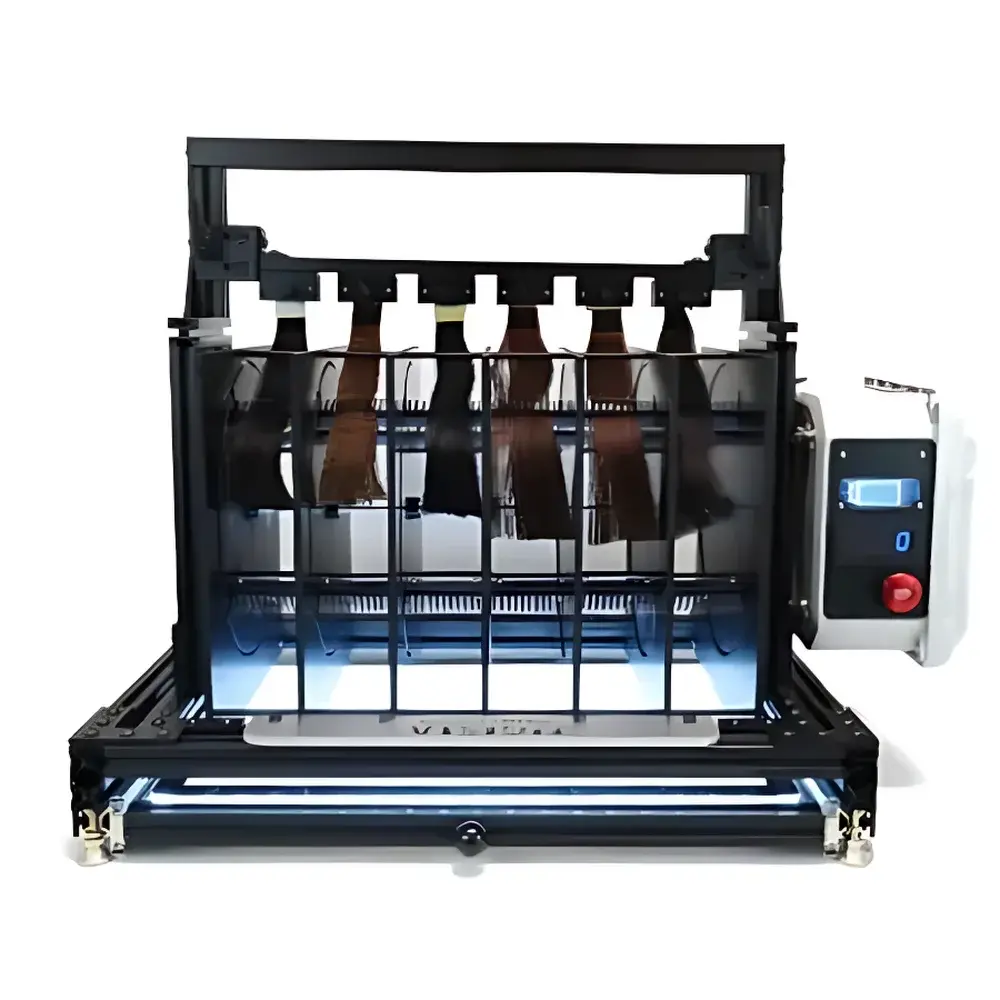
- Simultaneous six-channel configuration enables parallel testing of up to six independent hair tresses—each mounted in standardized stainless-steel sample holders with calibrated tension clamping.
- Integrated backlit collection tray with slide-out access allows visual verification and manual enumeration of broken hair fragments post-test without disassembling the instrument.
- Robust aluminum alloy chassis and sealed stepper-motor actuation provide long-term operational stability in humidified lab environments typical of cosmetic testing facilities.
- No external PC dependency for basic operation; onboard control panel supports start/stop, cycle count setting, and real-time status display.
Sample Compatibility & Compliance
The SIRTAKI accepts human hair tresses (natural or chemically treated), synthetic fiber bundles, and standardized reference hair samples (e.g., ISO 10993-compliant donor hair). Tress diameter, length (recommended 15–25 cm), and moisture content (conditioned at 21 °C / 65% RH per ASTM D5229) must be documented per test protocol. The instrument complies with mechanical safety requirements outlined in EN 61000-6-2 (EMC immunity) and EN 61000-6-4 (EMC emission), and its mechanical design adheres to ISO 12100 principles for low-risk laboratory equipment. While not certified as medical device, its output data supports GLP-aligned studies required for cosmetic product registration under EU Regulation (EC) No 1223/2009 and FDA Voluntary Cosmetic Registration Program (VCRP) submissions.
Software & Data Management
The SIRTAKI operates standalone but interfaces via RS-232 or USB-to-serial adapter with Dia-stron’s optional Combing Analysis Suite (CAS) v3.2 software. CAS enables automated logging of cycle count, elapsed time, and operator ID; exports CSV-formatted datasets compatible with JMP, Minitab, or Python pandas workflows. Audit trail functionality meets ALCOA+ principles: all parameter changes, run initiation, and data export events are timestamped and user-attributed. Software validation documentation (IQ/OQ protocols) is available upon request for laboratories operating under GxP frameworks requiring 21 CFR Part 11 compliance for electronic records.
Applications
- Quantitative comparison of anti-breakage efficacy between silicone-based vs. plant-derived conditioning agents.
- Evaluation of cumulative damage after repeated shampooing and thermal styling cycles.
- Supporting claims substantiation for “reduced shedding,” “improved manageability,” or “enhanced strength” in marketing dossiers.
- Correlation studies between combing force metrics and instrumental measurements (e.g., tensile strength via Dia-stron DMT500, surface roughness via AFM).
- Method development for ISO/IEC 17025-accredited cosmetic testing laboratories seeking scope expansion into mechanical hair performance.
FAQ
What hair sample preparation standards does the SIRTAKI require?
Hair tresses must be cut to uniform length (±1 mm), weighed (target mass 100 ± 5 mg per tress), and equilibrated for ≥48 h at 21 °C / 65% RH prior to mounting. Pre-conditioning follows ISO 3696 Grade 3 water rinsing when applicable.
Can the SIRTAKI integrate with third-party data acquisition systems?
Yes—via TTL-compatible digital I/O signals (start trigger, cycle pulse, end-of-test flag) and ASCII serial command set, enabling synchronization with high-speed cameras or force sensors in custom experimental rigs.
Is routine calibration required, and what traceability does it support?
Frequency accuracy is factory-calibrated against NPL-traceable quartz oscillator standards; torque calibration requires annual verification using Dia-stron-certified torque test kit (PN: TORQ-SIRTAKI-VERIF). Calibration certificates include uncertainty budgets per ISO/IEC 17025.
Does the instrument support automated fragment counting?
No—fragment enumeration remains manual via backlit tray inspection to avoid optical misclassification of split ends vs. full breaks; however, CAS software supports configurable pass/fail thresholds based on operator-entered counts.