
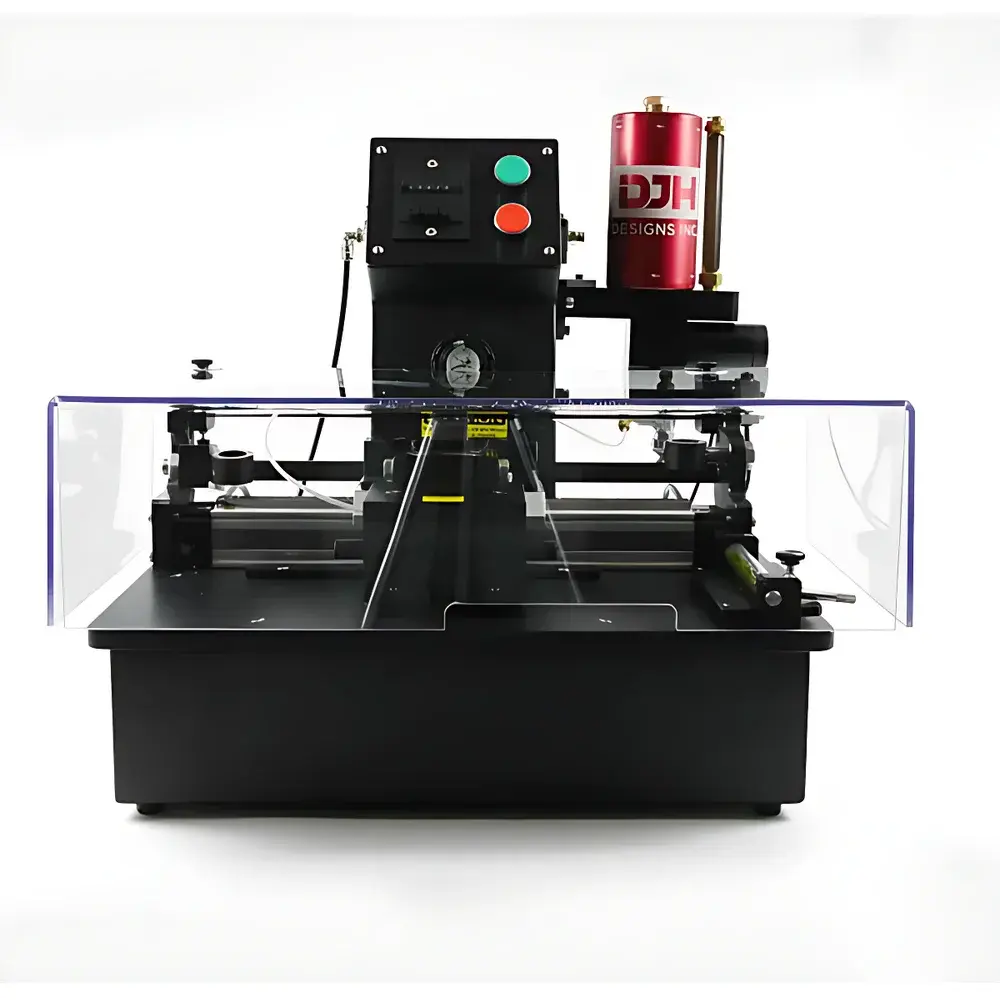
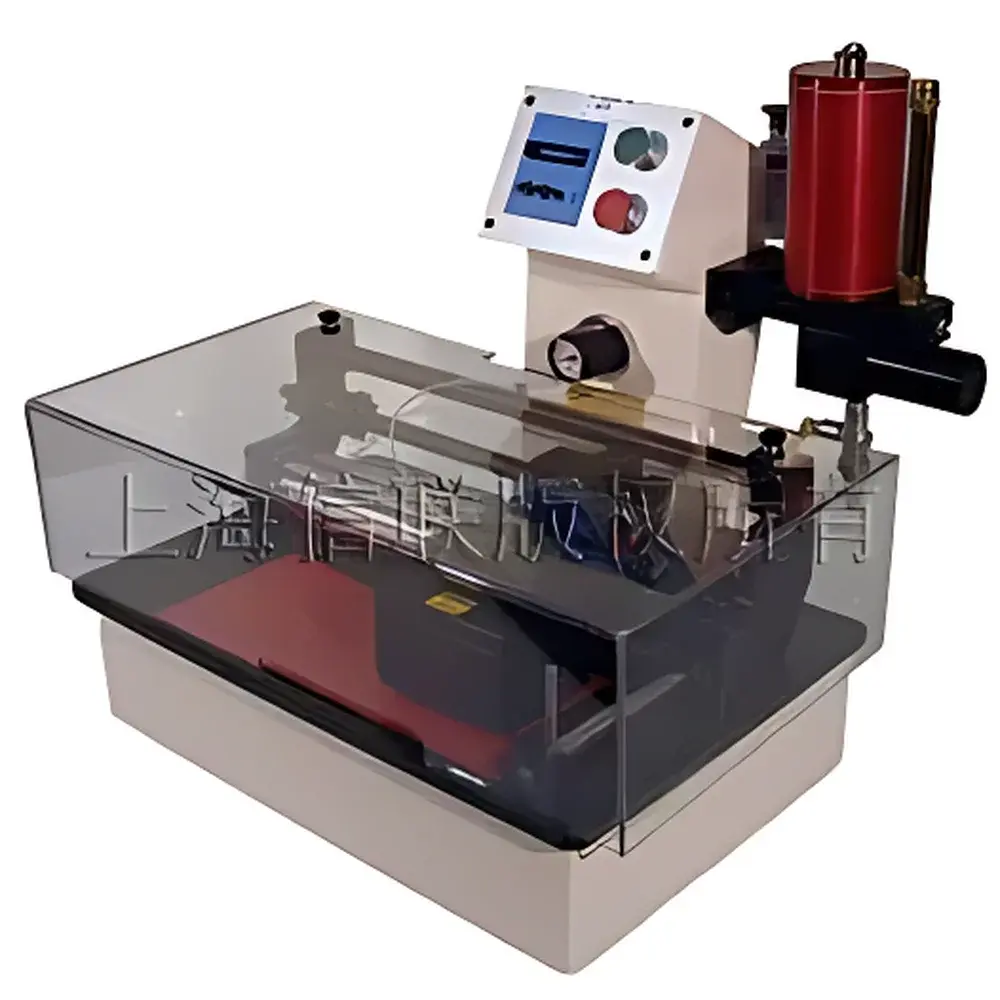
DJH Designs MEK Rub Test Machine – Reciprocating Solvent Rub Tester for Coated Steel Panels
| Brand | DJH Designs |
|---|---|
| Origin | Canada |
| Model | MEK |
| Instrument Type | Reciprocating Tribological Tester |
| Max Friction Load | 4 kg |
| Friction Force Resolution | 0.4 mN |
| Max Operating Temperature | 60 °C |
| MEK Reservoir Capacity | 425 mL |
| Reciprocating Stroke Length | 203 mm |
| Cycle Count Range | 1–9999 |
| Operating Air Pressure | 550 kPa (80 psi) |
| Air Consumption | 2.35 SCFM @ 550 kPa |
| Air Inlet Connection | ¼ NPT |
| Counter Accuracy | ±1 cycle |
| Weight of Rubbing Block Assembly | 3 kg |
Overview
The DJH Designs MEK Rub Test Machine is a precision-engineered, pneumatically driven reciprocating tribological tester designed specifically to evaluate the solvent resistance and surface durability of pre-painted metal substrates—particularly coil-coated steel panels—against repeated mechanical abrasion in the presence of methyl ethyl ketone (MEK). Unlike general-purpose wear testers, this instrument implements a standardized rub test methodology aligned with industry-accepted protocols such as ASTM D5402 (“Standard Practice for Assessing the Solvent Resistance of Organic Coatings Using MEK Double-Rub Test”) and ISO 15184 (“Paints and Varnishes — Determination of Film Hardness by Pencil Test and MEK Rub Resistance”). The system operates on a controlled reciprocating motion where a standardized weighted rubbing block, saturated with MEK solvent, traverses a fixed stroke length across the coated sample surface at a consistent frequency and pressure. The endpoint is determined visually or instrumentally by observing the onset of substrate exposure, gloss loss, or coating delamination after a defined number of double-rubs. Its fully pneumatic architecture eliminates electrical hazards in solvent-rich environments and ensures stable, repeatable force application without thermal drift or motor-induced vibration.
Key Features
- Fully pneumatic operation—no electrical connections required, enhancing safety in volatile solvent handling environments.
- Adjustable and repeatable reciprocating stroke (203 mm) with precise air-pressure regulation (550 kPa nominal operating pressure) for consistent normal load application.
- Integrated MEK reservoir (425 mL capacity) with sealed delivery path to minimize solvent evaporation and operator exposure.
- Digital programmable counter (1–9999 cycles) with non-volatile memory, supporting GLP-compliant test documentation and audit trails.
- Robust aluminum-alloy frame and stainless-steel wetted components engineered for long-term chemical compatibility with MEK and related ketone solvents.
- Modular rubbing block assembly (3 kg total mass) with standardized contact geometry per ASTM D5402 Annex A1, ensuring inter-laboratory reproducibility.
- Onboard compressed-air filtration interface (¼ NPT) compatible with ISO 8573-1 Class 2 desiccated, oil-free air supply systems.
Sample Compatibility & Compliance
The MEK Rub Test Machine accommodates flat, rigid specimens up to 150 mm × 300 mm and thicknesses from 0.3 mm to 2.0 mm—covering standard coil-coated steel, aluminum, and zinc-alloy panels used in architectural cladding, appliance housings, and automotive trim applications. It supports both single-pass and double-rub configurations per ASTM D5402 Section 7. All mechanical and pneumatic subsystems comply with CSA C22.2 No. 14-M1995 (General Requirements for Pneumatic Equipment) and meet CE marking requirements for machinery safety (2006/42/EC). When operated with calibrated air supply and traceable weight verification, test data satisfies internal quality control requirements and external certification audits—including those mandated under ISO 9001:2015 Clause 7.1.5 and IATF 16949:2016 Section 7.1.5.2 for measurement system analysis (MSA).
Software & Data Management
While the base model operates via hardware-based digital counter and manual parameter setting, optional RS-232 or USB-to-serial interface modules enable integration with laboratory information management systems (LIMS) and electronic lab notebooks (ELN). Data export includes timestamped cycle count, cumulative runtime, and user-defined test ID—formatted as ASCII CSV for traceability. Optional firmware upgrade supports 21 CFR Part 11-compliant electronic signatures and audit-log generation when paired with validated third-party software platforms compliant with GxP data integrity principles (ALCOA+). All configuration changes are logged with operator ID, timestamp, and previous/updated values.
Applications
- Quality assurance of coil-coated steel used in roofing, siding, and HVAC ductwork.
- R&D evaluation of new resin formulations (e.g., polyester, PVDF, SMP) for improved solvent resistance.
- Batch release testing for compliance with AAMA 2603/2604/2605 specifications.
- Failure analysis of field-failed coated panels to correlate rub resistance with accelerated weathering data.
- Supplier qualification against OEM material specifications (e.g., Ford WSS-M2P177-A2, GMW14872).
- Validation of cleaning process efficacy on post-painted surfaces prior to adhesive bonding or secondary finishing.
FAQ
What standards does the MEK Rub Test Machine support?
It is configured to execute tests per ASTM D5402, ISO 15184, and JIS K 5600-5-3, with mechanical parameters traceable to NIST-certified force and displacement standards.
Is calibration service available?
Yes—DJH Designs provides annual calibration certificates (traceable to NRC Canada) for stroke length, applied load, and cycle counting accuracy, including uncertainty budgets per ISO/IEC 17025.
Can the machine be used with solvents other than MEK?
While optimized for MEK, it may accommodate other low-viscosity ketones or alcohols (e.g., acetone, ethanol) provided compatibility with elastomer seals and reservoir materials is verified per manufacturer’s chemical resistance guide.
What maintenance is required?
Monthly inspection of air filter elements, quarterly lubrication of pneumatic cylinder seals with food-grade silicone grease, and annual verification of counter linearity and stroke repeatability.
Does the system include test report templates?
Yes—the operator manual includes editable PDF and Excel templates aligned with ISO/IEC 17025 reporting requirements, including fields for environmental conditions (temperature/humidity), operator ID, equipment ID, and raw observation notes.



