
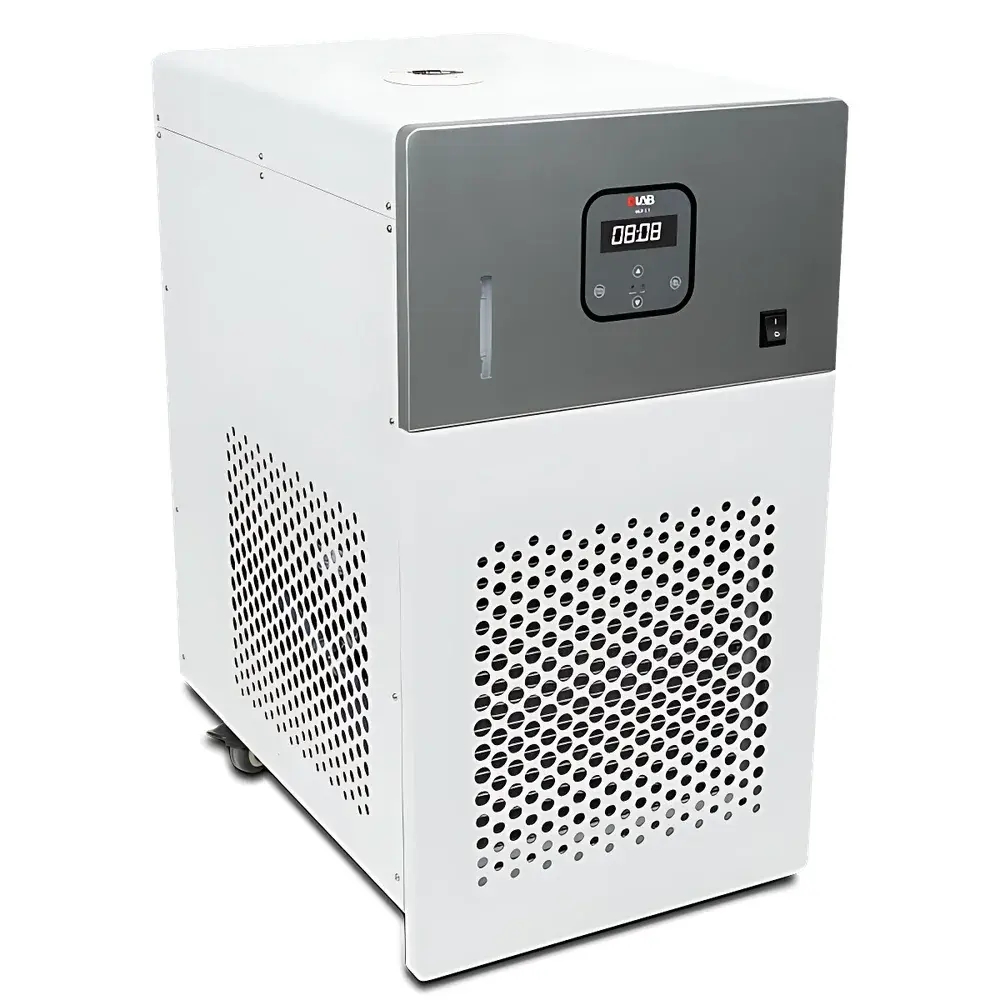
DLAB DCP-17 Benchtop Low-Temperature Circulating Chiller
| Brand | DLAB |
|---|---|
| Origin | Beijing, China |
| Manufacturer Type | Direct Manufacturer |
| Product Type | Integrated Circulating Chiller |
| Cooling Method | Water-Cooled |
| Temperature Range | −20 °C to Ambient |
| Temperature Stability | ±0.5 °C |
| Pump Pressure | 1.0 bar |
| Pump Flow Rate | 22 L/min |
| Reservoir Capacity | 17 L |
| Temperature Display | LED, 0.1 °C Resolution |
| Control Algorithm | Intelligent PID |
| Sensor Type | PT100 |
| Refrigerant | R404a |
| Refrigeration Capacity @ 20 °C | 2400 W |
| Power Supply | 100–120 V / 200–240 V, 50/60 Hz |
| Max. Power Consumption | 1000 W |
| Max. Current | 5 A |
| Ambient Operating Conditions | 5–40 °C, ≤80% RH |
| External Hose Port ID | 10 mm |
| Dimensions (W×D×H) | 400 × 560 × 705 mm |
| Mounting | Floor-Standing |
| Continuous Operation | Yes |
Overview
The DLAB DCP-17 is an integrated low-temperature circulating chiller engineered for precision thermal management in demanding laboratory and industrial applications. It operates on a closed-loop refrigeration cycle using R404a — a non-toxic, zero-ozone-depletion-potential (ODP) refrigerant compliant with current environmental safety standards. The unit employs a water-cooled condenser architecture coupled with intelligent PID temperature control and a high-stability PT100 resistance thermometer, enabling accurate setpoint maintenance across a continuous operating range from −20 °C to ambient temperature. Its compact floor-standing footprint (400 × 560 × 705 mm) supports flexible integration into fume hoods, analytical instrument benches, and process lines where spatial constraints are critical. Designed for 100% duty-cycle operation, the DCP-17 delivers consistent thermal load rejection with minimal drift — essential for applications requiring long-duration stabilization, such as rotary evaporation, spectroscopic sample conditioning, or exothermic reaction control.
Key Features
- Integrated design with front-accessible, tool-free panel removal for routine filter maintenance and internal inspection
- High-efficiency insulation layer minimizing parasitic heat ingress and improving energy efficiency by up to 25% compared to standard foam-insulated units
- Dual-point fluid level monitoring: visual window + electronic overflow protection to prevent dry-run conditions and pump cavitation
- Proportional refrigeration control modulates compressor speed in real time based on thermal load, reducing mechanical wear and extending service life
- Low-noise operation (<58 dB[A] at 1 m) achieved via optimized fan blade geometry and vibration-damped compressor mounting
- Top-fill and rear-drain configuration with quick-release valve enables rapid coolant exchange without disassembling the reservoir
- Robust circulation system featuring a corrosion-resistant centrifugal pump rated for continuous 22 L/min flow at 1.0 bar pressure head
Sample Compatibility & Compliance
The DCP-17 is compatible with standard aqueous glycol mixtures (e.g., 30% ethylene glycol/water), silicone oils, and other non-corrosive heat transfer fluids meeting ISO 6743-22 lubricant classification requirements. Its sealed refrigeration circuit complies with EN 378-1:2016 for safety and performance of refrigerating systems. While not certified for Class I Div 1 hazardous locations, the unit meets CE marking requirements under the EU Machinery Directive 2006/42/EC and Electromagnetic Compatibility Directive 2014/30/EU. For regulated environments, its stable temperature output supports adherence to ASTM E2910 (Standard Practice for Temperature Calibration of Thermal Analyzers) and USP (Thermal Analysis) when used with validated external probes.
Software & Data Management
The DCP-17 features embedded firmware supporting RS-485 Modbus RTU communication (optional USB-to-RS485 adapter required). This interface allows integration into centralized lab infrastructure via SCADA or LIMS platforms for remote parameter setting, real-time temperature logging, and alarm event reporting. Audit trail functionality — including timestamped setpoint changes, error codes, and power-on/off cycles — is stored locally for GLP/GMP-aligned record retention. No proprietary software is required; standard Modbus-compatible tools (e.g., QModMaster, LabVIEW Modbus libraries) enable full programmability. Firmware updates are performed via microSD card slot located behind the front panel.
Applications
- Rotary evaporation: Maintains condenser jacket temperatures at −15 °C to maximize solvent recovery efficiency during low-boiling-point compound isolation
- Spectroscopy: Stabilizes optical components in FTIR, Raman, and UV-Vis instruments to mitigate thermal lensing and wavelength drift
- Chemical synthesis: Controls exothermic Grignard, lithiation, or nitration reactions within narrow windows (±0.3 °C) to suppress side-product formation
- Biopharmaceutical processing: Supports cryo-storage of enzyme solutions and buffer equilibration for HPLC column conditioning at sub-zero temperatures
- Semiconductor metrology: Provides thermal stabilization for ellipsometers and AFM stages during nanoscale surface characterization
- Food science research: Enables controlled freezing rate studies in texture analyzer calibration protocols per ISO 11348-3
FAQ
What types of heat transfer fluids are compatible with the DCP-17?
The unit is validated for use with water-glycol blends (up to 50% v/v), polyalphaolefin (PAO)-based synthetic coolants, and silicone oils with viscosity ≤50 cSt at 20 °C. Avoid chlorinated solvents, acetone, or low-flashpoint hydrocarbons.
Can the DCP-17 operate continuously for 72+ hours without intervention?
Yes — it is rated for uninterrupted 100% duty-cycle operation under ambient conditions ≤35 °C and relative humidity ≤70%. Internal thermal cutouts and refrigerant pressure sensors ensure safe extended runtime.
Is the temperature display traceable to NIST standards?
The factory-calibrated PT100 sensor has an initial accuracy of ±0.15 °C over −20 to 0 °C and ±0.25 °C from 0 to 30 °C. Optional third-party calibration certificates (NIST-traceable) are available upon request.
Does the unit support external temperature feedback control?
No — the DCP-17 uses internal PT100 sensing only. For process-coupled control, users must implement external PID controllers interfaced via analog 0–10 V or 4–20 mA signals (not included).
What maintenance intervals are recommended for optimal performance?
Inspect and clean the air-intake filter monthly; replace the fluid filter every 6 months or after 1000 operational hours; perform full coolant replacement and system flush annually or when conductivity exceeds 150 µS/cm.



