
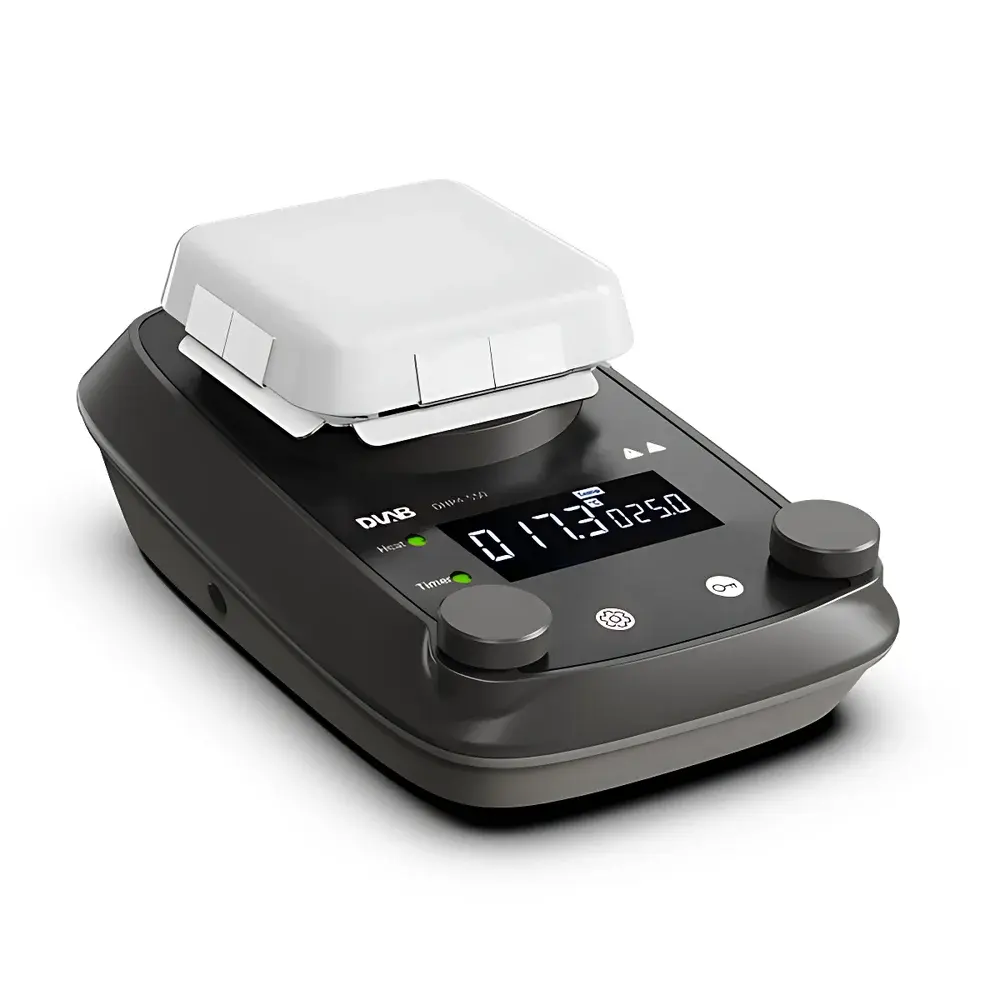
DLAB DHP4-550 LCD Digital Ceramic Hotplate
| Brand | DLAB |
|---|---|
| Origin | Beijing, China |
| Manufacturer Type | Direct Manufacturer |
| Product Category | Domestic |
| Model | DHP4-550 |
| Heating Temperature Range | Ambient to 550 °C (1 °C increment) |
| Working Plate Dimensions | 100 × 100 mm (4-inch square) |
| Working Plate Material | Glass-Ceramic |
| Temperature Control Accuracy | ±1 °C (<100 °C) or ±1% of setpoint (>100 °C) |
| Temperature Display Resolution | 0.1 °C |
| External Sensor | PT1000 (±0.2 °C accuracy) |
| Residual Heat Warning Threshold | >50 °C |
| Overtemperature Cut-off | 580 °C |
| Timer Range | 1 min – 99 h 59 min |
| Power Input | 100–120 V / 200–240 V, 50/60 Hz |
| Rated Power | 430 W |
| Thermal Output | 410 W |
| IP Rating | IP21 |
| Dimensions (L×W×H) | 270 × 175 × 108 mm |
| Weight | 1.8 kg |
| Operating Ambient | 5–40 °C, ≤80% RH |
Overview
The DLAB DHP4-550 LCD Digital Ceramic Hotplate is a precision-engineered benchtop heating platform designed for consistent, safe, and traceable thermal control in analytical, quality control, and research laboratories. Built around a monolithic glass-ceramic heating surface, it delivers uniform heat distribution across its 100 × 100 mm active zone—optimized for compatibility with standard round-bottom flasks, beakers, and reaction vessels up to 1 L capacity. Unlike traditional aluminum or stainless-steel plates, the ceramic surface resists chemical degradation from concentrated acids (e.g., HNO3, H2SO4), alkalis (e.g., NaOH, KOH), organic solvents, and high-boiling-point oils—eliminating surface pitting and ensuring long-term calibration stability. Its operational range spans ambient temperature to 550 °C with 1 °C programmable resolution, supporting applications from gentle solvent evaporation to high-temperature digestion protocols. The unit complies with IEC 61010-1:2010 safety standards for laboratory electrical equipment and incorporates dual redundant thermal protection circuits to meet GLP/GMP environmental monitoring requirements.
Key Features
- Glass-ceramic heating plate (100 × 100 mm) with exceptional chemical inertness and thermal shock resistance (up to 800 °C short-term exposure)
- Dual independent safety circuits continuously monitor surface temperature and internal electronics; automatic power cutoff occurs upon sensor failure, short circuit, or sustained overtemperature (>580 °C)
- Residual heat warning system: LCD displays flashing “HOT” when plate surface exceeds 50 °C—even after main power disconnection—to prevent accidental contact burns
- LCD interface showing real-time temperature, setpoint, elapsed/remaining timer, and system status; supports simultaneous display of internal sensor and optional external PT1000 probe readings
- Precise thermal regulation: ±1 °C accuracy below 100 °C; ±1% of setpoint above 100 °C; external PT1000 probe (±0.2 °C) enables closed-loop sample temperature control
- Programmable timer (1 minute to 99 hours 59 minutes) with auto-shutdown function to prevent thermal degradation of sensitive samples or reagents
- IP21-rated enclosure with corrosion-resistant metal housing, integrated drip guard, and optimized airflow channels for passive thermal management
- Remote operation capability via RS232 interface (cable and protocol documentation provided); compatible with LabVIEW™, Python-based SCADA systems, and custom LIMS integrations
Sample Compatibility & Compliance
The DHP4-550 accommodates standard laboratory glassware including borosilicate beakers (50–1000 mL), Erlenmeyer flasks, and flat-bottom reaction vessels. Its low-profile design ensures stable placement on fume hood benches or vibration-isolated workstations. The glass-ceramic surface is certified non-porous per ASTM C1122, preventing absorption of volatile organics or heavy metal residues—critical for trace-metal analysis workflows. Electrical safety conforms to EN 61326-1 (EMC) and EN 61010-1 (safety), while thermal performance validation follows ISO/IEC 17025-recommended practices. For regulated environments, audit trails (via optional software logging) support compliance with FDA 21 CFR Part 11 when paired with validated PC acquisition tools.
Software & Data Management
DLAB provides a Windows-compatible configuration utility for remote parameter setting, real-time data streaming (temperature/time), and event-triggered logging (e.g., timer completion, fault alerts). Data exports to CSV or Excel formats include timestamps, sensor IDs, and operator tags—enabling integration into ELN platforms such as LabArchives or Benchling. The RS232 interface supports Modbus RTU protocol for enterprise-level SCADA deployment. All firmware updates are digitally signed and delivered via DLAB’s secure customer portal, maintaining integrity throughout the device lifecycle.
Applications
- Controlled evaporation of solvents (e.g., acetone, chloroform, DMF) under nitrogen sweep in synthetic chemistry
- Preparation of calibration standards requiring precise thermal equilibration (e.g., pH buffer solutions, conductivity reference fluids)
- Heating baths for viscosity measurements using capillary or rotational viscometers
- Sample drying and pre-concentration in environmental testing (EPA Method 3510C, APHA 2540B)
- Controlled thermal activation of catalysts or solid-phase extraction cartridges
- Supporting ASTM D92 (flash point), D1555 (density), and USP compounding environment warm-up procedures
FAQ
Does the DHP4-550 support external temperature feedback control?
Yes—it accepts input from an optional PT1000 probe (included upon request) for closed-loop regulation based on actual sample temperature rather than plate surface reading.
Can the hotplate be operated inside a fume hood with restricted airflow?
Yes—the IP21 rating and passive cooling architecture ensure reliable operation at ambient temperatures up to 40 °C, even under low-airflow conditions typical of containment hoods.
Is the LCD display readable under bright laboratory lighting?
Yes—the high-contrast monochrome LCD features anti-glare coating and adjustable backlight intensity for optimal legibility in both fluorescent and LED-lit environments.
What is the expected service life of the glass-ceramic plate under routine use?
With proper handling (no mechanical impact or thermal shock from cold liquid spills), the plate maintains functional integrity for ≥5 years or 10,000 operating hours, consistent with ISO 9001 manufacturing validation data.
How does the dual-safety-circuit architecture differ from single-sensor overtemperature protection?
One circuit monitors real-time plate temperature via embedded thermistor; the second independently validates thermal continuity of the heating element and power relay—ensuring fail-safe shutdown even if one subsystem degrades without triggering an error condition.



