
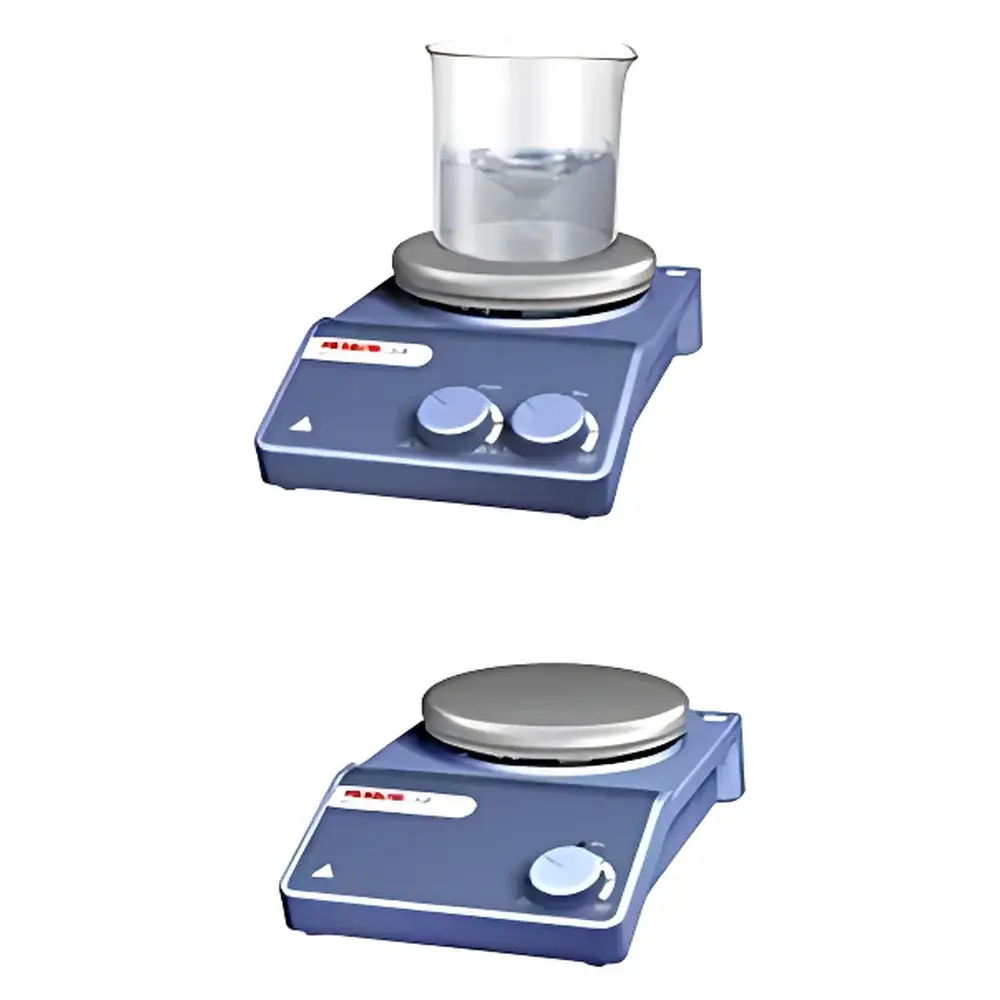
DLAB MS-H-S Standard Magnetic Hotplate Stirrer
| Brand | DLAB |
|---|---|
| Origin | Beijing, China |
| Model | MS-H-S |
| Instrument Type | Magnetic Stirrer |
| Max. Stirring Volume | 20 L (H₂O) |
| Speed Range | 0–1500 rpm |
| Temperature Control Range | Ambient to 340 °C |
| Heating Power | 500 W |
| Motor | Brushless DC |
| Display | Analog Scale (Speed & Temp) |
| Plate Material | Enamel or Stainless Steel |
| Plate Diameter | Ø135 mm |
| Safety Cut-off | 350 °C |
| IP Rating | IP42 |
| Dimensions (W×D×H) | 280 × 160 × 85 mm |
| Weight | 2.8 kg |
| Input Voltage | 220 VAC, 50/60 Hz |
| Total Power Consumption | 530 W |
| Max. Stir Bar Length | 80 mm |
| Heating Rate (1 L H₂O) | 6 K/min |
| Operating Environment | 5–40 °C, ≤80% RH |
Overview
The DLAB MS-H-S Standard Magnetic Hotplate Stirrer is an engineered solution for precise, reproducible heating and mixing of laboratory samples under controlled thermal and mechanical conditions. Based on the fundamental principle of magnetic coupling—where a rotating permanent magnet beneath the plate induces synchronous rotation of a magnetic stir bar immersed in the sample—the MS-H-S delivers stable agitation across a wide viscosity and volume range. Its integrated resistive heating element enables uniform temperature distribution across the ceramic-enamel or stainless-steel plate surface, supporting applications from routine buffer preparation to high-temperature synthesis reactions. Designed for daily use in QC labs, teaching laboratories, and R&D environments, the unit features a robust mechanical architecture, analog precision control, and fail-safe thermal protection aligned with IEC 61000-6-3 and EN 60529 (IP42) environmental ingress standards.
Key Features
- Brushless DC motor ensures consistent rotational speed (0–1500 rpm) regardless of load variation or viscosity changes—critical for maintaining shear history in sensitive suspensions or polymer solutions.
- Dual plate material options: chemically resistant enamel-coated steel for general-purpose use, or electropolished stainless steel for enhanced corrosion resistance in acidic or alkaline media.
- Independent safety circuit interrupts heating at 350 °C—exceeding the maximum operational setpoint (340 °C)—to prevent thermal runaway and protect both sample integrity and equipment longevity.
- IP42-rated enclosed housing provides protection against solid objects ≥1 mm and vertically falling water droplets, extending service life in humid or splash-prone lab environments.
- Analog speed and temperature scales offer intuitive, zero-drift operation without reliance on digital firmware—reducing calibration dependency and minimizing electronic failure points.
- Optimized thermal design achieves a heating rate of 6 K/min for 1 L of deionized water, enabling rapid ramp-to-target protocols while maintaining ±5 °C thermal stability at steady state (measured per ASTM E2479).
Sample Compatibility & Compliance
The MS-H-S accommodates standard laboratory glassware up to 20 L capacity (e.g., beakers, flasks, crystallization dishes), with compatibility confirmed for borosilicate glass, PTFE-coated vessels, and most common plastic containers rated for temperatures up to 340 °C. Stir bar retention is enhanced by high-coercivity neodymium magnets, minimizing slippage or ejection even at elevated speeds and viscosities. The device complies with CE marking requirements (2014/30/EU EMC Directive and 2014/35/EU LVD Directive), meets RoHS 2011/65/EU substance restrictions, and supports GLP documentation workflows through traceable analog setpoints and manual log recording. While not equipped with electronic audit trails, its mechanical controls align with FDA 21 CFR Part 11 guidance for non-critical process steps where electronic records are not mandated.
Software & Data Management
The MS-H-S operates as a standalone analog instrument with no embedded microprocessor, firmware, or data output interface. All operational parameters—including speed setting and temperature setpoint—are adjusted manually via calibrated dials and monitored using dual analog scales. This architecture eliminates software validation requirements, reduces cybersecurity exposure, and ensures uninterrupted functionality during power fluctuations or electromagnetic interference. For laboratories requiring digital integration, external temperature probes (e.g., Pt100 sensors) may be used in conjunction with third-party data loggers compliant with ISO/IEC 17025 traceability frameworks. Calibration certificates for speed and temperature accuracy can be generated per ISO/IEC 17025-accredited procedures using NIST-traceable reference standards.
Applications
- Routine dissolution testing and reagent homogenization in pharmaceutical quality control labs (aligned with USP <701>).
- Preparation of culture media and buffer solutions in microbiology and molecular biology workflows.
- Controlled heating and mixing during sol-gel synthesis, nanoparticle precipitation, and catalyst activation protocols.
- Accelerated aging studies requiring sustained elevated temperatures (e.g., 250–340 °C) with continuous agitation to prevent sedimentation or localized decomposition.
- Teaching laboratories demonstrating thermodynamic equilibria, reaction kinetics, and mass transfer principles under variable shear and thermal input.
FAQ
What is the maximum recommended stirring volume for viscous solutions?
For fluids with dynamic viscosity >1000 mPa·s (e.g., glycerol, polymer melts), the effective maximum volume is reduced to 5–8 L to maintain stable stir bar rotation and thermal uniformity.
Can the MS-H-S be used with closed-vessel systems?
Yes—provided the vessel allows magnetic coupling (e.g., thin-walled glass or non-magnetic metal reactors) and internal pressure remains within atmospheric limits; vented caps or septa are recommended for volatile solvents.
Is the stainless-steel plate suitable for hydrochloric acid exposure?
Electropolished 316 stainless steel offers moderate resistance to dilute HCl (<10%) below 60 °C; for prolonged or concentrated exposure, enamel-coated plates are preferred.
Does the unit support timer-based operation?
No—timing must be managed externally using laboratory timers or programmable power controllers compatible with 220 VAC switching.
How often should calibration verification be performed?
Per ISO/IEC 17025 recommendations, verify speed accuracy annually using a handheld tachometer and temperature accuracy quarterly using a calibrated PT100 probe and dry-block calibrator.



