
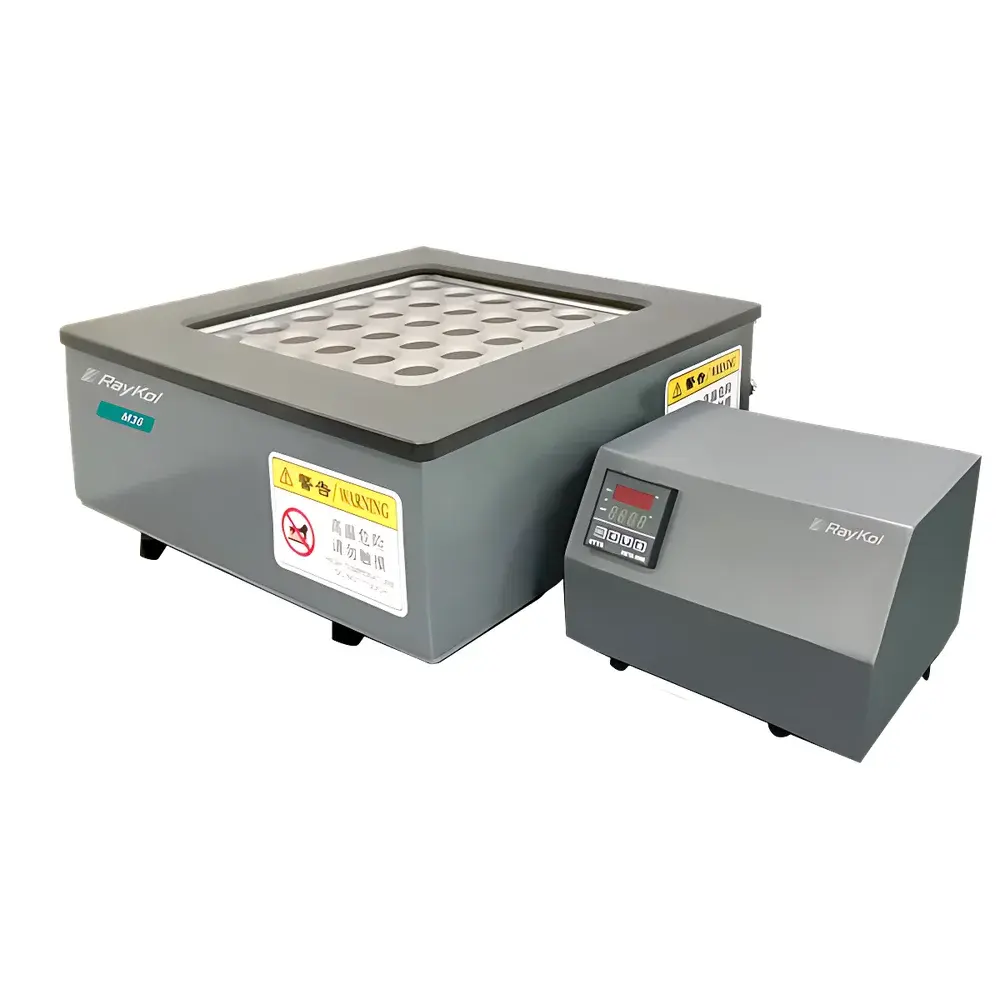
Raykol M36 Intelligent Graphite Block Digestion System
| Brand | Raykol |
|---|---|
| Origin | Fujian, China |
| Manufacturer Type | Direct Manufacturer |
| Product Category | Domestic |
| Model | M36 |
| Instrument Type | Graphite Block Digestion System |
| Automation Level | Semi-Automatic |
| Sample Capacity | 36 positions |
| Temperature Range | Ambient to 450 °C |
| Temperature Control Accuracy | ±1 °C |
| Heating Principle | Electric Resistive Heating |
| Reagent Channels | 36 |
Overview
The Raykol M36 Intelligent Graphite Block Digestion System is a semi-automated, high-capacity sample preparation platform engineered for reproducible, trace-metal–compatible acid digestion in regulated analytical laboratories. It operates on the principle of uniform conductive heating via high-purity pyrolytic graphite blocks, which provide exceptional thermal stability, chemical inertness, and rapid heat transfer—critical attributes for achieving complete matrix decomposition while minimizing analyte loss or contamination. Designed as a front-end solution for elemental analysis workflows, the M36 serves as a dedicated sample digestion module prior to atomic absorption spectroscopy (AAS), inductively coupled plasma optical emission spectrometry (ICP-OES), and inductively coupled plasma mass spectrometry (ICP-MS). Its 36-position configuration supports batch processing of heterogeneous environmental, food, pharmaceutical, and industrial samples under tightly controlled thermal profiles—enabling laboratories to maintain throughput without compromising method robustness or regulatory compliance.
Key Features
- High-Purity Graphite Block Architecture: Constructed from isotropic, ultra-low-metal-content graphite with >99.99% purity; resistant to HNO₃, HCl, HF, and aqua regia up to 450 °C; minimizes background contamination and ensures long-term thermal consistency.
- Precision PID Temperature Control: Real-time feedback loop with ±1 °C accuracy across the full 25–450 °C range; self-tuning algorithm adapts to load variance and ambient drift; independent sensor calibration per block zone.
- Modular Thermal Design: Physical separation between the graphite heating block and electronic control unit prevents thermal degradation of circuitry and reduces acid vapor exposure to sensitive components.
- Multi-Layer Safety Insulation: Triple-layer ceramic fiber + stainless steel housing attenuates surface temperature to <60 °C during operation; integrated overtemperature cutoff (470 °C hard limit) and ground-fault circuit interruption (GFCI) meet IEC 61010-1 safety requirements.
- 36-Channel Reagent Delivery Compatibility: Designed for integration with optional automated reagent dispensers (e.g., Raykol AutoAdd series); each position supports individual timed acid addition sequences synchronized with thermal ramping profiles.
Sample Compatibility & Compliance
The M36 accommodates standard 50 mL PTFE, quartz, or borosilicate digestion tubes (diameter ≤32 mm), supporting EPA Methods 3050B, 3051A, 3052, ASTM D5511/D5512, ISO 11466, and USP / for heavy metal quantification. Its corrosion-resistant construction complies with GLP and GMP documentation standards when paired with audit-trail-capable software (e.g., Raykol Digilab Suite). The system meets CE marking requirements for electromagnetic compatibility (EN 61326-1) and low-voltage directive (2014/35/EU), and its operational parameters align with ISO/IEC 17025 clause 5.4.2 for equipment suitability verification.
Software & Data Management
When operated with Raykol Digilab Suite (v3.2+), the M36 enables method-driven workflow automation—including multi-step temperature ramps, hold times, and reagent addition triggers—with full electronic record retention. All temperature logs, user actions, and system events are timestamped and digitally signed, satisfying FDA 21 CFR Part 11 requirements for audit trails, electronic signatures, and data integrity. Raw thermal data export is supported in CSV and XML formats for LIMS integration or third-party statistical analysis (e.g., JMP, Minitab).
Applications
The M36 is routinely deployed in accredited testing laboratories for digestion of complex matrices requiring rigorous elemental recovery: soil and sediment per EPA 3050B; water and wastewater sludge per ISO 17294-2; edible oils and cereals per AOAC 999.10; pharmaceutical excipients per USP ; cosmetics per ISO 18416; and electronic component leachates per IEC 62321-5. Its consistent heating profile ensures high repeatability (RSD <2.5% for Cd in CRM BCR-681 at n=6), making it suitable for proficiency testing and interlaboratory validation studies.
FAQ
What sample tube materials are compatible with the M36?
PTFE, quartz, and borosilicate glass tubes with outer diameters ≤32 mm and heights ≤150 mm are validated for use. Quartz is recommended for HF-containing protocols.
Can the M36 be integrated into an existing LIMS environment?
Yes—via OPC UA or REST API interfaces provided by Digilab Suite, enabling bidirectional method push, status polling, and result ingestion.
Is method validation support available from Raykol?
Raykol provides application notes, certified reference material (CRM) digestion protocols, and IQ/OQ documentation templates aligned with ISO/IEC 17025 Annex A.2.
Does the system support programmable cooling after digestion?
No built-in active cooling; however, passive cooldown profiles can be scheduled within Digilab Suite, and optional forced-air cooling modules are available as accessories.
What maintenance is required for long-term accuracy?
Annual calibration of thermocouples using NIST-traceable dry-block calibrators is recommended; graphite block surface inspection for pitting or carbon residue should occur after every 200 digestions.



