
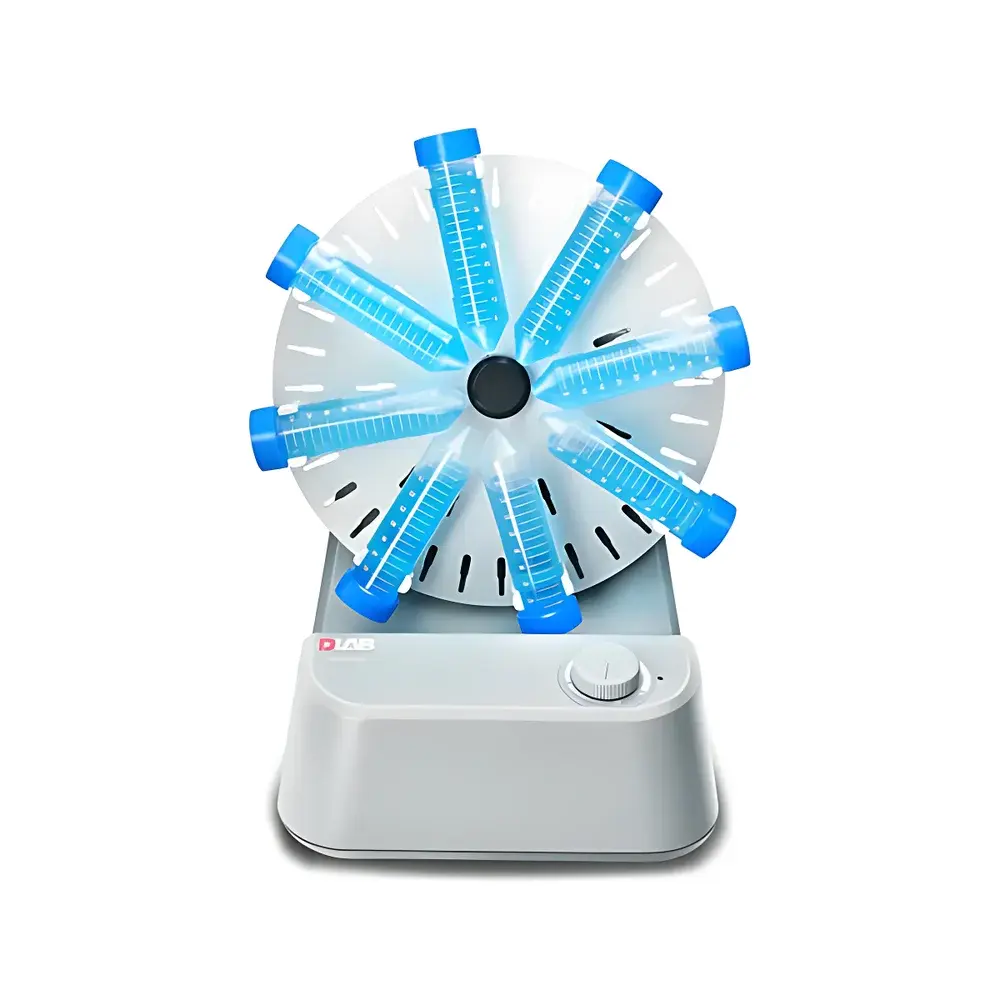
DLAB MX-RD-E Economical Orbital Shaker
| Brand | DLAB |
|---|---|
| Origin | Beijing, China |
| Manufacturer Type | Direct Manufacturer |
| Country of Origin | China |
| Model | MX-RD-E |
| Speed Range | 0–80 rpm |
| Drive Type | Adjustable Orbital Motion |
| Display | Analog Speed Scale (0–80 rpm) |
| Motor | DC Motor |
| Power Supply | 100–240 V, 50/60 Hz |
| Power Consumption | 20 W |
| Dimensions (L×W×H) | 300 × 220 × 310 mm |
| Operating Environment | 5–40 °C, ≤80% RH |
| Enclosure Rating | IP21 |
| Housing Material | ABS Plastic |
| Operation Mode | Continuous |
| Tube Compatibility | 1.5–50 mL microtubes and centrifuge tubes |
| Optional Accessories | Interchangeable tube platforms for 1.5/2.0 mL, 15 mL, and 50 mL tubes |
Overview
The DLAB MX-RD-E Economical Orbital Shaker is a compact, benchtop laboratory instrument engineered for consistent, low-shear orbital mixing of liquid samples in standard microcentrifuge and conical tubes. It operates on the principle of controlled orbital motion—where the platform rotates around a fixed central axis with a defined eccentricity—generating gentle yet effective fluid agitation without vortex formation or excessive foaming. This mechanism ensures uniform suspension of particulates, reagents, or biological components while minimizing shear-induced damage to sensitive biomolecules or cell aggregates. Designed for routine applications requiring reproducible mixing at low rotational speeds, the MX-RD-E delivers stable performance across ambient and controlled-environment settings—including operation inside refrigerated incubators and CO2 chambers (subject to compatibility with chamber ventilation and condensation management).
Key Features
- Adjustable analog speed control: A calibrated rotary knob with a clear 0–80 rpm scale enables precise manual speed selection without digital interface complexity—ideal for labs prioritizing simplicity, reliability, and minimal maintenance.
- DC motor drive: Provides smooth torque delivery across the full speed range, ensuring consistent platform motion even under variable load conditions and contributing to long-term operational stability.
- ABS polymer housing: Offers chemical resistance to common laboratory solvents and disinfectants, mechanical durability against incidental impact, and electrical insulation compliant with IEC 61010-1 safety standards for laboratory equipment.
- IP21-rated enclosure: Protects internal electronics from vertically falling drips and solid objects larger than 12.5 mm—suitable for general lab environments but not recommended for wet or high-humidity enclosures without additional environmental mitigation.
- Modular tube platform system: Supports interchangeable aluminum or polymer inserts accommodating 1.5–2.0 mL microtubes, 15 mL conical tubes, and 50 mL centrifuge tubes—enabling rapid reconfiguration between sample formats without tooling.
- Continuous-duty operation: Rated for uninterrupted use over extended periods, supporting overnight incubation protocols and unattended mixing workflows within validated temperature-controlled cabinets.
Sample Compatibility & Compliance
The MX-RD-E is validated for use with standard polypropylene and polyethylene microcentrifuge tubes (1.5–2.0 mL), Falcon-style conical tubes (15 mL and 50 mL), and compatible glass vials up to 50 mL volume. Its orbital amplitude and speed profile are optimized to prevent tube ejection or cap loosening during operation. While not certified to specific ISO or ASTM mixing standards (e.g., ISO 8573 for compressed air purity or ASTM D341 for viscosity blending), the device conforms to general-purpose laboratory equipment requirements per IEC 61010-1:2010 (Ed.3) for electrical safety and EN 61326-1:2013 for electromagnetic compatibility. It is suitable for GLP-aligned workflows where mixing consistency is documented via operator logs; however, it does not include audit-trail-capable firmware or electronic speed verification required for FDA 21 CFR Part 11 compliance.
Software & Data Management
The MX-RD-E operates as a standalone analog instrument with no embedded microprocessor, firmware, or data connectivity. Speed setting is manually recorded via operator logbook or electronic lab notebook (ELN) entry. No software drivers, configuration utilities, or remote monitoring interfaces are provided. This design eliminates cybersecurity exposure, firmware update dependencies, and calibration drift associated with digital displays—making it appropriate for regulated environments where instrument qualification focuses on mechanical repeatability rather than electronic traceability. Users requiring automated speed logging or integration into LIMS must implement external validation protocols using independent tachometric measurement during IQ/OQ/PQ phases.
Applications
- Anticoagulant mixing in clinical hematology workflows prior to CBC analysis
- Resuspension of antibody-coated latex particles in immunodiagnostic assays
- Homogenization of protein precipitation mixtures before centrifugation
- Equilibration of binding buffers in ELISA plate preparation
- Low-speed agitation of cell culture suspensions during cold-chain transport simulation studies
- Pre-incubation mixing of PCR master mixes containing heat-labile enzymes
FAQ
Can the MX-RD-E be operated inside a 4 °C refrigerator?
Yes—its DC motor, sealed bearing assembly, and IP21-rated housing permit safe operation in refrigerated environments between 5–40 °C, provided condensation is managed and airflow is sufficient to prevent thermal buildup.
Is speed calibration traceable to NIST or other national standards?
No—the analog speed scale is factory-set and not individually calibrated; users requiring metrological traceability must perform periodic verification using an external handheld tachometer.
What tube formats are supported without adapter purchase?
The base unit includes a universal platform compatible with 1.5–2.0 mL microtubes; 15 mL and 50 mL tube support requires optional insert kits (sold separately).
Does the unit include overload or thermal protection?
Yes—the integrated DC motor driver incorporates current-limiting circuitry and thermal cutoff to prevent coil damage during stall or extended high-load operation.
Can multiple units be stacked or mounted in a rack system?
Not recommended—the 310 mm height and lack of rear ventilation grilles limit vertical stacking; side-to-side placement with ≥50 mm clearance is advised for heat dissipation.



