
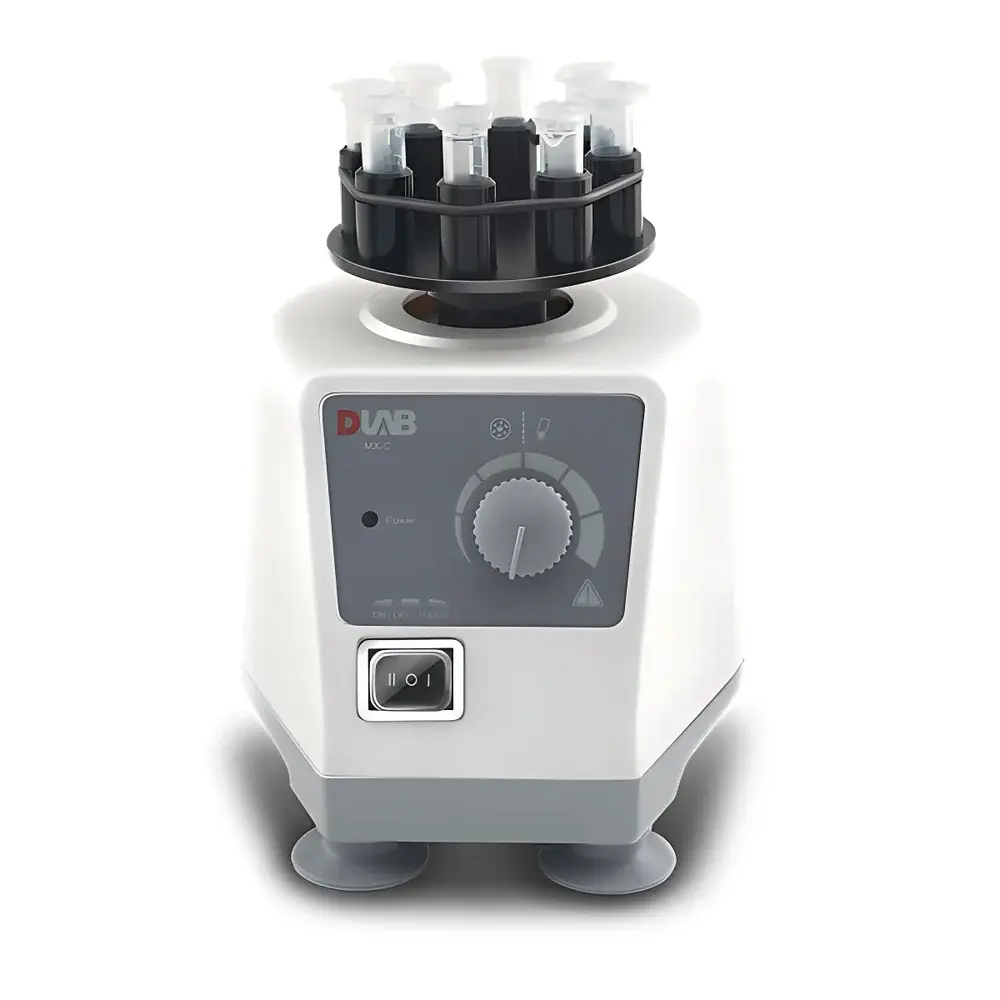
DLAB MX-C High-Performance Cell Disruptor
| Brand | DLAB |
|---|---|
| Origin | Beijing, China |
| Manufacturer Type | Direct Manufacturer |
| Product Category | Domestic |
| Model | MX-C |
| Instrument Type | Vortex-Based Mechanical Cell Disruptor |
| Sample Throughput | 8 × 2 mL Tubes |
| Motion Mode | High-Speed Orbital Vortexing & Oscillation |
| Orbit Diameter | 4 mm |
| Speed Range | 0–3000 rpm (Adjustable) |
| Speed Display | Analog Scale |
| Power Input | 60 W |
| Voltage | 100–120 V / 200–240 V AC |
| Frequency | 50/60 Hz |
| Dimensions (L × W × H) | 127 × 130 × 160 mm |
| Weight | 2.0 kg |
Overview
The DLAB MX-C High-Performance Cell Disruptor is an engineered solution for consistent, non-thermal mechanical lysis of biological cells in research and quality control laboratories. Unlike ultrasonic or pressure-based disruption methods, the MX-C employs controlled orbital vortexing combined with oscillation—generating reproducible shear forces across multiple samples simultaneously. This principle minimizes localized heating and avoids DNA shearing, preserving genomic integrity critical for downstream applications such as PCR amplification, next-generation sequencing library preparation, and plasmid isolation. Designed for walk-away operation, the instrument accommodates eight 2 mL microcentrifuge tubes without manual holding, enabling hands-free processing under standardized kinetic conditions. Its compact footprint and dual-voltage compatibility support deployment in diverse lab environments—including ISO-certified cleanrooms, GLP-compliant QC labs, and academic core facilities.
Key Features
- Simultaneous processing of up to eight 2 mL sample tubes—eliminating inter-sample variability from sequential handling.
- Orbital motion with precise 4 mm orbit diameter ensures uniform energy transfer and laminar fluid dynamics within each tube.
- Continuously adjustable speed range (0–3000 rpm) with analog scale calibration for method transferability and SOP adherence.
- Low thermal load design: 60 W power consumption and optimized motor cooling prevent temperature spikes during extended runs (>10 min).
- Robust housing constructed from reinforced polymer and stainless steel components—resistant to chemical exposure from common lysis buffers (e.g., RIPA, Tris-EDTA, guanidine thiocyanate).
- Dual-voltage input (100–120 V / 200–240 V AC) with auto-sensing frequency detection (50/60 Hz), ensuring global electrical compliance without external transformers.
Sample Compatibility & Compliance
The MX-C is validated for use with standard polypropylene and low-binding 2 mL microcentrifuge tubes (including certified RNase/DNase-free variants). It supports a broad range of biological matrices—including bacterial cultures (E. coli, Bacillus spp.), yeast (S. cerevisiae), mammalian cell pellets (HEK293, CHO), plant tissue homogenates, and frozen lysates. No consumables or disposable parts are required; all wetted surfaces are autoclavable or compatible with 70% ethanol and 0.5% sodium hypochlorite decontamination. The device meets IEC 61010-1:2010 safety standards for laboratory electrical equipment and complies with CE marking requirements for electromagnetic compatibility (EMC Directive 2014/30/EU). While not classified as a medical device, its operational repeatability supports alignment with ISO/IEC 17025:2017 clause 7.2.2 (method validation) when integrated into accredited testing workflows.
Software & Data Management
The MX-C operates as a stand-alone hardware platform with no embedded firmware or digital interface. Speed settings are manually selected via calibrated analog dial, ensuring deterministic, interference-free operation in electromagnetically sensitive environments (e.g., near mass spectrometers or NMR systems). For traceability, users are advised to document run parameters—including speed, duration, ambient temperature, and tube lot numbers—in laboratory notebooks or LIMS-integrated electronic records. When used within FDA-regulated environments, the instrument’s mechanical simplicity facilitates straightforward IQ/OQ validation per 21 CFR Part 11 Annex 11 guidelines, particularly where audit trails rely on procedural documentation rather than software logs.
Applications
- Routine lysis of prokaryotic and eukaryotic cells prior to nucleic acid extraction protocols compliant with ISO 20387:2018 (biobanking standards).
- Preparation of whole-cell lysates for Western blotting and ELISA—maintaining native protein conformation better than sonication-induced denaturation.
- Homogenization of cryopreserved tissues in buffer systems containing protease inhibitors, where thermal stability is essential.
- High-throughput screening workflows requiring parallel sample processing with minimal operator intervention—reducing human error and improving inter-assay CVs (<5%).
- Training platforms in teaching laboratories due to intuitive operation, visual speed feedback, and absence of complex software dependencies.
FAQ
Can the MX-C be used for lysing Gram-positive bacteria?
Yes—when combined with enzymatic pretreatment (e.g., lysozyme) or bead-beating adjuncts, the MX-C delivers sufficient shear force for robust lysis of thick-walled organisms.
Is tube balancing required before operation?
No—its balanced orbital drive mechanism eliminates the need for symmetrical loading; however, using identical tube types and fill volumes is recommended for optimal consistency.
Does the instrument generate significant noise during operation?
At maximum speed (3000 rpm), sound pressure levels remain below 62 dB(A) at 1 m distance—suitable for open-plan lab spaces without acoustic enclosures.
How often does maintenance require scheduled servicing?
With proper cleaning and avoidance of corrosive solvents, the brushless motor and bearing assembly are rated for >10,000 hours of continuous service; no routine lubrication or recalibration is specified by the manufacturer.
Can I integrate the MX-C into a robotic liquid handling workflow?
While it lacks API or digital I/O ports, its fixed-height platform and repeatable mechanical timing allow synchronization with third-party robotic arms via external timer triggers or vision-guided positioning systems.



