
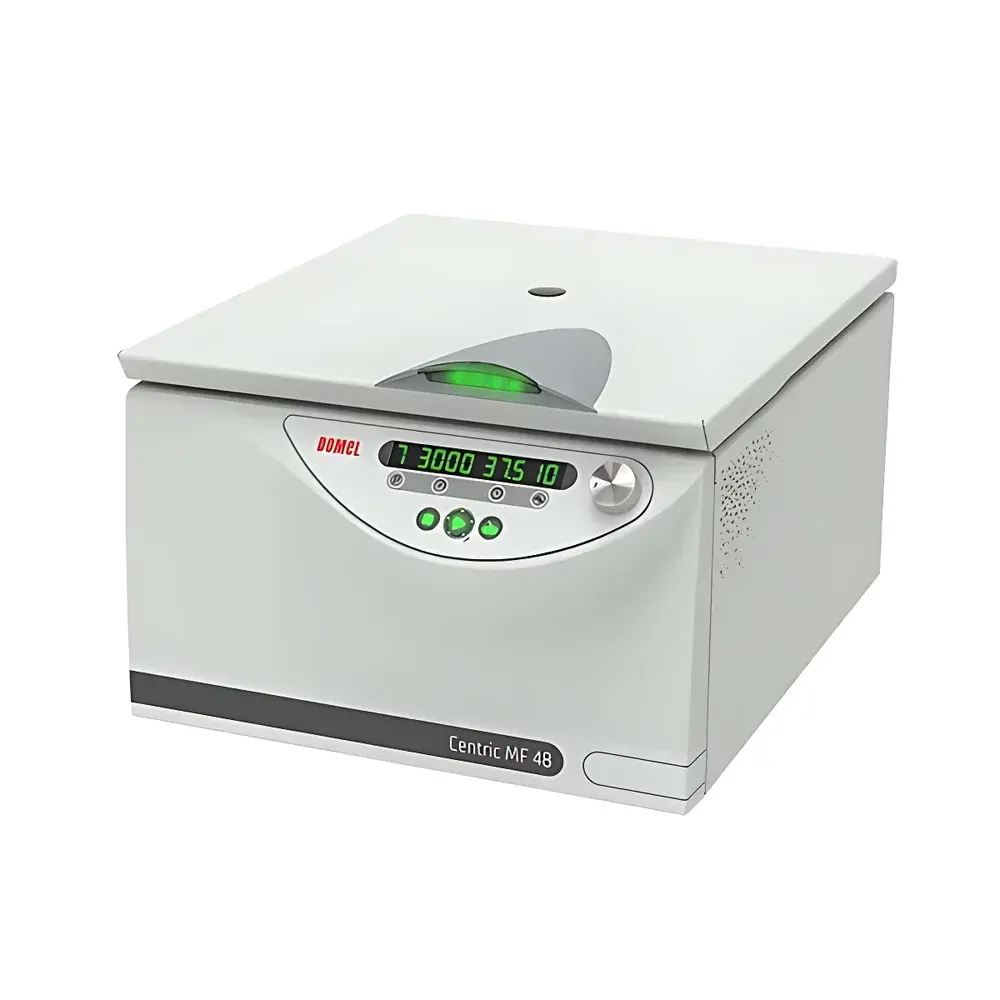
Domel CENTRIC MF48 Benchtop High-Speed High-Capacity Multifunction Centrifuge
| Brand | Domel |
|---|---|
| Model | CENTRIC MF48 |
| Type | Benchtop Centrifuge |
| Max. Speed | 12600 rpm |
| Max. RCF | 17990 × g |
| Max. Capacity | 6 × 100 mL (angular rotor) / 4 × 400 mL (swinging bucket rotor) |
| Acceleration/Deceleration Steps | 10 each |
| Timer Range | 0:00–59:50 (10 s step), 1:00–99:59 h (1 min step) |
| Drive | Brushless Induction Motor |
| Noise Level | < 62 dB(A) |
| Power Consumption | 840 W |
| Dimensions (H×W×D) | 305 × 420 × 526 mm |
| Net/Gross Weight | 50 / 56 kg |
| Operating Environment | 2–35 °C, ≤75% RH |
| Power Supply | 230 V, 50/60 Hz |
Overview
The Domel CENTRIC MF48 is a precision-engineered benchtop high-speed centrifuge designed for demanding separation tasks in life science, clinical diagnostics, and industrial R&D laboratories. Utilizing proven fixed-angle and swinging-bucket rotor configurations, it delivers reproducible sedimentation performance across a broad operational envelope—from gentle pelleting of cells to high-resolution isolation of subcellular organelles and macromolecular complexes. Its core architecture employs a brushless induction motor with digital speed regulation, ensuring stable rotational control within ±10 rpm across the full 500–12600 rpm range. The centrifuge operates on the principle of differential sedimentation under controlled centrifugal force (RCF), where particle migration velocity depends on mass, density, shape, and medium viscosity—enabling reliable fractionation of biological samples without thermal or mechanical degradation when operated within specified environmental limits (2–35 °C, ≤75% RH).
Key Features
- Robust benchtop design with integrated electric lid lock system (dual-latch mechanism) meeting IEC 61010-2-020 safety requirements for centrifugal equipment
- Backlit LCD display with intuitive menu navigation and real-time monitoring of speed (rpm), RCF (×g), time remaining, and acceleration/deceleration status
- Programmable memory for up to 10 user-defined protocols—including speed, time, acceleration ramp (1–10), deceleration ramp (1–10), and auto-brake activation (0 = coast-down)
- High-efficiency cooling-free operation optimized for ambient lab conditions; no refrigeration unit required
- Low-noise acoustic enclosure (< 62 dB[A] at 1 m) compliant with ISO 15714:2017 laboratory noise emission standards
- Modular rotor compatibility supporting eight certified rotor types—including angular, swinging-bucket, and microplate carriers—each validated for maximum load, imbalance tolerance, and material compatibility per ISO 13485 manufacturing controls
Sample Compatibility & Compliance
The CENTRIC MF48 accommodates standard laboratory consumables including polypropylene and polycarbonate tubes (2–400 mL), PCR strips, and 96-well microplates. Angular rotors enable rapid pelleting of nucleic acids, proteins, and virus particles, while swinging-bucket configurations support density gradient separations (e.g., sucrose, iodixanol) and large-volume sample processing. All rotors are CE-marked and comply with EN 61010-1:2010+A1:2019 for electrical safety and EN 61000-6-3:2019 for electromagnetic compatibility. The instrument meets essential requirements for GLP-compliant workflows, with traceable calibration documentation available upon request. While not inherently refrigerated, its operational envelope aligns with ASTM E2915-21 guidelines for non-refrigerated centrifuge qualification in routine QC environments.
Software & Data Management
The CENTRIC MF48 operates as a standalone instrument with embedded firmware (v3.2+). No external software is required for routine operation; however, all parameters—including executed run logs (date/time, rotor ID, speed, duration, RCF)—are stored internally and accessible via display interface. For integration into LIMS or electronic lab notebook (ELN) systems, optional RS-232 or USB-to-serial adapters support ASCII-based data export in comma-delimited format. Audit trail functionality adheres to ALCOA+ principles for data integrity: each record includes operator ID (manually entered), timestamp, and immutable parameter set. Firmware updates are performed via secure USB flash drive following ISO/IEC 17025 clause 5.9.2 change control procedures.
Applications
- Isolation of mitochondria, lysosomes, and nuclear fractions from mammalian cell lysates using RA 30/2 or RA 24/2 angular rotors
- Clarification of bacterial culture supernatants prior to HPLC or LC-MS analysis
- Preparative purification of plasmid DNA and RNA using silica-membrane spin columns in 2 mL tubes
- Density gradient ultracentrifugation of exosomes (with RS 4/400 rotor and appropriate cushion media)
- High-throughput serum/plasma separation in clinical labs using 400 mL conical tubes
- Processing of 96-well plates for ELISA wash steps or bead-based immunoassays (RM 2/64 rotor)
FAQ
What is the maximum allowable imbalance tolerance for the RA 6/100 angular rotor?
The RA 6/100 rotor is certified for ≤0.5 g imbalance per tube position, verified during factory balancing per ISO 15714 Annex B.
Can the CENTRIC MF48 be used for regulatory submissions under FDA 21 CFR Part 11?
While the device itself does not provide electronic signatures or role-based access control, its audit-ready run logs and firmware traceability support Part 11 compliance when deployed within a validated laboratory IT infrastructure.
Is rotor certification documentation included with each purchase?
Yes—each rotor ships with a Certificate of Conformance listing serial number, maximum rated speed/RCF, material composition, and test report reference per EN 61010-2-020 Annex D.
Does the instrument support automatic rotor recognition?
No. Rotor identification is manual via the display interface; users must select the correct rotor model before initiating a run to ensure proper RCF calculation and safety interlock validation.
What maintenance intervals are recommended for the brushless motor?
The motor requires no scheduled lubrication or bearing replacement; routine inspection of air intake filters every 6 months is advised to maintain thermal stability under continuous operation.
Related Products



