
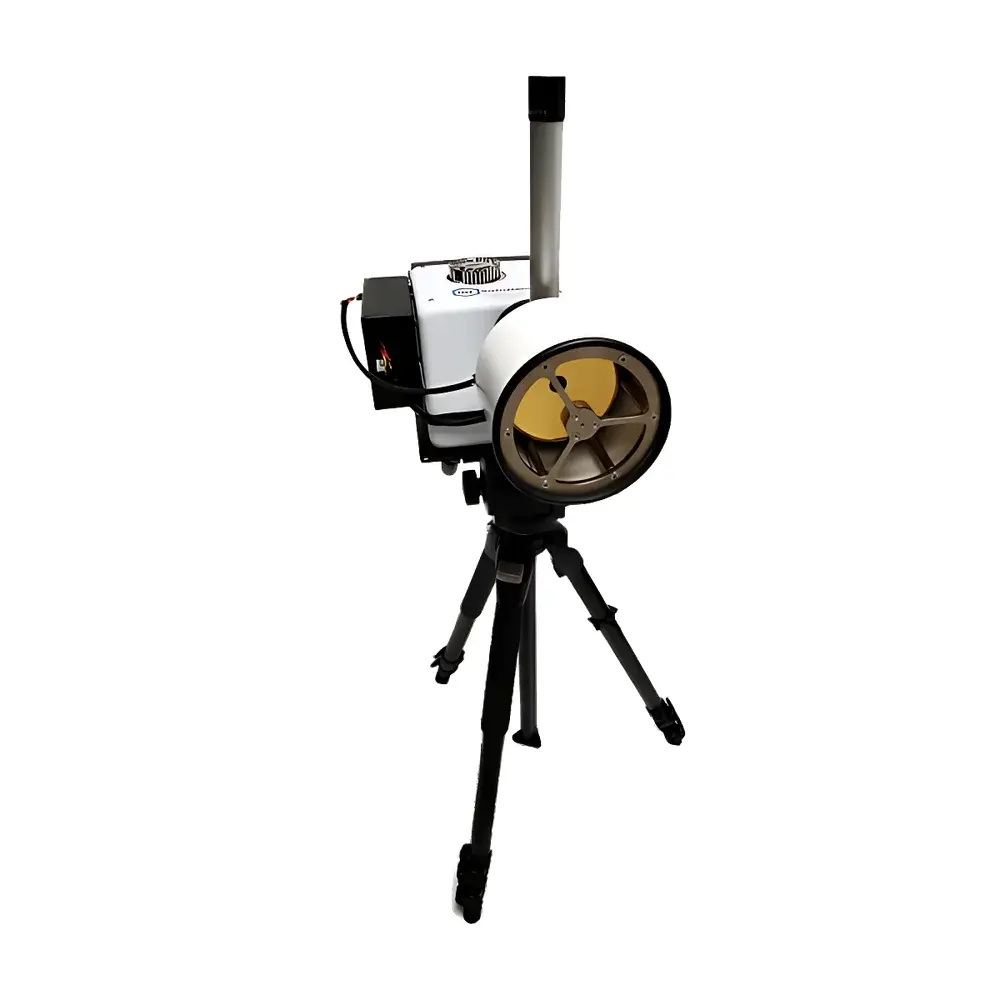
D&P Turbo FT Fourier Transform Thermal Infrared Spectrometer
| Brand | D&P |
|---|---|
| Origin | USA |
| Manufacturer Status | Authorized Distributor |
| Product Origin | Imported |
| Model | Turbo FT |
| Instrument Type | Portable |
| Instrument Category | Fourier Transform |
| Spectral Range | 2.5–16 µm (optional 1.7–16 µm) |
| Spectral Resolution | 4 cm⁻¹ (adjustable) |
| Scan Speed | 25–100 spectra/sec @ 4 cm⁻¹ |
| Maximum Continuous Acquisition | 1,000,000 spectra (gapless or sequential file mode) |
Overview
The D&P Turbo FT Fourier Transform Thermal Infrared Spectrometer is an engineered solution for real-time, high-temporal-resolution infrared spectral analysis in field-deployable and lab-adjacent environments. Unlike conventional benchtop FTIR systems relying on linear interferometer motion, the Turbo FT employs a patented high-speed rotating mirror interferometer architecture that enables true continuous scanning without mechanical dwell time. It operates on the principle of Michelson interferometry, where thermal infrared radiation emitted from samples (or ambient background) is split, recombined, and detected as an interferogram—subsequently Fourier-transformed into a calibrated spectrum. Designed specifically for thermal emission spectroscopy (TES), it captures intrinsic molecular vibrational signatures across the mid- to long-wave infrared (MWIR–LWIR) region, supporting qualitative identification, quantitative trend monitoring, and dynamic process characterization without external illumination.
Key Features
- High-speed rotating interferometer delivering sustained acquisition at 25–100 spectra per second at 4 cm⁻¹ resolution—enabling capture of transient thermal events such as combustion fronts, catalytic surface reactions, or rapid phase transitions.
- Thermally stabilized optical path with sealed, purged interferometer housing to minimize atmospheric CO₂/H₂O interference and ensure spectral reproducibility across ambient temperature fluctuations (15–35 °C operating range).
- Two synchronized data acquisition modes: (1) gapless streaming into a single binary file for time-series integrity; (2) sequential file segmentation with sub-millisecond inter-file latency—both supporting up to 1,000,000 consecutive spectra per session.
- Compact, ruggedized portable chassis (32 × 24 × 14 cm; <8.2 kg) compliant with MIL-STD-810G for shock, vibration, and humidity exposure—validated for outdoor deployment, mobile laboratory integration, and industrial floor use.
- Integrated uncooled microbolometer detector array (320 × 240 pixels) with broadband antireflection coating optimized for 2.5–16 µm response, eliminating cryogenic cooling requirements while maintaining signal-to-noise ratio >8,000:1 (RMS, 100 scans).
Sample Compatibility & Compliance
The Turbo FT is optimized for passive thermal emission measurements and requires no sample preparation for bulk solids, liquids, or gases emitting detectable IR radiation above ambient temperature (>~30 °C). It supports standoff analysis at distances up to 5 m (with optional telephoto optics) and accommodates in-situ mounting via standard ¼”-20 tripod threads or OEM flange interfaces. All firmware and spectral processing algorithms comply with NIST-traceable calibration protocols. Data output formats (e.g., .spc, .jdx, CSV) conform to ASTM E1421–22 and ISO 14644-9 spectral metadata standards. The system meets IEC 61326-1 for electromagnetic compatibility and carries CE marking under the EU Instrument Directive 2014/30/EU.
Software & Data Management
The included TurboSpectra™ v4.2 software provides real-time spectral visualization, time-resolved chemometric mapping (PCA, PLS-DA), and automated peak tracking with configurable alarm thresholds. Raw interferograms and processed spectra are stored with embedded audit trail metadata—including timestamp (GPS-sync capable), instrument configuration hash, environmental sensor logs (ambient T/RH), and operator ID. The software supports 21 CFR Part 11-compliant user authentication, electronic signatures, and immutable archive export—fully compatible with LIMS integration via OPC UA and RESTful API. Batch processing workflows can be scripted in Python (via provided SDK) for GLP/GMP-aligned validation protocols.
Applications
- Real-time monitoring of exothermic reactions in chemical pilot plants and pharmaceutical crystallization reactors.
- Non-contact thermal fingerprinting of polymer degradation, battery electrode delamination, or composite material delamination during mechanical stress testing.
- Field-based detection and speciation of volatile organic compounds (VOCs) and greenhouse gases (e.g., CH₄, N₂O, SF₆) via open-path or extractive cell configurations.
- Forensic analysis of trace residues (e.g., explosives, accelerants) on surfaces using thermal contrast enhancement and spectral library matching (NIST/EPA libraries preloaded).
- Quality assurance in food processing lines—detecting moisture migration, lipid oxidation, or adulteration through time-evolving spectral endmember analysis.
FAQ
Is the Turbo FT suitable for quantitative concentration analysis?
Yes—when paired with validated calibration models (e.g., partial least squares regression) and reference gas cells or temperature-controlled blackbody sources, it achieves ±3% relative error for known analytes under controlled emissivity conditions.
Can the spectral resolution be adjusted in real time during acquisition?
Yes—resolution is software-selectable between 2 cm⁻¹ and 16 cm⁻¹; however, scan speed scales inversely with resolution due to interferogram sampling constraints.
Does the system support external triggering or synchronization with other instruments?
Yes—it features TTL-compatible trigger I/O (BNC), IEEE-1588 precision time protocol (PTP) support, and programmable GPIO for hardware sync with high-speed cameras, laser sources, or process control systems.
What maintenance is required for long-term field operation?
Annual verification of optical alignment and detector responsivity is recommended; the interferometer’s solid-state rotation mechanism eliminates belt wear or motor brush replacement—typical MTBF exceeds 25,000 hours.
Is spectral library search functionality included out-of-the-box?
Yes—the base software includes searchable access to the NIST Chemistry WebBook IR database (22,000+ compounds), with optional add-on modules for polymer, pharmaceutical, and environmental contaminant libraries.





