
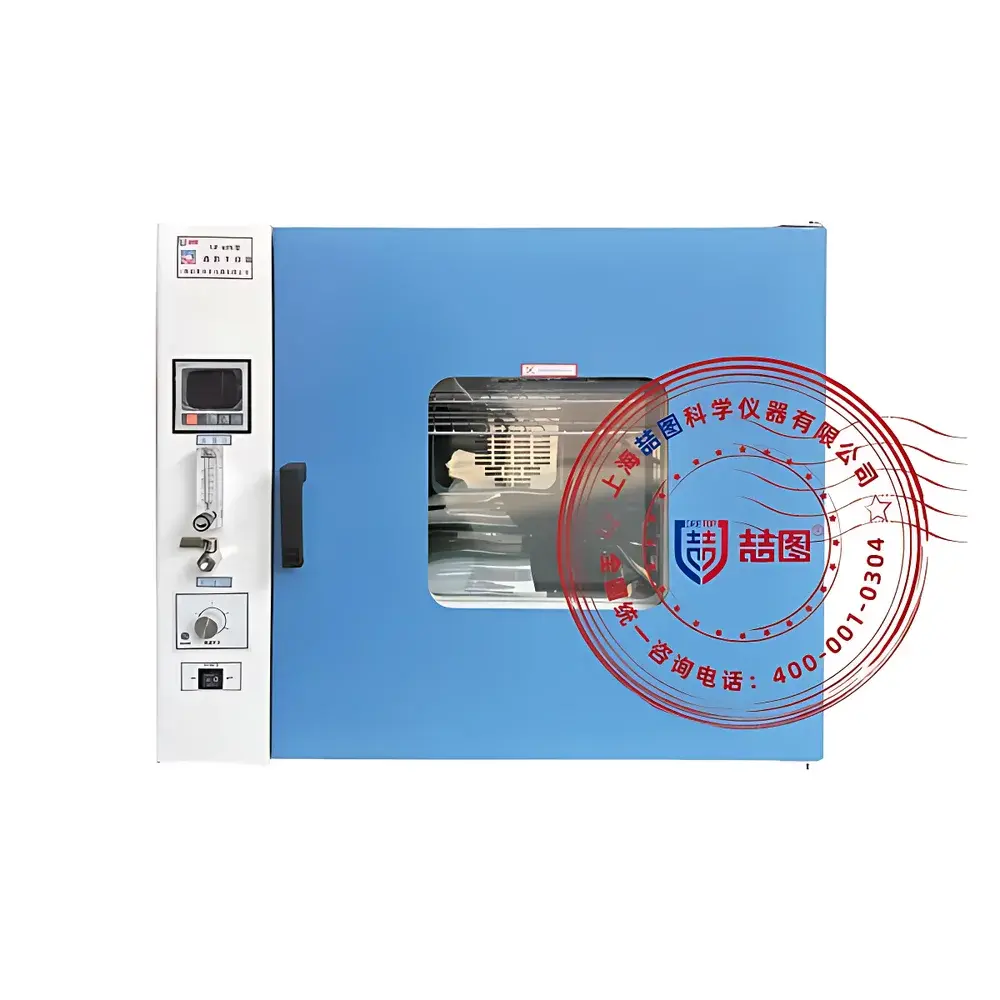
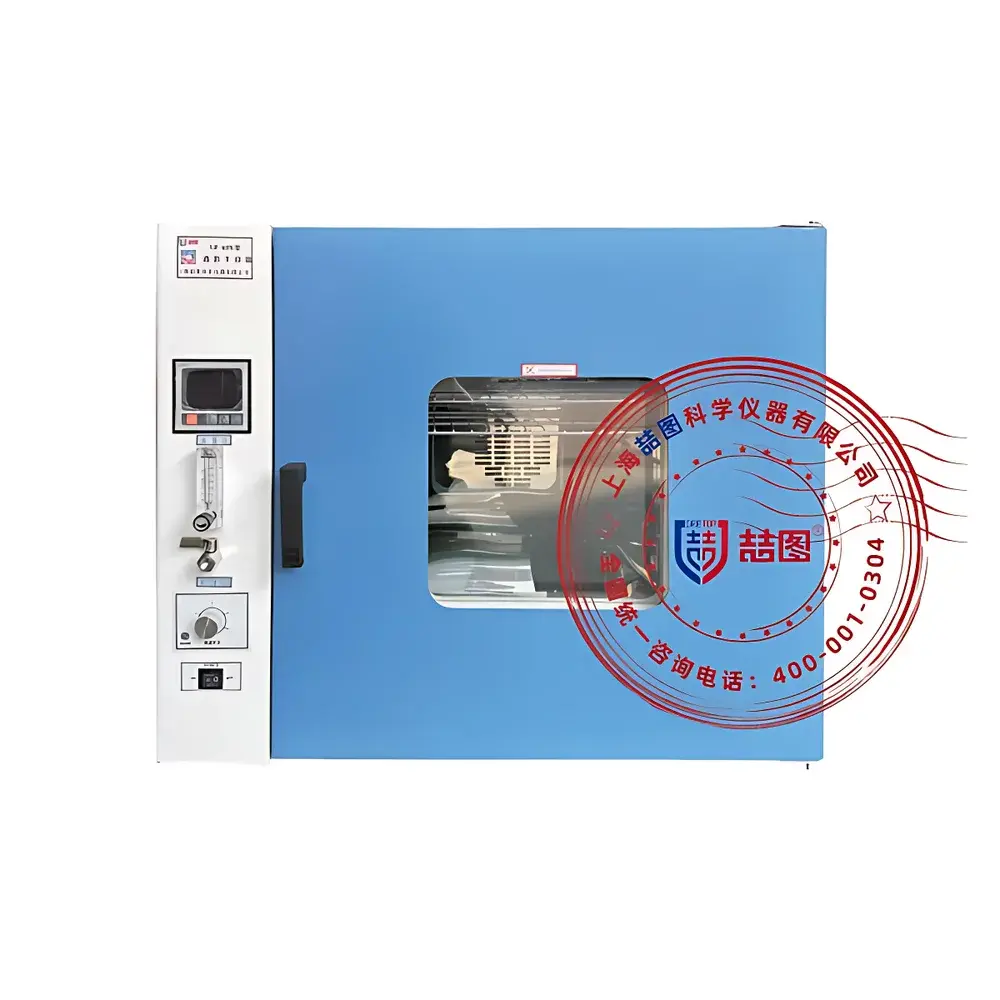
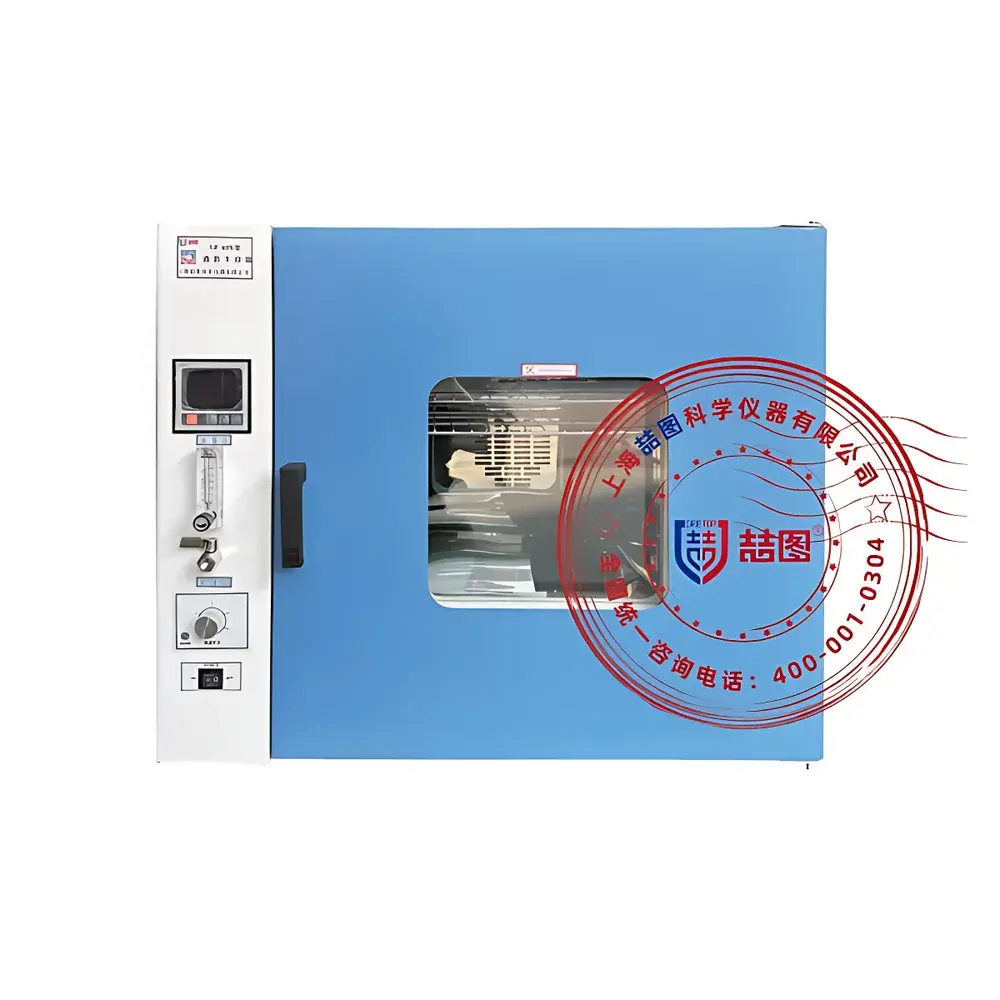
DRETOP TDG-50A Nitrogen-Purged Drying Oven
| Brand | DRETOP |
|---|---|
| Origin | Shanghai, China |
| Model | TDG-50A |
| Instrument Type | General-Purpose Forced-Air Drying Oven |
| Temperature Range | RT+5°C to 250°C |
| Temperature Uniformity | Not specified by manufacturer |
| Temperature Fluctuation | ±0.5°C |
| Temperature Resolution | 0.1°C |
| Chamber Dimensions (W×D×H) | 420 × 350 × 350 mm |
| External Dimensions (W×D×H) | 705 × 520 × 520 mm |
| Nominal Volume | 50 L |
| Interior Material | Stainless Steel (SUS304) |
| Heating Method | Forced-Air Convection with Adjustable Fan Speed |
| Power Supply | AC 220 V, 50 Hz |
| Rated Power | 850 W |
| Operating Ambient Temperature | 15–30°C |
| Safety Features | Over-Temperature Alarm, Over-Heat Protection, Pressure Relief Mechanism |
| Control System | LCD Digital Controller with PID Algorithm |
| Standard Accessories | 2 Removable Stainless Steel Shelves, Nitrogen Flow Control Assembly (Rotameter + Solenoid Valve), Fan Speed Regulator |
Overview
The DRETOP TDG-50A Nitrogen-Purged Drying Oven is an engineered solution for thermal processing under controlled inert atmospheres. Unlike conventional drying ovens, the TDG-50A integrates programmable nitrogen purging with precision forced-air convection to suppress oxidative degradation during drying, curing, annealing, and stability testing. Its operational principle relies on continuous or intermittent nitrogen introduction—via calibrated mass flow control—into a sealed stainless-steel chamber, reducing ambient oxygen concentration to levels compatible with oxygen-sensitive materials. The system employs a PID-regulated heating circuit coupled with dynamic fan-speed modulation to maintain thermal stability across the working volume. Designed for laboratory and pilot-scale applications, it complies with foundational mechanical and thermal safety requirements outlined in JB/T 5520–1991 (Technical Specifications for Drying Ovens) and supports process documentation aligned with GLP practices.
Key Features
- Stainless-steel interior (SUS304) with full-welded seams and fluororubber door gasketing—ensuring low gas permeability and long-term compatibility with nitrogen, argon, and other inert gases.
- Adjustable forced-air convection system featuring stepless fan speed control; enables optimization of heat transfer rates across temperature zones—from low-energy stabilization at 40°C to rapid equilibration at 200°C.
- LCD-based digital controller with embedded PID algorithm, supporting up to 8-segment programmable ramp-soak profiles—critical for pharmaceutical stability studies (ICH Q1A–Q1E), polymer crosslinking, and electronic component aging protocols.
- Dual-mode nitrogen delivery: manual rotameter + solenoid valve actuation allows reproducible flow rate setting (typically 0.5–5 L/min); optional vacuum pre-purge module (not standard) enables initial O₂ reduction to <0.1% v/v prior to nitrogen fill.
- Comprehensive safety architecture including independent over-temperature cutoff (mechanical backup), audible/visual alarm triggers, and thermal insulation rated for continuous operation at 250°C.
Sample Compatibility & Compliance
The TDG-50A accommodates samples ranging from bulk powders (e.g., metal oxides, battery cathode precursors) to delicate thin-film substrates and hygroscopic pharmaceutical intermediates. Its inert-atmosphere capability meets functional requirements for ASTM E145–22 (Standard Specification for Gravity-Convection and Forced-Ventilation Ovens) when operated with verified nitrogen purity (>99.995%). While not intrinsically certified for hazardous location use, its construction adheres to GB 474–2008 (Coal Sample Preparation) and GB/T 211–2017 (Total Moisture in Coal) for moisture-loss-critical drying workflows. For regulated environments, audit-ready operation requires external validation of temperature uniformity (per ISO/IEC 17025 clause 5.4.2) and traceable calibration of both temperature sensors and flow meters.
Software & Data Management
The TDG-50A operates via standalone firmware without proprietary PC software. All setpoints, real-time chamber temperature, elapsed time, and fan status are displayed on the front-panel LCD. Data logging is not built-in; however, analog voltage outputs (0–5 V or 4–20 mA, optional) can interface with third-party SCADA or LIMS platforms for 21 CFR Part 11–compliant recordkeeping when paired with validated acquisition hardware. Users performing GMP-aligned stability testing should implement external thermocouple mapping (per USP ) and periodic verification of nitrogen flow accuracy using NIST-traceable calibrators.
Applications
- Pharmaceutical: Residual solvent removal from APIs under inert conditions; accelerated stability testing per ICH guidelines where oxidation must be excluded as a degradation pathway.
- Electronics: Pre-bake of PCBs and semiconductor wafers to eliminate moisture without promoting intermetallic oxidation.
- Materials Science: Thermal treatment of air-sensitive catalysts (e.g., Ni-, Co-, or Ru-based), lithium-ion battery electrode slurries, and perovskite precursor films.
- Food & Agriculture: Low-oxygen drying of anthocyanin-rich botanical extracts to preserve color stability and antioxidant activity.
- Research Labs: Controlled pyrolysis of organometallic precursors, desolvation of MOFs, and conditioning of humidity-calibration standards.
FAQ
Does the TDG-50A include vacuum capability?
No—the base model lacks integrated vacuum pumping. A separate vacuum pump may be connected via optional flanged port (requires custom adapter); this configuration supports pre-evacuation but does not constitute a certified vacuum oven per ISO 27861.
What nitrogen purity is recommended for optimal performance?
For general oxidation suppression, ≥99.9% (Grade 2.5) nitrogen suffices. For ultra-sensitive applications (e.g., noble metal nanoparticle synthesis), ≥99.999% (Grade 5.0) is advised, with inline oxygen analyzers recommended for real-time verification.
Can the unit be validated for GxP environments?
Yes—though the instrument itself carries no regulatory certification, its design permits IQ/OQ/PQ execution per ASTM E2500 and EU Annex 15. Key validation parameters include temperature mapping (≥9 points), flow rate repeatability (±2% FS), and alarm response latency (<3 s).
Is the chamber pressure rated for positive nitrogen overpressure?
The TDG-50A is not designed for sustained overpressure operation. Maximum safe gauge pressure is +0.02 MPa; prolonged exposure above this threshold risks seal deformation and compromised inert integrity.
How often should the door gasket be replaced?
Under typical lab usage (≤4 cycles/day), fluororubber gaskets retain sealing efficacy for 18–24 months. Visual inspection for cracking or compression set—and helium leak testing annually—is recommended for critical applications.



