
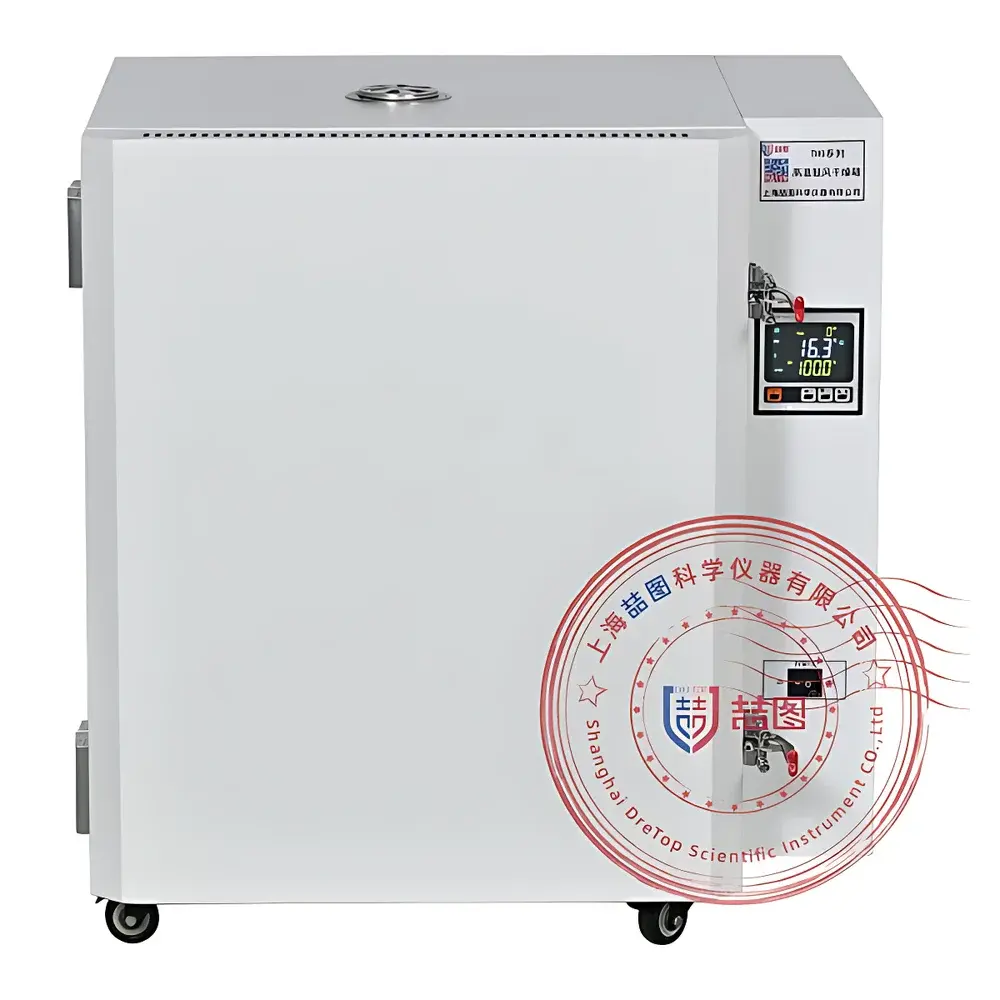
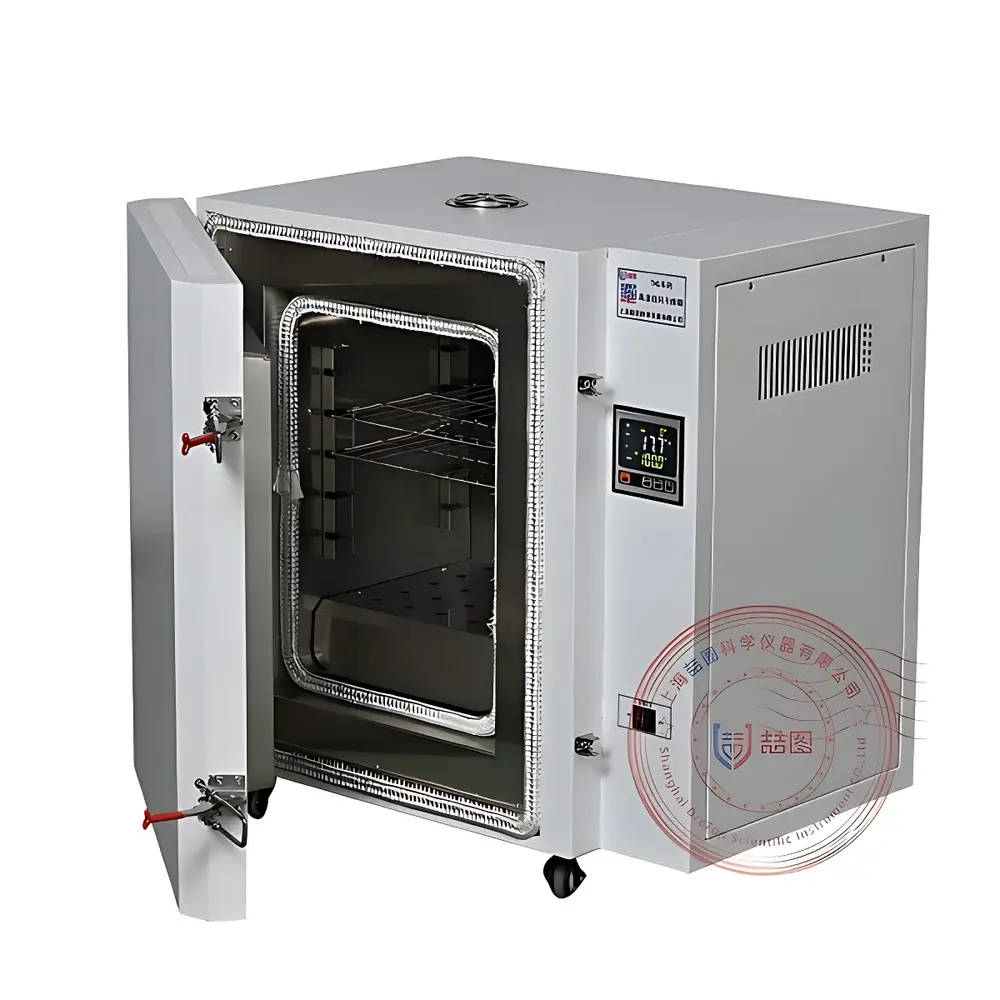
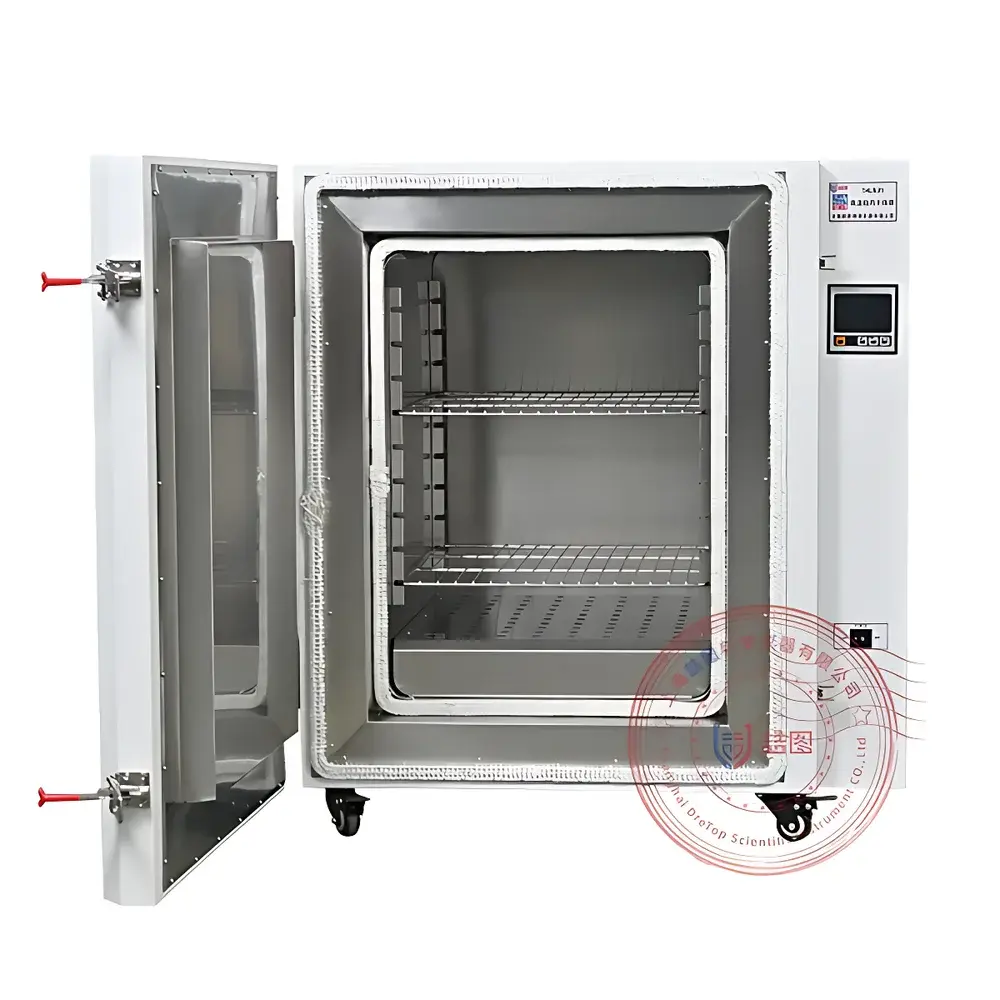
DRETOP THG Series High-Temperature Forced-Air Drying Oven
| Brand | DRETOP |
|---|---|
| Origin | Shanghai, China |
| Model Series | THG |
| Temperature Range | 400–600 °C |
| Temperature Uniformity | ±0.5 °C |
| Temperature Fluctuation | ±1 °C |
| Control Range | RT + 20 to 500 °C |
| Temperature Resolution | 0.1 °C |
| Internal Chamber Dimensions (W×D×H) | 300 × 300 × 350 mm |
| External Dimensions (W×D×H) | 670 × 480 × 700 mm |
| Chamber Material | Brushed Stainless Steel (SUS304) |
| Heating Method | Forced Convection with Dual-Airflow Circulation |
| Insulation | High-Density Glass Fiber |
| Safety Protections | Overtemperature Cut-off, Leakage Current Protection, Short-Circuit & Overload Protection, Power-Fail Data Retention |
| Optional Upgrades | Multi-segment Programmable Controller, USB Data Export, RS-485 Communication, Thermal Printer Interface, Independent Limit Temperature Controller |
Overview
The DRETOP THG Series High-Temperature Forced-Air Drying Oven is an industrial-grade thermal processing instrument engineered for precision temperature control and uniform heat distribution in demanding laboratory and production environments. Utilizing a dual-channel forced convection system powered by high-efficiency, low-noise centrifugal blowers and SUS304 sheathed high-wattage heating elements, the THG series achieves rapid thermal ramping and exceptional spatial temperature homogeneity across its working chamber. Designed specifically for applications requiring sustained operation at elevated temperatures—up to 600 °C—the oven complies with core thermal stability requirements defined in ISO 17025-accredited calibration protocols and supports traceable process validation under GLP and GMP frameworks. Its robust architecture integrates advanced microprocessor-based PID temperature regulation with real-time deviation monitoring, enabling reproducible thermal treatment of ceramics, metallurgical samples, polymer composites, catalyst substrates, and pre-sterilization components.
Key Features
- Microprocessor-controlled PID temperature regulator with K-type thermocouple feedback, offering ±0.1 °C setpoint resolution and <1.5 °C overshoot suppression during ramp-up;
- Dual independent airflow channels with adjustable multi-position stainless steel shelves and full-depth drawer-style tray design for flexible sample loading and ergonomic access;
- High-density glass fiber insulation (≥100 mm thickness) combined with high-temperature silicone rubber door gasket (rated to 650 °C), minimizing thermal loss and ensuring surface temperatures remain below 45 °C at ambient conditions;
- Self-diagnostic system with alphanumeric fault-code display on large-format LCD screen (three-color backlight), supporting rapid troubleshooting without external service tools;
- Comprehensive safety architecture: independent mechanical overtemperature limiter, SSR-based zero-cross switching heater control (eliminating contactor chatter), ground-fault interrupter, and non-volatile memory for parameter retention after power interruption;
- Electrostatically coated cold-rolled steel exterior and electropolished brushed stainless steel interior (SUS304), resistant to oxidation, corrosion, and repeated thermal cycling;
- Configurable alarm thresholds with audible/visual alerts for deviation, upper-limit breach, or sensor failure—fully compliant with IEC 61000-4 electromagnetic immunity standards.
Sample Compatibility & Compliance
The THG series accommodates a broad range of sample formats—including crucibles, ceramic setters, metal fixtures, quartz boats, and standard petri dishes—within its uniformly heated workspace. Chamber geometry and airflow dynamics are validated per ASTM E2209-19 (Standard Practice for Calibration of Forced-Convection Ovens) to ensure ≤±0.5 °C temperature uniformity across all designated test zones. The unit meets structural and electrical safety requirements outlined in UL 61010-1 and EN 61010-1 for laboratory equipment. Optional configurations support 21 CFR Part 11-compliant audit trails when paired with programmable controllers featuring electronic signature capability and time-stamped event logging.
Software & Data Management
While the base model operates via standalone front-panel interface, optional digital upgrades extend data integrity and process documentation capabilities. The USB data export module enables direct transfer of time-stamped temperature logs to FAT32-formatted USB drives for offline analysis in Excel or MATLAB. RS-485 Modbus RTU communication allows integration into centralized SCADA or LIMS platforms for remote monitoring and automated report generation. Programmable variants feature up to 30 segment temperature ramps with soak-hold functionality, ramp rate control (0.1–20 °C/min), and automatic cycle termination with cooldown confirmation. All controller firmware versions undergo periodic revision control and include built-in calibration offset adjustment per sensor channel.
Applications
- Thermal aging studies of aerospace-grade composites and refractory coatings;
- Pre-baking of sintering substrates and powder metallurgy green bodies;
- Moisture removal from hygroscopic reagents prior to gravimetric analysis;
- Heat treatment of calibration standards (e.g., NIST-traceable reference materials);
- Stabilization annealing of optical crystals and semiconductor wafers;
- Residual solvent evaporation in pharmaceutical active ingredient (API) synthesis;
- Accelerated life testing of encapsulated electronic assemblies per MIL-STD-810H methods.
FAQ
What is the maximum continuous operating temperature for the THG series?
The THG series is rated for continuous operation at up to 500 °C in standard configuration; select models (e.g., THG-9249AP) are validated for intermittent use at 600 °C with derated duty cycles.
Does the oven support validation documentation for ISO 17025 laboratories?
Yes—factory-installed calibration certificates (traceable to NIM, China) and optional IQ/OQ documentation packages are available upon request, including temperature mapping reports per Annex A of EU GMP Annex 15.
Can the THG oven be integrated into a networked lab infrastructure?
With the RS-485 option enabled, it supports Modbus RTU protocol for bidirectional communication with building management systems (BMS) or enterprise-level process historians.
Is the internal chamber suitable for corrosive atmospheres?
The SUS304 chamber resists mild acidic or alkaline vapors; for aggressive halogen or sulfur-bearing environments, optional quartz-lined or Inconel 600 chamber inserts are available.
How often does the temperature sensor require recalibration?
Annual verification against a NIST-traceable reference thermometer is recommended; drift tolerance is specified as ±0.5 °C over 12 months under normal usage conditions.



