
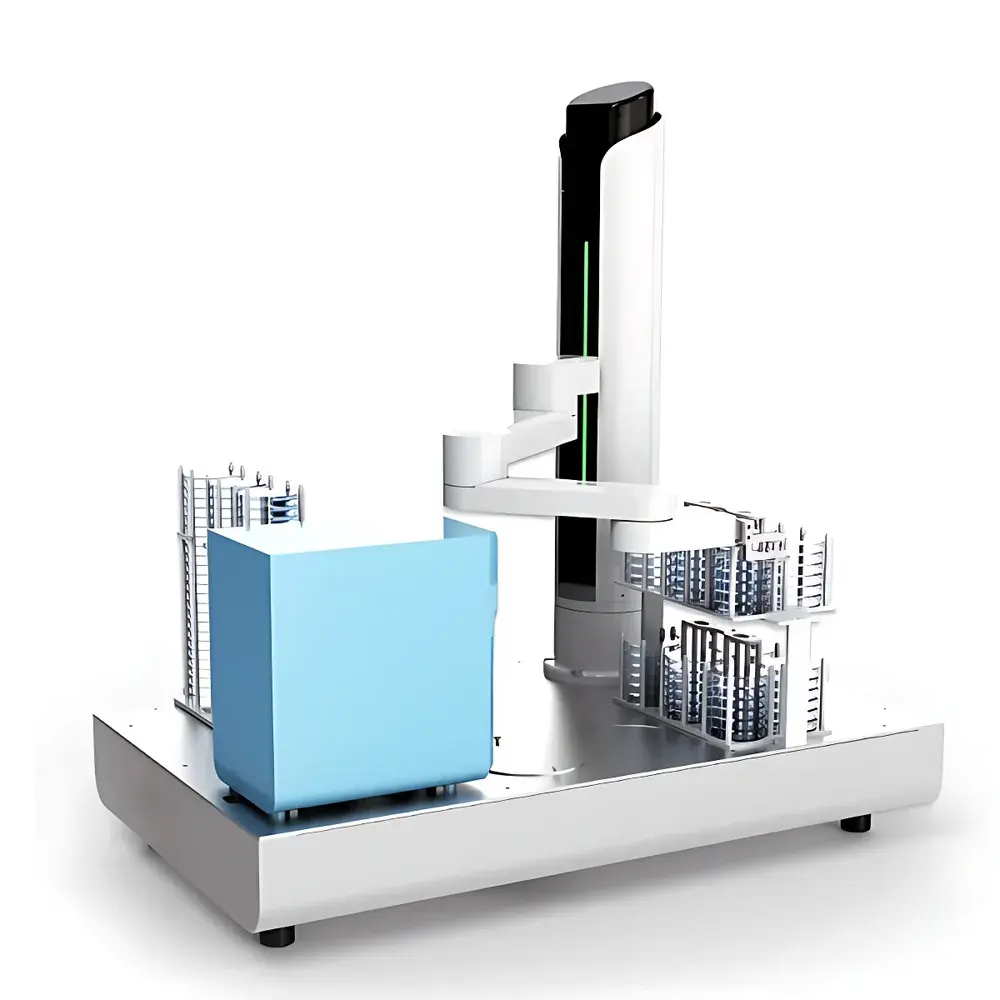

Drick DRK-2000 Intelligent Microbial Colony Analyzer
| Brand | Drick |
|---|---|
| Origin | Shandong, China |
| Manufacturer Type | Direct Manufacturer |
| Country of Origin | China |
| Model | DRK-2000 |
| Dimensions | 1460 mm × 800 mm × 1245 mm |
| Analysis Speed | 30 seconds per Petri dish |
| Colony Recognition Capability | Morphology-based detection and enumeration of target/suspect colonies |
| Pre-screening Logic | Configurable rules for blank plates, negative controls, total viable count plates, etc. |
| Plate Handling | Automated plate transfer, temporary storage in designated plate cassettes, and post-analysis routing to recycling or manual review stations |
| Worklist Generation | Auto-generated digital worklists for ambiguous regions or suspect colonies requiring human verification |
| Imaging System | High-resolution monochrome/RGB imaging with adjustable illumination and focus |
| Data Management | Local database storage with timestamped audit trails, user login logging, and exportable CSV/PDF reports |
| Compliance Support | Designed to support GLP/GMP-aligned workflows, including electronic signatures (role-based), 21 CFR Part 11–ready metadata logging (where configured), and LIMS integration via HL7 or RESTful API |
Overview
The Drick DRK-2000 Intelligent Microbial Colony Analyzer is an automated digital imaging system engineered for high-throughput, standardized colony enumeration and preliminary morphological classification on agar-based Petri dishes. It operates on the principle of high-fidelity optical imaging combined with supervised machine learning algorithms trained on validated microbial colony morphology datasets. Unlike conventional manual counting or basic threshold-based image analyzers, the DRK-2000 implements an expert recognition engine that differentiates colonies by size, shape, texture, edge definition, optical density, and spatial distribution—enabling reliable distinction between viable colonies, satellite colonies, confluent growth, and non-biological artifacts. Its architecture supports full workflow digitization—from plate barcode scanning and physical handling through analysis, decision logic application, and structured data output—making it suitable for regulated environments where traceability, repeatability, and procedural consistency are mandated.
Key Features
- Automated plate handling with integrated barcode reader and robotic transfer mechanism for seamless sample intake and post-analysis routing.
- Expert recognition engine calibrated against ISO 4833-1:2013 and AOAC Official Method 977.27 reference standards for colony morphology interpretation.
- Configurable pre-screening logic to automatically classify plates as blank, negative control, total viable count, or selective media plates—reducing analyst intervention by up to 70% in routine QC workflows.
- Dual-path output architecture: plates meeting all pass/fail criteria are directed to a recycling station; those requiring confirmation are staged in labeled cassettes with priority tagging.
- Dynamic worklist generation for ambiguous zones or morphologically atypical colonies, including annotated thumbnails, coordinate mapping, and contextual metadata (e.g., incubation time, medium type, dilution factor).
- High-resolution imaging module with uniform LED illumination, motorized focus, and multi-spectral capability (optional RGB + UV reflectance) to enhance contrast for pigmented or translucent colonies.
- Fully auditable local database with immutable timestamps, operator ID linkage, version-controlled analysis parameters, and encrypted export options compliant with internal QA documentation requirements.
Sample Compatibility & Compliance
The DRK-2000 accommodates standard 90 mm and 150 mm Petri dishes (glass or polystyrene), including those containing PCA, TSA, VRBA, XLD, Sabouraud Dextrose Agar, and other ISO/USP-compliant media formulations. It supports both aerobic and anaerobic plate types when used with compatible incubation protocols. The system’s software architecture enables alignment with Good Laboratory Practice (GLP) and Good Manufacturing Practice (GMP) frameworks: user access levels are role-defined, all analytical actions generate time-stamped audit logs, and critical parameters (e.g., segmentation thresholds, color filters, minimum colony area) are locked under administrator privileges. While not certified as a medical device, its design intent and validation methodology conform to ISO/IEC 17025:2017 requirements for testing laboratories performing microbiological enumeration.
Software & Data Management
The embedded software platform provides a Windows-based interface with intuitive workflow navigation, real-time status monitoring, and customizable report templates. All raw images, processed overlays, and intermediate binary masks are retained alongside final counts. Data export supports CSV (for Excel/LIMS ingestion), PDF (with embedded images and signature fields), and XML (for HL7 v2.x or FHIR-compatible LIMS interfaces). Optional modules include 21 CFR Part 11 compliance packs—featuring electronic signature capture, biometric authentication add-ons, and extended audit trail retention (≥10 years). Database backups are scheduled automatically and stored on redundant local drives or network-attached storage (NAS) with SHA-256 checksum verification.
Applications
This analyzer serves core microbiological quality control functions across food safety (pathogen screening per ISO 6579, ISO 11290), pharmaceutical sterility testing (USP , ), cosmetic challenge testing (ISO 11930), clinical microbiology support (non-diagnostic enumeration), and public health surveillance (CDC/WHO-recommended plate count methodologies). It is routinely deployed in accredited laboratories seeking to reduce inter-operator variability, meet ISO/IEC 17025 clause 7.2.2 (method validation), and streamline annual method revalidation cycles through built-in performance trending tools.
FAQ
Does the DRK-2000 require external calibration standards or daily verification plates?
Yes—routine verification using NIST-traceable colony-count reference plates (e.g., ATCC® 11573™ or equivalent) is recommended before each shift or after major software updates.
Can the system distinguish between mold hyphae and bacterial colonies?
It classifies based on morphology; while not a taxonomic identifier, its algorithm differentiates filamentous growth patterns from discrete colonies using texture and branching metrics—supporting preliminary differentiation per ISO 21527-1.
Is remote diagnostics or software update capability supported?
Yes—secure SSH-based remote maintenance is available under signed service agreement; firmware updates are delivered as cryptographically signed packages with rollback functionality.
What LIMS vendors has the DRK-2000 been validated with?
Pre-tested integrations include Thermo Fisher SampleManager LIMS, LabVantage 8.x, and STARLIMS v12; custom API development is supported via documented REST endpoints.
How is data integrity ensured during power failure or unexpected shutdown?
The system employs journaling file systems and atomic write operations; all pending analyses are checkpointed every 5 seconds, ensuring zero data loss upon recovery.
Related Products





