
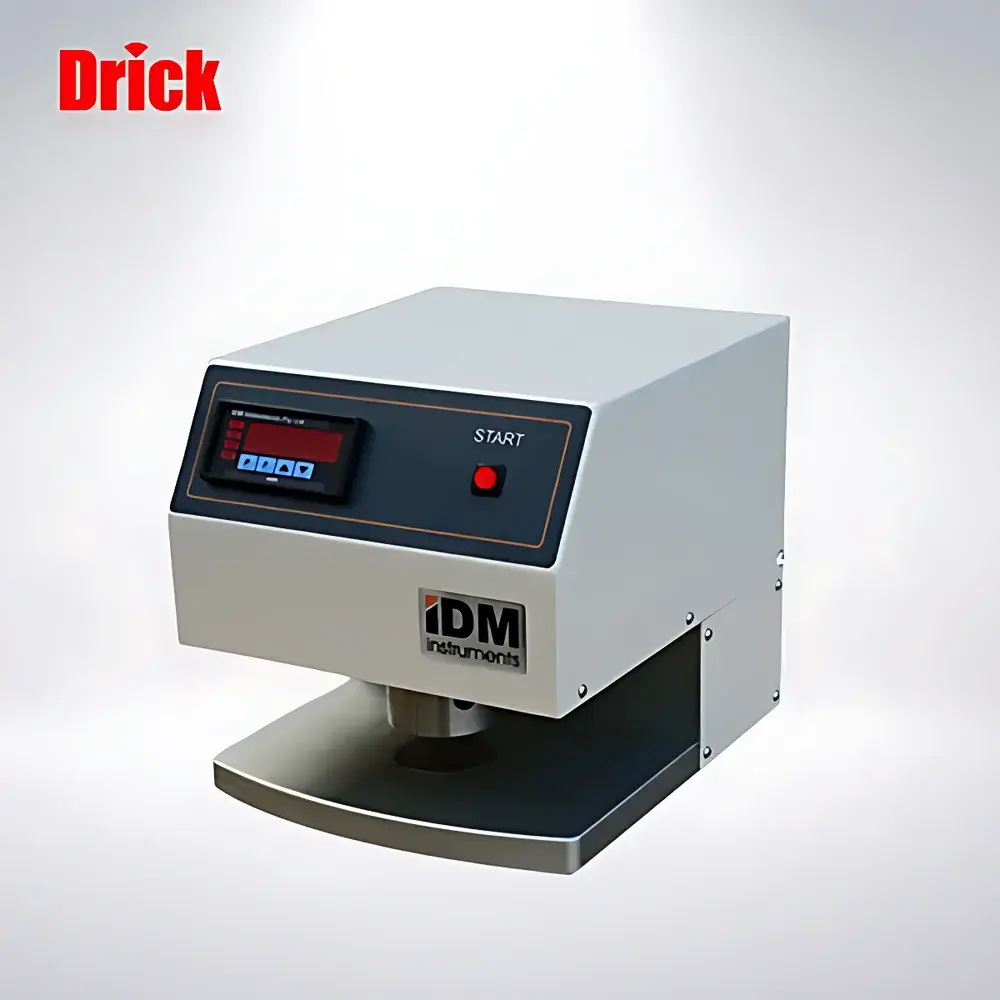
IDM D0011 High-Precision Digital Thickness Gauge for Paper, Plastic & Flexible Packaging Materials
| Brand | IDM |
|---|---|
| Origin | Imported |
| Manufacturer Type | Authorized Distributor |
| Model | D0011 |
| Measuring Range | 0–12 mm |
| Resolution | 0.001 mm |
| Applied Pressure Options | 2 kPa, 20 kPa, 50 kPa, 100 kPa (user-selectable) |
| Platen Diameter (Anvil) | 55 mm |
| Measuring Head Diameter | 35.7 mm |
| Traverse Speed | 1 ± 0.1 mm/sec |
| Compliance Standards | ISO 534:1988, ASTM D645, TAPPI T 411, BS 7387, AS 1301.426s, ISO 3034, FEFCO No.3, SCAN P31 |
| Electrical Supply | 220/240 VAC @ 50 Hz or 110 VAC @ 60 Hz (customizable) |
| Dimensions (H×W×D) | 270 × 250 × 300 mm |
| Weight | 18.5 kg |
| RS232 Interface | Standard (for data export and PC integration) |
Overview
The IDM D0011 High-Precision Digital Thickness Gauge is a metrologically engineered instrument designed specifically for non-destructive thickness measurement of planar, compressible, and semi-rigid sheet materials used across packaging, paper, and polymer manufacturing sectors. It operates on the principle of controlled-force mechanical compression between two parallel, precision-ground platens — an anvil base and a motorized measuring head — with displacement measured via a high-resolution linear encoder (0.001 mm resolution). Unlike optical or ultrasonic methods, this gauge delivers direct, traceable mechanical thickness values under standardized pressure conditions, ensuring alignment with international physical testing protocols for caliper determination. Its primary application domain includes quality assurance in paper mills, corrugated board production lines, flexible plastic film extrusion facilities, and R&D laboratories validating substrate dimensional stability under defined load conditions.
Key Features
- Programmable, user-selectable test pressures: 2 kPa (for low-density tissue and lightweight papers), 20 kPa (standard for printing papers per ISO 534), 50 kPa (for coated boards and laminates), and 100 kPa (for rigid corrugated medium and composite packaging substrates).
- Motor-driven vertical traverse with precise speed control (1 ± 0.1 mm/sec), minimizing operator-induced variability and enabling consistent dwell-time application prior to measurement.
- Dual-platen geometry: 55 mm diameter anvil base and 35.7 mm diameter measuring head ensure uniform stress distribution and minimize edge effects during measurement of heterogeneous or fiber-based materials.
- Integrated digital display with real-time thickness readout, statistical functions (mean, min, max, SD), and automatic zero calibration routine.
- RS232 serial interface as standard — supports bidirectional communication with LIMS, QA databases, or custom SPC software for automated reporting and audit trail generation.
- Robust aluminum-alloy frame and vibration-damped base structure ensure long-term dimensional stability and repeatability in industrial lab environments.
Sample Compatibility & Compliance
The D0011 accommodates a broad spectrum of planar materials including uncoated and coated papers (e.g., offset, newsprint, label stock), paperboard (SBS, CCKB, folding boxboard), corrugated fiberboard (single- and double-wall), plastic films (PP, PET, PE, PVC), laminated foils, nonwovens, and technical textiles. Its design strictly conforms to the mechanical requirements outlined in ISO 534:1988 (paper and board), ASTM D645 (standard test method for thickness of solid electrical insulating materials), TAPPI T 411 om-17 (thickness of paper, paperboard, and combined board), and ISO 3034 (corrugated fiberboard). For regulated environments, the device supports GLP-compliant operation when paired with validated software; its pressure selection capability enables direct correlation to FEFCO No.3 (European Federation of Corrugated Board Manufacturers) and SCAN P31 (Scandinavian Pulp and Paper Research Institute) specifications.
Software & Data Management
While the D0011 operates autonomously via its front-panel interface, its RS232 port enables seamless integration into enterprise-level quality management systems. Raw measurement data — including timestamp, applied pressure, sample ID, and individual readings — can be streamed in ASCII format for import into Excel, Minitab, or statistical process control platforms. Optional firmware upgrades support configurable data logging intervals, pass/fail threshold alerts, and CSV export with metadata tagging. When deployed in FDA-regulated packaging validation workflows, the system may be qualified under 21 CFR Part 11 through documented IQ/OQ protocols — provided the host software implements electronic signatures, audit trails, and user access controls.
Applications
- Verification of incoming raw material thickness against supplier specifications (e.g., linerboard caliper tolerance ±0.02 mm at 20 kPa).
- In-process monitoring of caliper variation across web widths during paper machine reel-up or plastic film casting.
- Correlation studies between thickness, basis weight, and compressibility in multi-layer packaging structures.
- Development of thickness-pressure response curves for novel biopolymer films or recycled fiber composites.
- Supporting ISO/IEC 17025-accredited testing laboratories requiring documented uncertainty budgets for thickness measurement.
FAQ
What pressure should I use when testing standard copy paper?
For uncoated woodfree paper (e.g., 80 g/m² office paper), ISO 534:1988 specifies 20 kPa as the standard test pressure.
Can the D0011 measure corrugated board flute height?
Yes — when configured at 100 kPa and using the optional depth gauge accessory kit, it quantifies flute profile dimensions in accordance with FEFCO No.3 Annex A.
Is calibration traceable to national standards?
The instrument accepts NIST-traceable gauge blocks for periodic verification; calibration certificates are issued per ISO/IEC 17025 by accredited third-party labs upon request.
Does the device meet requirements for pharmaceutical packaging QA?
It satisfies mechanical thickness testing requirements in USP , EP 3.2.1, and ISO 11607-1 for primary packaging substrates, provided pressure settings align with material-specific compaction profiles.
Can I export data directly to my company’s ERP system?
Yes — via RS232-to-USB conversion and custom middleware, measurement records can populate designated fields in SAP QM or Oracle Quality modules using predefined XML or flat-file templates.




