
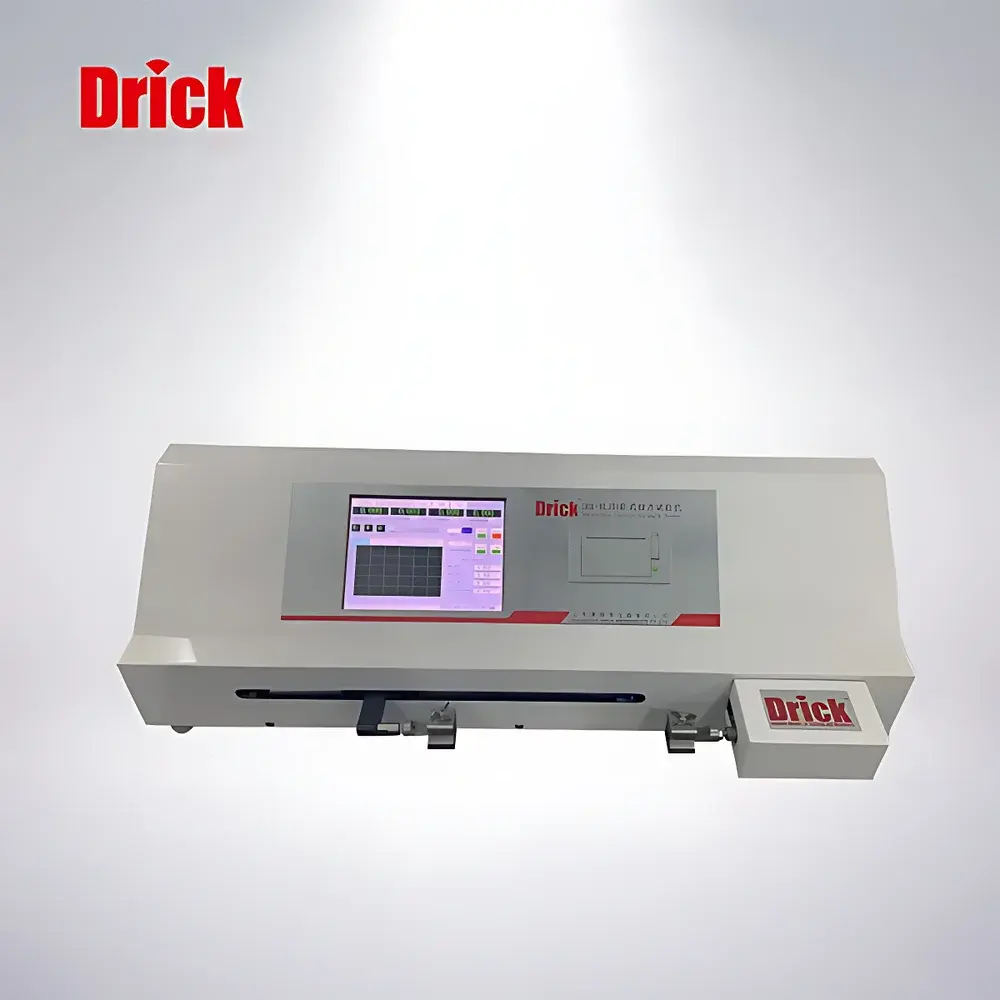
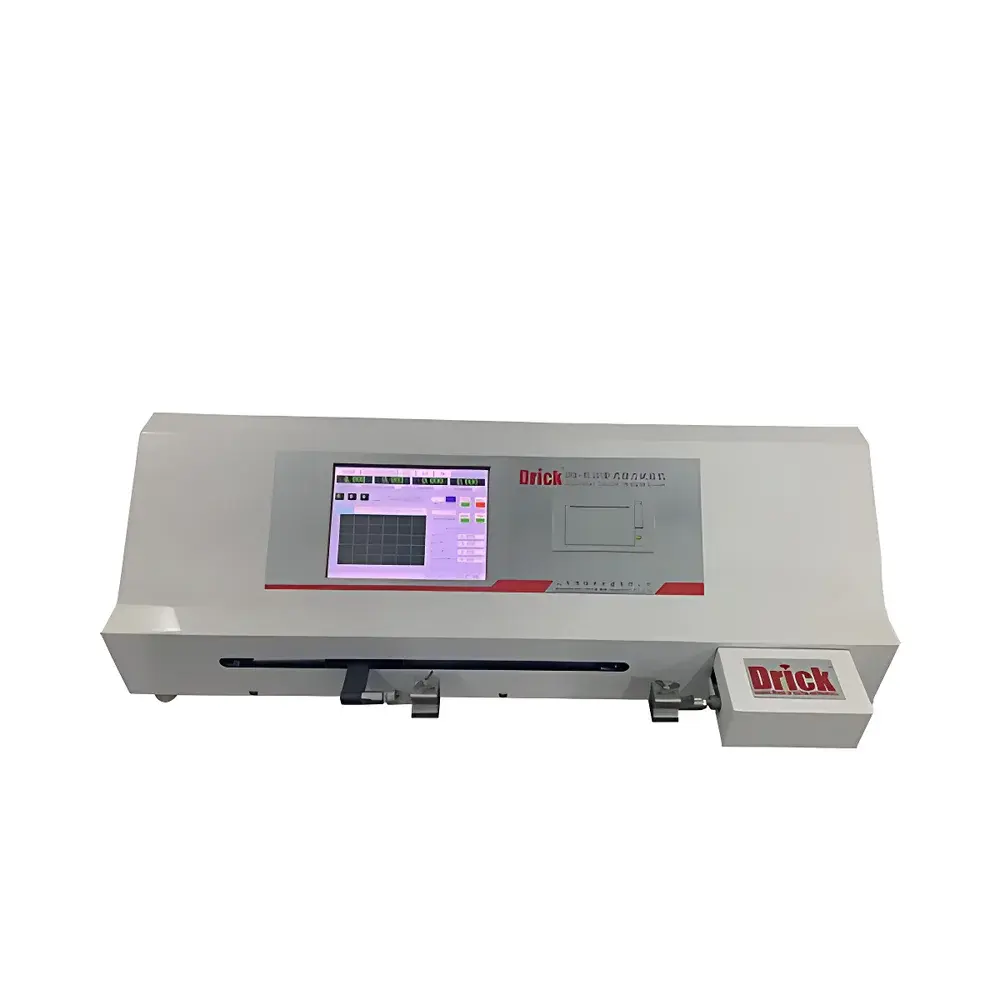
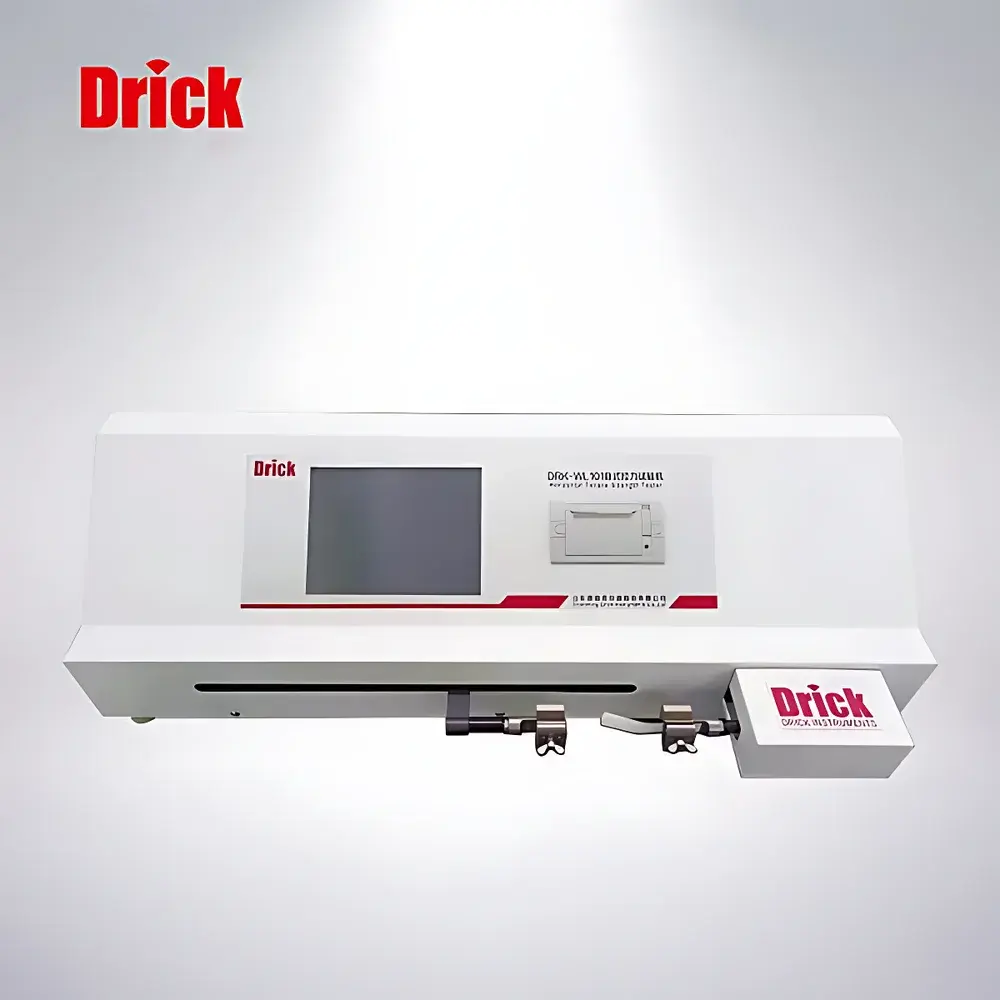
Drick DRK-WL Horizontal Tensile Tester with Customizable Test Zone
| Brand | Drick |
|---|---|
| Origin | Shandong, China |
| Manufacturer Type | Direct Manufacturer |
| Country of Origin | China |
| Model | DRK-WL |
| Load Capacity | 500 N (customizable) |
| Force Accuracy | Better than Class 1 |
| Force Resolution | 0.1 N |
| Deformation Resolution | 0.001 mm |
| Test Speed | 1–500 mm/min (stepless adjustment) |
| Standard Specimen Width | 15 mm |
| Crosshead Travel | 500 mm (customizable) |
| Power Supply | AC 220 V ±5%, 50/60 Hz |
Overview
The Drick DRK-WL Horizontal Tensile Tester is an electromechanical materials testing system engineered for high-reproducibility mechanical characterization of flexible packaging substrates and thin-sheet materials. Designed in accordance with universal principles of uniaxial tensile testing—based on Hooke’s law and ASTM E4-compliant force calibration methodology—the instrument applies controlled axial load to specimens while continuously measuring force, displacement, and time-synchronized deformation. Its horizontal configuration minimizes gravitational interference during specimen handling and enables seamless integration into packaging QC laboratories where space constraints and ergonomic workflow are critical. Unlike vertical systems, the DRK-WL’s oil-cylinder-underneath structural architecture ensures superior mechanical rigidity, reduced frame deflection under load, and long-term stability across repeated test cycles—essential for compliance-driven environments requiring traceable, auditable results.
Key Features
- High-precision dual linear guide rail + ball screw transmission system ensures smooth, backlash-free crosshead movement and eliminates lateral deviation during loading.
- Stepper motor drive delivers quiet operation, fine speed resolution, and repeatable positioning accuracy across the full 1–500 mm/min range.
- 24-bit high-resolution analog-to-digital converter (ADC) with 10,000,000-count internal resolution, coupled with calibrated load cells, achieves real-time force sampling at ≤0.1 N resolution and sub-millisecond temporal fidelity.
- 7-inch industrial-grade capacitive touchscreen interface supports intuitive bilingual (English/Chinese) navigation, real-time plotting of force–time, force–displacement, and force–strain curves, and on-screen parameter configuration without external PC dependency.
- Integrated thermal printer outputs compliant test reports directly—including mean values, standard deviation, coefficient of variation, and pass/fail flags per test method—formatted to meet internal QA documentation requirements.
- Embedded microcontroller performs automatic zero-reset, overload protection (120% FS cut-off), fault self-diagnosis, and non-volatile memory retention of up to 1,000 test records with timestamp and operator ID tagging.
Sample Compatibility & Compliance
The DRK-WL is validated for standardized mechanical evaluation of low-stiffness, high-ductility materials commonly used in primary and secondary packaging: paper grades (kraft, coated, linerboard), plastic films (LDPE, BOPP, PET, CPP), laminated composites, aluminum foils, and heat-sealed pouch structures. It supports ASTM D882 (tensile properties of thin plastic sheeting), ISO 527-2 (plastics—determination of tensile properties), GB/T 1040.3 (plastics—tensile testing of films and sheets), GB/T 4850 (peel adhesion of pressure-sensitive tapes), GB/T 2790 (adhesion of flexible materials to rigid substrates), GB/T 2792 (peel resistance of adhesive tapes), QB/T 2358 (heat seal strength of plastic films), and ASTM F88 (seal strength of flexible barrier materials). All hardware and firmware comply with GLP-aligned data integrity principles, including audit-trail-capable event logging and user-access-controlled parameter modification.
Software & Data Management
The onboard firmware implements a deterministic real-time control loop synchronized with high-frequency sensor acquisition. Test sequences are preconfigured per standard method (e.g., “ASTM D882 Tensile”, “GB/T 2792 180° Peel”) and include automated ramp-hold-relax profiles, trigger-based data capture initiation, and configurable pass/fail thresholds. Export options include CSV-formatted raw data (force, displacement, time stamps at ≥100 Hz), PDF summary reports with embedded curve graphics, and batch export via USB 2.0 port. While no cloud connectivity is provided, all stored data adhere to ALCOA+ principles (Attributable, Legible, Contemporaneous, Original, Accurate, Complete, Consistent, Enduring, Available) for regulatory review under FDA 21 CFR Part 11–aligned internal validation protocols.
Applications
The DRK-WL delivers quantitative metrics critical to packaging performance assurance: tensile strength (MPa), elongation at break (%), modulus of elasticity (MPa), tear resistance (N), peel adhesion (N/15 mm), heat seal strength (N/15 mm), puncture resistance (N), and energy-to-break (J/m²). It is routinely deployed for incoming raw material verification (e.g., film lot qualification), in-process line monitoring (e.g., seal integrity checks post-form-fill-seal), and finished-package release testing (e.g., pouch burst resistance prior to sterilization). Its customizable 500 mm stroke accommodates oversized specimens such as wide-web laminates or multi-layer corrugated board coupons—enabling full-width mechanical profiling without sectioning.
FAQ
What standards does the DRK-WL conform to for tensile testing of plastic films?
It complies with ASTM D882, ISO 527-2:1993, GB/T 1040.3-2006, and QB/T 2358 for film tensile and heat seal evaluation.
Can the test zone be extended beyond 500 mm?
Yes—stroke length is customizable per customer specification; extended travel options require mechanical revalidation and updated calibration certificates.
Is force calibration traceable to national metrology institutes?
Yes—each unit ships with a factory calibration certificate referencing CNAS-accredited reference standards; field recalibration kits and third-party certification services are available.
Does the system support automated data archiving to network drives?
No—data export is limited to USB storage; network integration requires external middleware or custom API development.
What is the minimum detectable force increment?
The system resolves force changes down to 0.1 N across its full 500 N range, verified per ISO 7500-1 Class 1 requirements.






