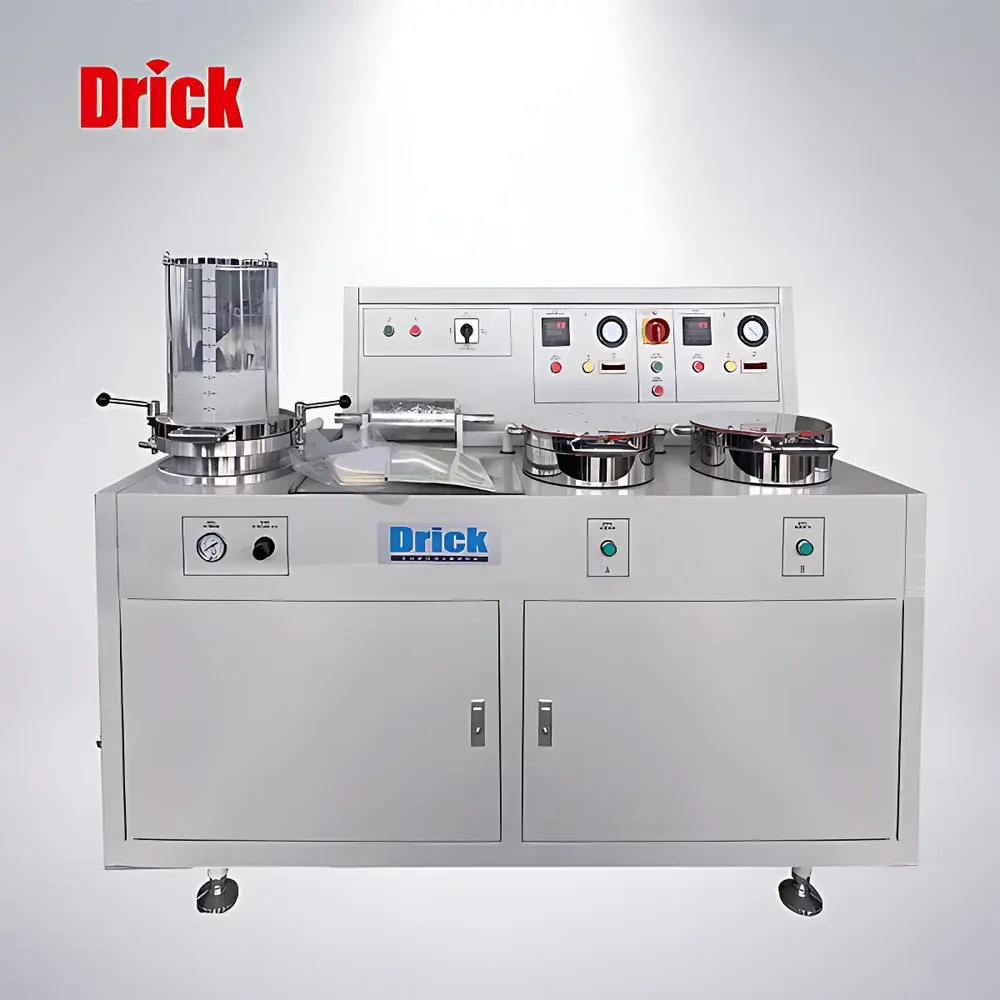
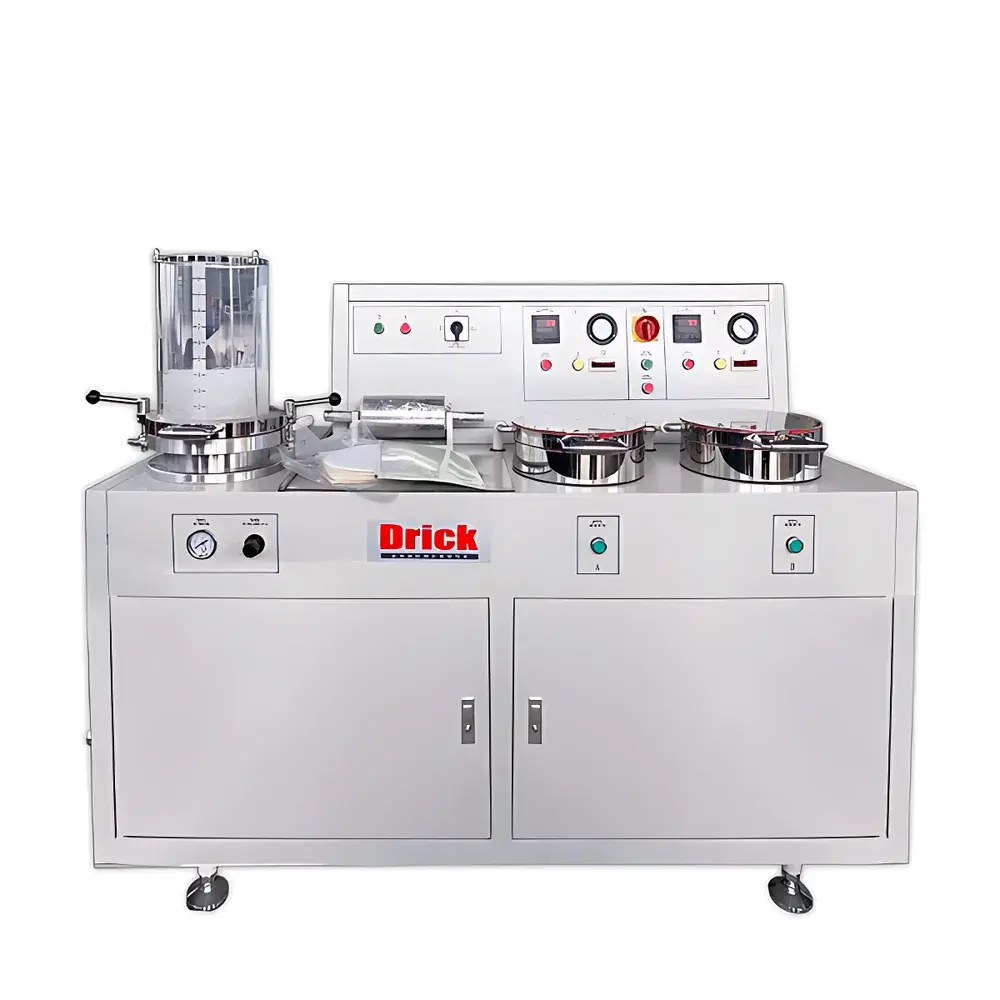
Drick DRK502B Laboratory Sheet Former for Papermaking – QB/T 3703-1999 Compliant
| Brand | Drick |
|---|---|
| Origin | Shandong, China |
| Manufacturer Type | Direct Manufacturer |
| Country of Origin | China |
| Model | DRK502B |
| Sheet Diameter | Φ200 mm |
| Forming Chamber Capacity | 10 L |
| Drying Temperature Range | 80–110 °C |
| Vacuum Pump Ultimate Pressure | −0.090 to −0.098 MPa |
| Pump Air Displacement | 120 L/min |
| Drying Time (for 30–80 g/m² handsheets) | 3–7 min |
| Overall Dimensions | 1500 × 850 × 1300 mm |
| Weight | 300 kg |
| Construction Material | ASTM A240 316 stainless steel (wetted parts), 304L stainless steel work surface |
| Compliance | QB/T 3703-1999, ISO 5269-2:2004, ISO 5269-3:2004, TAPPI T 205 sp-18, DIN 54358:2007, NBR 14380:1999, ZM V/8/76 |
Overview
The Drick DRK502B Laboratory Sheet Former is a fully electric, integrated handsheet-making system engineered for precision and reproducibility in pulp and paper R&D laboratories and quality control centers. It implements the standardized laboratory sheet-forming principle based on vacuum-assisted filtration (as defined in ISO 5269-2 and QB/T 3703-1999), followed by mechanical dewatering via pneumatic compression and final vacuum-assisted thermal drying. This three-stage process—filtration, pressing, and drying—ensures consistent formation of uniform, dimensionally stable handsheets across a broad spectrum of fiber types, including conventional wood pulps, microfibrillated cellulose (MFC), nanocellulose suspensions, and high-basis-weight specialty papers up to 10 mm thickness. The system is purpose-built for generating test specimens compliant with international physical testing standards (e.g., tensile strength per ISO 1924, burst strength per ISO 2758, tear resistance per ISO 1974), enabling rigorous evaluation of raw material performance, refining efficiency, and process optimization in pilot-scale pulp development.
Key Features
- Integrated vacuum filtration, pneumatic pressing, and vacuum thermal drying in a single compact footprint—eliminating manual transfer and minimizing sheet disturbance.
- Stainless steel construction throughout wetted zones: ASTM A240 316 stainless steel for corrosion resistance in aggressive pulp suspensions; 304L stainless steel tabletop for durability and cleanability.
- Automated slurry dosing via electric metering pump, ensuring repeatable pulp consistency and volume delivery into the Φ200 mm forming cylinder (10 L chamber capacity).
- Dual-mode agitation: programmable compressed-air pulsing for homogeneous fiber dispersion, plus optional manual stirring for low-concentration or shear-sensitive suspensions.
- White water recirculation system with integrated sediment trap and quick-drain valve—reducing water consumption and enabling closed-loop operation during multi-sample runs.
- Elastic suction-drying capsule with temperature-controlled electric heating (80–110 °C) and PID-regulated digital thermostat—providing ±1.5 °C thermal stability and preventing thermal degradation of sensitive fibers.
- High-vacuum generation via water-ring multi-function vacuum pump (−0.090 to −0.098 MPa ultimate pressure; 120 L/min free air displacement), equipped with built-in water cooling and auto-refill interface.
- Modular auxiliary ports: rapid-connect water inlet, spray-wash nozzle for screen cleaning, and dedicated exhaust venting for solvent-based or odor-prone suspensions.
Sample Compatibility & Compliance
The DRK502B accommodates diverse suspension rheologies—from low-solids hardwood kraft slurries (0.1–0.5% consistency) to highly viscous nanocellulose gels and thick-fiber composites. Its adjustable vacuum ramp profiles and dual-pressure pressing stage support optimal drainage kinetics for both fast-filtering bleached softwood pulps and slow-draining recycled fiber blends. All operational parameters—including vacuum onset timing, press dwell duration, drying setpoint, and airflow rate—are manually adjustable to align with method-specific requirements. The device meets full mechanical and metrological compliance with QB/T 3703-1999 (China’s national standard for laboratory sheet formers), ISO 5269-2:2004 (conventional sheet former), ISO 5269-3:2004 (rapid sheet former), TAPPI T 205 sp-18, DIN 54358:2007, NBR 14380:1999, and ZM V/8/76. Documentation includes traceable calibration records for vacuum transducers and temperature sensors, supporting GLP-compliant audit trails.
Software & Data Management
While the DRK502B operates via intuitive front-panel controls (no embedded software), its analog signal outputs (0–10 V DC for vacuum level, PT100 RTD for drying chamber temperature) are compatible with third-party data acquisition systems (e.g., LabVIEW, MATLAB, or PLC-based SCADA). Users may log time-stamped process variables—including vacuum decay curves, thermal ramp profiles, and press cycle timestamps—for post-run correlation with final sheet properties (e.g., density vs. dewatering rate). Optional external USB data loggers can capture and export CSV-formatted datasets, facilitating integration into LIMS environments under ISO/IEC 17025 or FDA 21 CFR Part 11–aligned workflows when paired with electronic signature modules.
Applications
- Routine preparation of ISO- and TAPPI-compliant handsheets for tensile, burst, tear, folding endurance, and air permeance testing.
- Comparative evaluation of pulp refining energy (PFI mill vs. disc refiner) through controlled handsheet formation at fixed freeness levels.
- Development and validation of novel fiber blends, filler formulations, and wet-end additives (e.g., retention aids, dry-strength resins).
- Process qualification of nanocellulose dispersions—enabling quantitative assessment of film-forming ability, optical homogeneity, and mechanical integrity.
- Supporting ISO 5351 (viscosity) and ISO 5350 (freeness) method validation by providing geometrically identical substrate geometry across test replicates.
- Teaching laboratories: demonstrating fundamental principles of fiber mat formation, drainage dynamics, and consolidation mechanics in paper science curricula.
FAQ
What standards does the DRK502B comply with for handsheet formation?
It conforms to QB/T 3703-1999, ISO 5269-2:2004, ISO 5269-3:2004, TAPPI T 205 sp-18, DIN 54358:2007, NBR 14380:1999, and ZM V/8/76.
Can it form handsheets thicker than 1 mm?
Yes—the elastic suction-drying capsule and extended drying cycle support handsheet thicknesses up to 10 mm, suitable for board-grade or composite fiber mats.
Is the white water system closed-loop capable?
Yes, the integrated sediment trap and quick-drain valve allow continuous recirculation; users may add optional filtration units for long-duration runs.
What maintenance is required for the vacuum pump?
The water-ring pump requires periodic water replacement and inspection of impeller clearance; no oil changes or seal replacements are needed due to its lubrication-free design.
Does the unit include calibration documentation?
Factory calibration certificates for vacuum transducers and drying chamber temperature sensors are supplied, traceable to national metrology institutes.