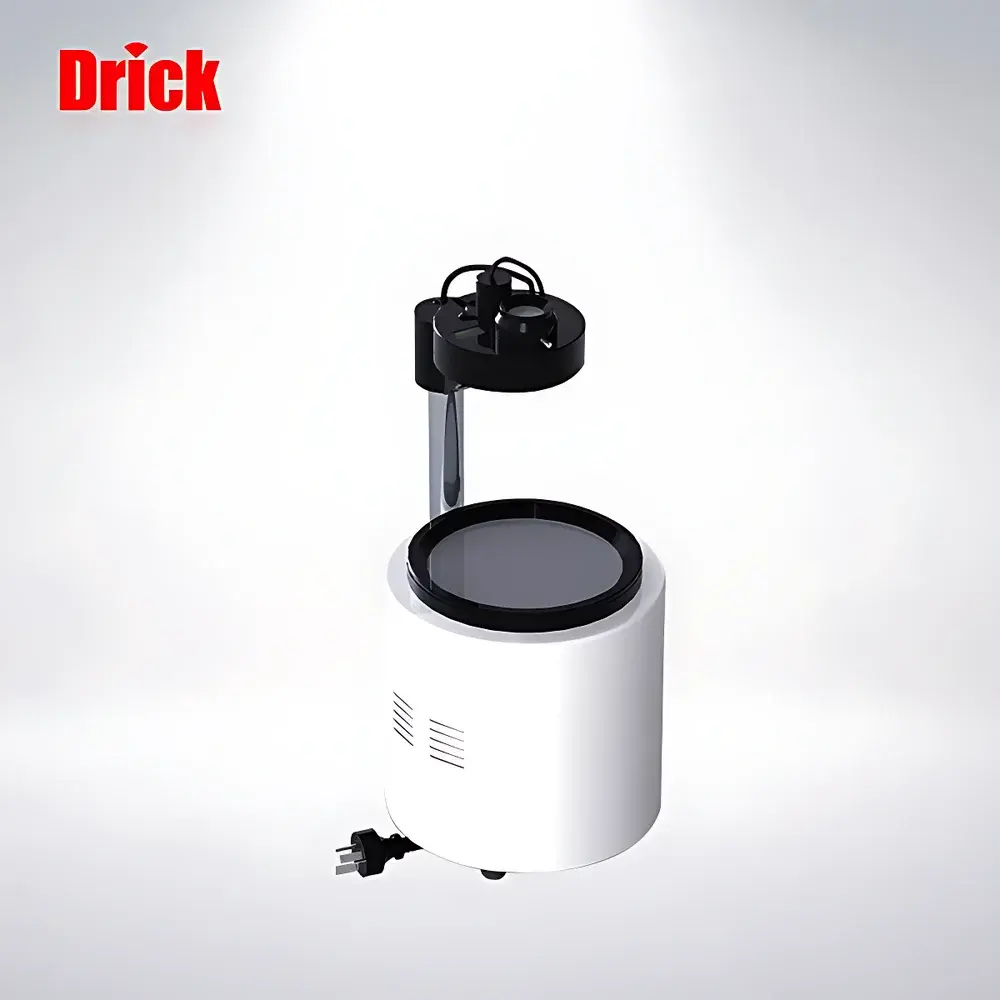
Drick DRK506 Photoelastic Stress Analyzer for Glass Containers
| Brand | Drick |
|---|---|
| Origin | Shandong, China |
| Manufacturer Type | Direct Manufacturer |
| Region Classification | Domestic (China) |
| Model | DRK506 |
| Key | Measurement Accuracy ≤ 2 nm |
| Key | Retract-to-Zero Error ≤ 2 nm |
| Key | Optical Path Difference Resolution 0.1 nm |
| Key | Angular Resolution 0.1° |
| Key | Polarized Field Diameter 150 mm |
| Key | Field Illuminance > 800 lux |
| Key | Analyzer Rotation Range 360° (±180°) |
| Key | Inter-Polarizer Spacing Adjustment 50–250 mm |
| Key | Light Source LED, CCT 3500 K |
| Key | Power Consumption < 8 W |
| Key | Input Voltage AC 220 V, 50 Hz |
| Key | Net Weight 5 kg |
Overview
The Drick DRK506 Photoelastic Stress Analyzer is a precision optical instrument engineered for quantitative and qualitative assessment of residual stress in transparent glass containers and optical materials. It operates on the fundamental principle of photoelasticity—leveraging polarized light interference to visualize and measure birefringence induced by internal mechanical stress within isotropic dielectric media such as soda-lime glass, borosilicate glass, and fused silica. When linearly polarized light passes through a stressed glass specimen placed between crossed polarizers, stress-induced anisotropy generates phase retardation, resulting in interference fringes or color patterns governed by the Senarmont or Babinet compensation method. The DRK506 integrates a calibrated quarter-wave plate and sensitive tint plate (sensitive color filter), enabling both semi-quantitative evaluation via isochromatic fringe identification and high-resolution quantitative measurement of optical path difference (OPD) in nanometers—directly correlating to stress magnitude per ASTM C148 and ISO 13125 standards.
Key Features
- High-resolution angular measurement using an integrated optical encoder with ≤ 2 nm equivalent path difference accuracy and ≤ 2 nm re-zero repeatability—ensuring traceable consistency across sequential measurements.
- Dual-parameter real-time display on a high-contrast LCD: simultaneous readout of analyzer rotation angle (0.1° resolution) and corresponding optical path difference (0.1 nm resolution), eliminating manual interpolation or external calculation.
- Zero-point self-consistency design: dark-field alignment requires no user-initiated calibration or zero adjustment, removing operator-dependent variability inherent in traditional null-point balancing procedures.
- Energy-efficient illumination system: warm-white LED light source (3500 K correlated color temperature) delivers uniform, stable, and flicker-free illumination (>800 lux at viewing plane) while consuming less than 8 W—reducing thermal drift and extending service life relative to tungsten-halogen or sodium-vapor alternatives.
- Modular mechanical architecture: adjustable inter-polarizer spacing (50–250 mm) accommodates diverse sample geometries including vials, ampoules, infusion bottles, and flat optical substrates; 150 mm clear aperture ensures full-field evaluation of standard pharmaceutical glass packaging.
Sample Compatibility & Compliance
The DRK506 is validated for use with glass containers manufactured to regulatory specifications defined in YBB00032005–2005 (Soda-Lime Glass Infusion Bottles), YBB00332002–2015 (Low-Borosilicate Glass Ampoules), and GB/T 4545–2021 (Test Method for Internal Stress in Glass Containers). Its measurement methodology aligns with internationally recognized photoelastic testing frameworks, including ASTM C148 (Standard Test Method for Thermal Shock Resistance of Glass Containers) and ISO 13125 (Glass—Determination of Residual Stress Using Polarized Light). Data acquisition supports GLP-compliant documentation when paired with external logging software, and the instrument’s stable optical train meets baseline requirements for routine QC/QA in GMP-regulated environments—including final container inspection prior to sterilization and fill-finish operations.
Software & Data Management
While the DRK506 operates as a standalone benchtop analyzer with embedded firmware, its analog/digital hybrid interface allows integration with third-party data acquisition systems via RS-232 or USB-to-serial adapters. Raw OPD and angular values can be streamed in ASCII format for post-processing in MATLAB, Python (NumPy/Pandas), or Excel-based statistical process control (SPC) platforms. Though not equipped with built-in audit trail or electronic signature functionality, the device’s deterministic output and mechanical reproducibility enable compliance with FDA 21 CFR Part 11 when deployed within validated laboratory information management systems (LIMS) that enforce user access controls and change management protocols.
Applications
- Residual stress mapping of pharmaceutical primary packaging: quantifying stress gradients in molded vials, syringes, and cartridges to assess risk of delamination or crack propagation during lyophilization or shipping.
- Quality conformance testing per USP and : verifying low-stress annealing cycles in glass manufacturing processes used for sterile drug product containment.
- R&D evaluation of alternative glass compositions (e.g., aluminosilicate, high-borosilicate) under thermal and mechanical load conditions.
- Failure analysis of field returns: correlating observed fracture origins with localized stress concentrations identified via photoelastic fringe density and orientation.
- Educational demonstration of stress-optic law (σ = C·Δn / t) in materials science laboratories, where C denotes the stress-optic coefficient and t is specimen thickness.
FAQ
What standards does the DRK506 comply with for pharmaceutical glass testing?
It conforms to GB/T 4545–2021, YBB00032005–2005, and YBB00332002–2015, and its measurement principle is consistent with ASTM C148 and ISO 13125.
Can the DRK506 measure stress in curved or non-planar glass surfaces?
Yes—the 150 mm field diameter and adjustable inter-polarizer spacing allow effective evaluation of cylindrical and spherical specimens up to 250 mm in height, provided the region of interest lies within the uniform polarization zone.
Is LED illumination spectrally suitable for accurate photoelastic analysis?
Yes—the 3500 K correlated color temperature provides broad visible spectrum emission with minimal infrared content, ensuring high contrast in isochromatic fringe visualization without inducing thermal artifacts.
Does the instrument require periodic recalibration by an accredited lab?
No formal recalibration is mandated; however, annual verification against NIST-traceable reference stress plates (e.g., quartz wedge standards) is recommended for metrological continuity in regulated environments.
How is measurement uncertainty estimated for a given reading?
Combined standard uncertainty is dominated by encoder linearity error (≤ ±2 nm), angular resolution (±0.05°), and ambient temperature stability (±0.5°C)—typically yielding an expanded uncertainty (k=2) of ≤ ±4.5 nm for OPD under controlled lab conditions.